
BNG Assessment & UKHab Baseline for Planning
Biodiversity Net Gain assessment for planning and development
ACP Consultants provides Biodiversity Net Gain assessments for developments across England. We use habitat baseline data, condition assessment and the Statutory Biodiversity Metric to establish biodiversity value, assess development impacts and identify practical opportunities to achieve BNG requirements.
- Planning-focused BNG assessment from habitat baseline to development strategy.
- Supporting developers, architects, planning consultants and landowners across England.
- UKHab-Informed Habitat Baseline
- Habitat Condition Assessment
- Statutory Biodiversity Metric Calculations
- BNG Design & Scenario Testing
- Planning Application Support
A robust BNG assessment starts by understanding the site’s existing habitats and biodiversity value. We review the development boundary, available ecological information and proposed layout before confirming the assessment scope.
The baseline information is then used with the Statutory Biodiversity Metric to compare pre-development and post-development biodiversity value. This helps identify habitat losses, design opportunities, trading-rule constraints and any likely biodiversity shortfall at an early stage.
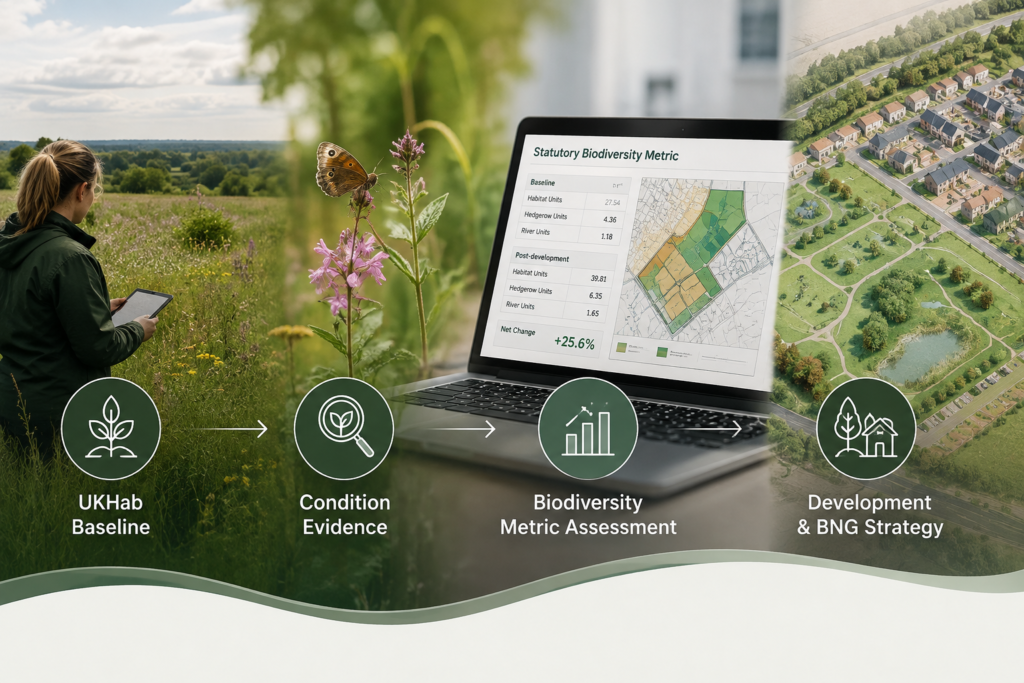
What Does a BNG Assessment Tell You?
A Biodiversity Net Gain assessment shows how the existing biodiversity value of a site compares with the value expected after development.
It brings together habitat baseline data, condition evidence, biodiversity unit calculations and the proposed layout. This allows the project team to understand where biodiversity losses occur, what gains are proposed and whether further design changes may be needed.
Baseline Biodiversity Value
Establish the biodiversity value of existing habitats before development using mapped habitat parcels, condition evidence and the relevant metric inputs.
Development Impacts
Identify which habitats will be retained, lost, enhanced or created as a result of the proposed development.
Biodiversity Unit Change
Compare pre-development and post-development biodiversity units using the Statutory Biodiversity Metric.
BNG Strategy
Identify whether the proposal achieves the required biodiversity gain or whether further design changes, habitat enhancement or off-site measures may be required.
A BNG assessment is therefore not just a calculation. It is a planning tool that can help shape the development while the design is still flexible.
How a BNG Assessment Works
A Biodiversity Net Gain assessment follows a structured process from establishing the existing habitat baseline through to testing the proposed development and defining the BNG strategy.
The assessment should develop alongside the scheme where possible. This allows habitat losses, enhancement opportunities and potential shortfalls to be identified before the development design becomes fixed.
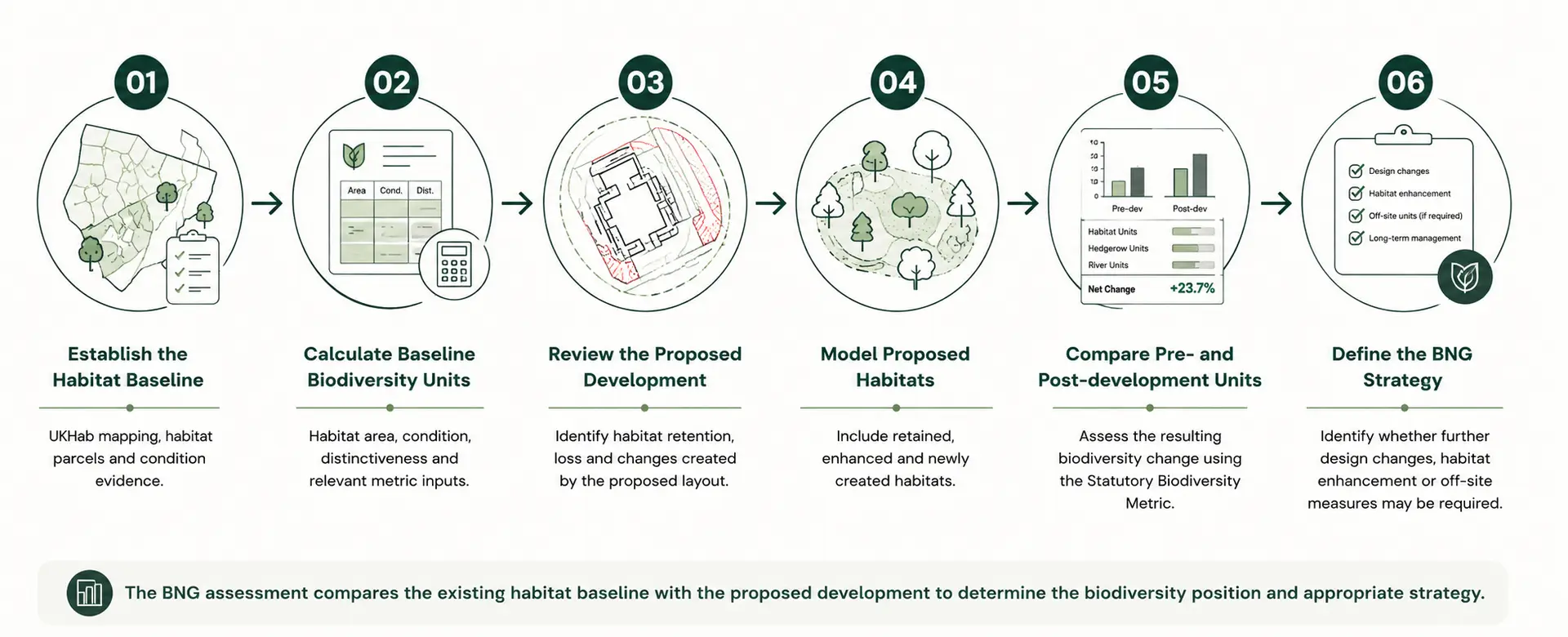
The process is iterative rather than strictly linear. For example, metric results may identify a biodiversity shortfall that can be reduced by retaining more habitat, revising the layout or changing the proposed habitat creation and enhancement measures.
Where an unavoidable shortfall remains after reasonable on-site measures have been considered, registered off-site biodiversity units may form part of the final strategy.
What is a Biodiversity Net Gain Assessment?
A Biodiversity Net Gain assessment establishes the biodiversity value of a development site and assesses how that value is expected to change after development.
The assessment uses habitat baseline information together with the Statutory Biodiversity Metric. Relevant inputs include habitat type, area or length, condition, distinctiveness and strategic significance where applicable.
It then compares the pre-development baseline with the proposed post-development habitats. This allows the project team to understand the scale of biodiversity losses and gains, whether trading rules are satisfied and whether the scheme is likely to achieve the required net gain.
The assessment can also be used during design development. By testing different layouts, retained habitats and proposed enhancements, it can help identify opportunities to improve the biodiversity outcome before the scheme becomes fixed.
Does Biodiversity Net Gain Apply to Your Development?
Mandatory Biodiversity Net Gain applies to many planning applications in England, although several exemptions and transitional arrangements exist.
For planning applications made on or after 6 August 2026, development on a site of 0.2 hectares or below is exempt from mandatory BNG, provided the development does not impact an onsite priority habitat. This new exemption means many smaller development sites no longer need to demonstrate mandatory 10% Biodiversity Net Gain.
Other exemptions include householder development, qualifying permitted development, certain temporary developments and development that meets the de minimis threshold. The de minimis exemption applies where a development does not impact onsite priority habitat and affects less than 25 m² of onsite habitat and less than 5 metres of linear habitat such as hedgerow.
The former general exemption for self-build and custom-build development no longer applies to new planning applications made on or after 6 August 2026. Transitional arrangements still apply to qualifying earlier applications and some subsequent variations.
Where mandatory BNG does apply, eligible developments may be able to use the Small Sites Metric instead of the full Statutory Biodiversity Metric. Therefore, confirming the correct BNG route at an early stage can avoid unnecessary survey or assessment work.
Not sure whether your development is exempt?
We can review the red-line boundary, development type and available habitat information before confirming the likely BNG assessment route.
How is Biodiversity Net Gain Measured?
Biodiversity Net Gain is measured using the Statutory Biodiversity Metric, which compares biodiversity value before and after development.
For a BNG assessment, the metric uses information such as habitat type, area or length, condition, distinctiveness and strategic significance where relevant. It then applies the statutory rules to calculate the site’s baseline biodiversity units.
The proposed development is assessed in the same way. Retained, enhanced and newly created habitats are entered into the metric so the pre-development and post-development positions can be compared.
This allows the assessment to show whether the proposal is likely to achieve the required biodiversity gain, whether trading rules are satisfied and where further design changes or habitat measures may be needed.
Accurate metric calculations depend on robust habitat information. Therefore, habitat mapping and condition evidence should be suitable for the habitats present and the scale of the development.
How the UKHab Baseline Supports a BNG Assessment
A robust BNG assessment starts with reliable habitat baseline information.
For many terrestrial development sites, habitats are mapped using UK Habitat Classification (UKHab) terminology. Habitat parcels are defined spatially and the information needed for the Statutory Biodiversity Metric is recorded for each relevant parcel.
The baseline may include habitat type, area or length, condition evidence and other metric inputs. Together, these data establish the site’s pre-development biodiversity value and provide the starting point for assessing the proposed development.
However, the baseline survey and the BNG assessment are not the same service. The survey establishes what habitats are present and records the field evidence. The assessment then uses that information to calculate biodiversity units, test the proposed layout and develop the BNG strategy.
Habitat Mapping
Map existing habitat parcels and relevant linear features across the development site.
Habitat Condition Evidence
Record the evidence needed to determine habitat condition where the Statutory Biodiversity Metric requires it.
Baseline Biodiversity Units
Use the mapped habitat information and relevant metric inputs to calculate the site's pre-development biodiversity value.
Sites containing watercourses or particular drainage features may require additional assessment before the relevant biodiversity units can be calculated accurately.
How the BNG Assessment Influences Development Design
A BNG assessment is most useful when it informs the development design rather than simply checking the result at the end.
Once the baseline biodiversity value has been established, the proposed layout can be tested to identify where habitat losses occur and how retained, enhanced or newly created habitats affect the overall biodiversity position.
If the first assessment shows a shortfall, the design can often be reviewed before more expensive or complex measures are considered. This may include retaining more existing habitat, reducing impacts on higher-value areas, increasing habitat enhancement or changing the type and location of proposed habitat creation.
The assessment can then be recalculated to show how those changes affect the pre-development and post-development biodiversity units.
Where the required gain still cannot be achieved through reasonable on-site measures, the project may need to consider registered off-site biodiversity units as part of the final BNG strategy.
The assessment can also be presented spatially, showing where existing habitats are retained, lost, enhanced or replaced by new habitat proposals. This helps the project team understand which parts of the development design are driving the biodiversity result.
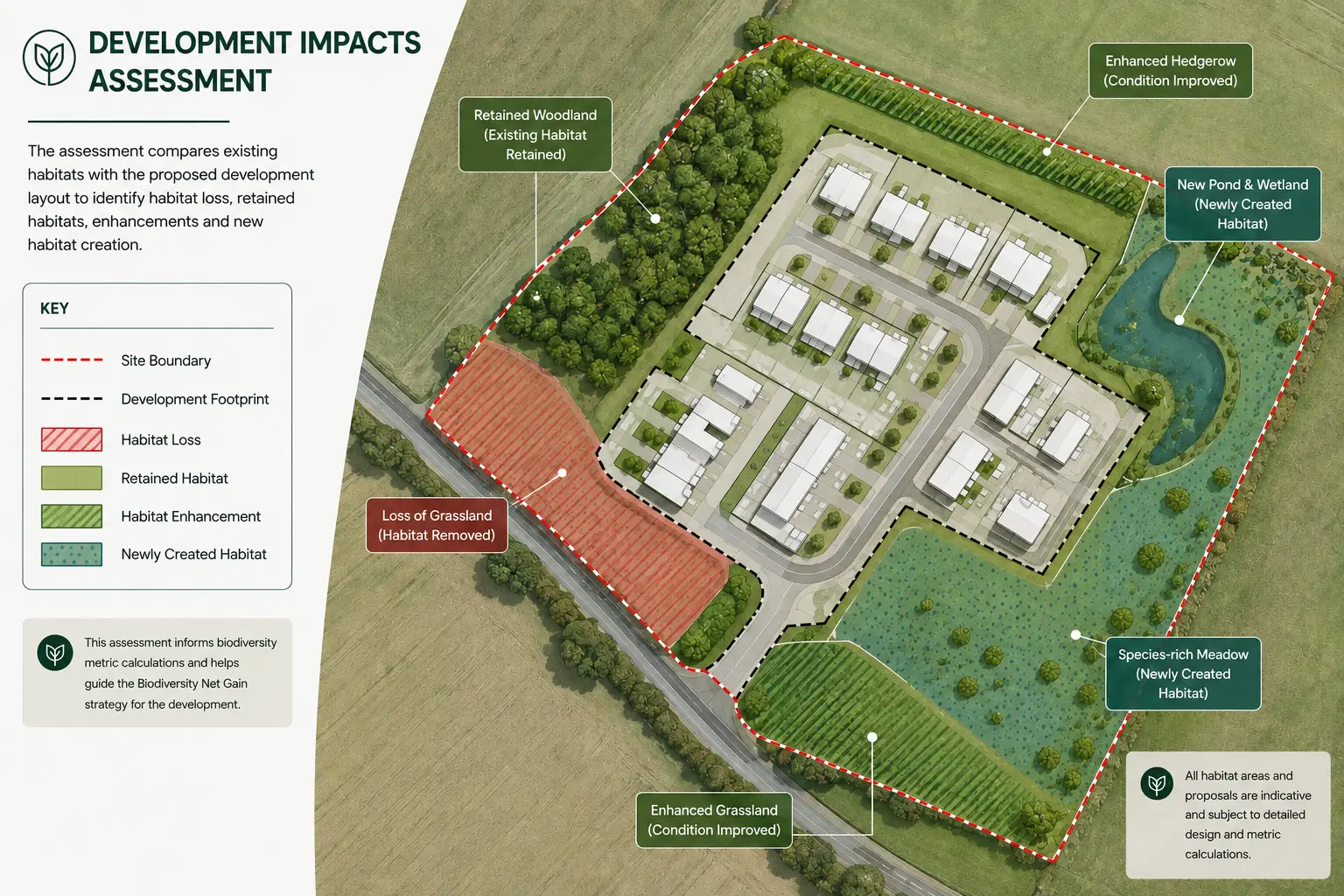
This type of spatial review can help identify where targeted design changes may improve the BNG outcome before the layout is finalised.
Retain Valuable Habitat
Avoid unnecessary losses where existing habitats make a significant contribution to the baseline value.
Refine the Layout
Test whether changes to the development footprint or landscape design can improve the BNG outcome.
Enhance or Create Habitat
Model realistic habitat enhancement and creation measures within the development site.
Address Any Remaining Shortfall
Where on-site measures are insufficient, consider the appropriate off-site delivery route.
Related BNG Guidance
The BNG assessment sits within a wider planning and ecological process. These related services and guidance pages explain the specialist stages that support or follow the assessment.
BNG Baseline Survey
Understand how habitat baseline information is collected and mapped before biodiversity units are calculated.
Statutory Biodiversity Metric
See how biodiversity units are calculated and how pre-development and post-development values are compared.
BNG Report
See how assessment findings can be presented in planning-ready technical documentation.
Biodiversity Gain Plan
Learn how the agreed BNG strategy is documented where a Biodiversity Gain Plan is required.
How Much Does a BNG Assessment Cost?
The cost of a BNG assessment depends on the size and complexity of the site, the habitats present, the planning stage and the information already available.
Smaller or simpler sites may only require baseline habitat mapping, condition assessment and a biodiversity metric calculation. Larger or more complex developments may need additional survey work, GIS mapping, watercourse assessment or several design iterations before the BNG strategy is finalised.
The cost can also increase where the proposed layout changes repeatedly, because the post-development biodiversity calculations may need to be updated each time.
To prepare an accurate quotation, please send us:
- the red-line boundary;
- the latest proposed development layout, if available;
- any existing ecological survey information; and
- any relevant planning or validation requirements.
If the layout is not yet available, we can still scope the baseline work and advise what will be needed for the later BNG assessment.
Site Size
Larger sites generally require more habitat mapping, condition assessment and biodiversity calculations.
Habitat Complexity
Sites containing several habitat types, hedgerows, ponds or watercourses often need more detailed assessment.
Planning Stage
Early assessment can help avoid redesign costs by identifying biodiversity constraints before the layout becomes fixed.
Additional Ecological Requirements
Some sites may require further habitat, watercourse or condition assessment before the metric can be completed.
Design Iterations
Changes to the proposed layout or landscape strategy may require the biodiversity calculations to be updated.
Reporting & Supporting Outputs
GIS plans, technical reporting and additional BNG documents can affect the overall scope of work.
Why Choose ACP Consultants for BNG Assessment?
A good BNG assessment should do more than produce a biodiversity percentage. It should give the project team clear evidence, reliable calculations and practical advice that can inform the development design and planning strategy.
ACP Consultants combines ecological field experience with planning-focused assessment and Statutory Biodiversity Metric calculations. We work with developers, architects, planning consultants and landowners to identify habitat constraints, test development scenarios and explain the most appropriate route forward.
Our approach is proportionate to the site and planning stage, with clear reporting and defined scopes of work.
UKHab & Habitat Assessment
Habitat baseline information is mapped and assessed using appropriate ecological methods and condition evidence.
Statutory Metric Experience
We prepare and review biodiversity unit calculations using the current Statutory Biodiversity Metric.
Planning-Focused Advice
Assessment findings are interpreted in the context of the proposed development and planning requirements.
Design Scenario Testing
Where useful, alternative layouts or habitat proposals can be tested before the scheme is finalised.
Clear Technical Outputs
We provide clear assessment findings, plans and supporting information suitable for project teams and planning submissions.
Defined Scope & Quotation
We explain what information is needed and provide a clear scope before work begins.
Frequently Asked Questions
These are some of the most common questions about BNG assessment, habitat baseline work and biodiversity metric calculations for planning applications in England.
What is the difference between a BNG assessment and a BNG survey?
A BNG survey establishes the habitat baseline by identifying and mapping habitats and recording the field evidence needed for the assessment. A BNG assessment then uses that baseline information with the Statutory Biodiversity Metric and the proposed development layout to calculate biodiversity units, compare pre- and post-development value and define the BNG strategy.
When should a BNG assessment be carried out?
Ideally, the assessment should begin while the development design is still flexible.
Early assessment can identify valuable habitats, likely biodiversity losses and potential shortfalls before the layout becomes fixed. This can reduce redesign and help the project team test practical on-site solutions.
Can a BNG assessment start before the development layout is final?
Yes.
The baseline habitat work can often begin before the final layout is available. Once the proposed design develops, the post-development biodiversity calculations can be added and updated as required.
Does every development need a BNG assessment?
No.
Mandatory BNG applies to many developments in England, but exemptions exist. Since 6 August 2026, development on sites of 0.2 hectares or below may be exempt where no onsite priority habitat is impacted.
The correct route should be confirmed before unnecessary survey or assessment work is commissioned.
Read BNG Legislation & Guidance for further information.
Should my project use the Statutory Biodiversity Metric or the Small Sites Metric?
That depends on the type and scale of development and whether the project meets the eligibility criteria for the Small Sites Metric.
Where the Small Sites Metric is not appropriate, the full Statutory Biodiversity Metric is generally used for mandatory BNG calculations.
What happens if the development does not achieve the required BNG?
The assessment can be used to test whether changes to the development layout, habitat retention, enhancement or habitat creation could improve the result.
Where an unavoidable shortfall remains after reasonable on-site measures have been considered, registered off-site biodiversity units may need to form part of the final strategy.
How much does a BNG assessment cost?
The cost depends on site size, habitat complexity, planning stage, the information already available and whether additional survey or design iterations are needed.
For an accurate quotation, send the red-line boundary, latest layout and any existing ecological information.
Useful BNG Assessment References
These official resources provide the current statutory framework and technical guidance relevant to Biodiversity Net Gain assessment in England.
Testimonials
Feedback from clients we have supported with Biodiversity Net Gain assessments and planning-related ecology work.

 Denise Skinner
Trustindex verifies that the original source of the review is Google.
Excellent Pump House Designs Battle OfficeVery efficient and professional service provided on one of our local projects
 James LukerI found ACP to be both cost effective and and very professional in the emergence survey that they recently undertook for me. I would highly recommend their services
 Danai TsiouriI recently worked with ACP Consultants for a bat emergence survey and was thoroughly impressed with their service. They were highly responsive, efficient, and delivered the work quickly without compromising on quality. The team was professional throughout and clearly knowledgeable in their field. Beyond bat surveys, they offer a wide range of ecological and other consultancy services, and I’m looking forward to working with them again in the future. Highly recommended!
 Manahil KhanACP has been great to work with—efficient, friendly, and professional. Megan was especially helpful and made sure we met all our requirements smoothly. Really appreciated the support!
 Zayn SaleemiWe recently used ACP for an air quality assessment and were extremely impressed with the service. Megan was professional, knowledgeable, and incredibly helpful throughout the entire process. She made everything straightforward and was always on hand to answer any questions we had. The report was thorough and delivered promptly. Highly recommended – would definitely work with them again.
 Katie CDavid and Megan from ACP were so helpful in assisting us with a PEA. We needed an ecological report to submit to the council and they are also helping us with a PRA. They have been so quick with everything and helped us understand it all.
 Paul HuntI was asked by the council to provide a biodiversity net gain assessment to support my planning application for a small extension to my house. ACP helped provide a statement to explain that the development was below the threshold and therefore exempt, saving me time and money! Highly recommend.
 Kayleigh DixonACP provided an air quality assessment to support my planning application. They were extremely helpful and managed to undertake it with a short turn around in order to meet a tight deadline with the council!
 Keith SpouncerI had a PEA done earlier this year. Fast delivery and easy to work with. I would definitely recommend!
Our BNG assessments are prepared to support planning decisions with clear habitat evidence, metric calculations and practical recommendations.
Need a BNG Assessment for Your Development?
Send us your red-line boundary, latest development layout and any existing ecological information.
We can review the likely scope, identify the key BNG assessment requirements and provide a clear quotation for the work needed.
Where the design is still developing, we can also advise what information should be collected now and what can follow once the layout is more advanced.
- Last Updated:
- September 2026
Important: Biodiversity Net Gain requirements depend on the development, planning route, application date and habitats affected. Exemptions and metric requirements should therefore be considered on a project-specific basis.
ACP Consultants can provide ecological surveys, habitat assessment, biodiversity metric calculations and BNG advice. However, acceptance of BNG information and approval of planning submissions remain matters for the relevant planning authority or other decision-maker.
Statutory guidance, metric tools and BNG requirements may be updated. This page reflects the position reviewed on or before the last updated date above.