Climate change impact assessment consultants
Our climate change consultants help you understand future risks. As a result, you can make informed decisions while your design can still respond.
ACP Consultants helps developers, planners and design teams assess how climate change could affect a development. In particular, we connect site evidence with adaptation measures and the needs of your planning or funding submission.
To begin with, we agree the questions, assumptions and specialist inputs your assessment needs.

When do you need climate assessment evidence?
A climate change impact assessment examines relevant future hazards, the people and assets exposed, and their vulnerability. As a result, it supports proportionate design and management decisions.
In practice, the required evidence depends on the proposal, its location and the planning route. For example, a climate assessment can support early design, respond to planning advice or contribute to an environmental statement.
In England, national planning policy addresses both emissions reduction and adaptation. In particular, Policy CC3 considers current and potential climate impacts over a scheme’s lifetime. However, this does not mean every application needs a standalone report with the same title or scope.
In addition, where the proposal requires environmental impact assessment, agree how climate evidence fits the environmental statement. Our EIA screening and scoping guide explains that wider route.
Which requirements shape your climate assessment?
Start your climate change impact assessment with the country, consent route and funding arrangements. In particular, national, regional and local requirements can apply alongside lender standards. Therefore, agree which requirements apply and what evidence each decision-maker needs.
Our climate change consultants can help organise the brief. Also share the lender’s terms of reference and project commitments where those standards apply.
Consent & policy
First, identify host-country law, national policy, relevant strategic plans, local requirements and the EIA route.
Check applicabilityLocation, proposal type and scale, consent route and policy status.
Finance & lender standards
Next, confirm the financier, funding instrument, applicable framework and agreed project commitments.
Check the funding conditionsInclude relevant intermediary and co-financing arrangements.
Climate exposure & consequences
Then screen hazards, asset lifetime, sensitive users, infrastructure dependencies and potential effects on surrounding communities.
Set the assessment depthConsider risk severity, uncertainty and the consequences of failure.
Applicable requirements → evidence gaps → proportionate assessment → design measures → responsibilities and monitoring

National policy and climate assessment
In practice, national requirements depend on the jurisdiction and consent route. For example, England’s national climate planning policy addresses emissions and adaptation over a scheme’s lifetime. However, it does not impose one universal report title or scope.
In addition, international commitments provide wider context. In particular, nationally determined contributions under the Paris Agreement describe countries’ climate commitments. Then check the domestic rules and financing conditions that make them relevant to the project.
Regional and local climate requirements
Also check strategic policy where it covers the site. For example, the London Plan forms part of London’s statutory development plan. Also review borough policies and application requirements alongside it.
Similarly, identify the applicable regional or local framework and its status elsewhere. For example, a regional climate study can provide useful evidence. Nevertheless, it does not automatically create a planning obligation or establish an individual site’s risks.
Climate assessments for IFC and World Bank funding
First, confirm the institution and financing product before choosing a framework. However, planning approval alone does not establish compliance with financing conditions. Therefore, our climate change consultants start by reviewing the requested climate evidence and its place within the wider assessment.
IFC Performance Standards
Where IFC Performance Standards apply, PS1 covers environmental and social risk assessment and management, including relevant climate risks. Meanwhile, PS3 addresses resource efficiency and greenhouse gas emissions. In addition, PS4 can matter where climate hazards affect community safety.
Similarly, other financiers may adopt these standards. Therefore, check the agreed financing conditions and applicable version. IFC is updating its Sustainability Framework. However, draft proposals should not be treated as effective requirements.
IFC standards and guidance →World Bank requirements
For projects covered by the Environmental and Social Framework, ESS1 sets the assessment and management approach. Meanwhile, ESS3 addresses resource efficiency and pollution, including emissions, while ESS4 addresses community health and safety.
The framework applies to relevant Investment Project Financing. However, other instruments have different arrangements. In addition, Paris-alignment assessment methods vary by financing instrument. Therefore, confirm the project-specific requirements with the Bank.
World Bank framework →What sets the climate change impact assessment scope?
For this reason, our climate change consultants use the following questions to organise an initial brief. Therefore, the scope should reflect the project’s risks and the decisions it needs to support.
- Jurisdiction & consent
- First, identify the country, authority, applicable plans, permits and EIA route.
- Funding arrangements
- Also confirm the lender, financing product, framework version, commitments and submission stage.
- Project characteristics
- For example, sector, scale and design life can change the evidence required.
- Exposure & vulnerability
- In particular, consider sensitive people, ecosystems and essential services.
- Emissions & resources
- Then confirm relevant emissions sources, water and energy use, and the applicable assessment method.
- Decisions & follow-up
- Finally, identify evidence gaps, action owners, monitoring and review triggers.
As a result, the team has a requirements register and an agreed brief. In combination, these coordinate planning evidence, environmental and social assessment, climate-risk analysis and separately scoped emissions work.
What does a climate change impact assessment cover?
In practice, the scope connects climate hazards with the development’s intended use, location and lifetime. In addition, it should cover relevant construction and operational risks, including dependencies outside the site boundary.
| Climate consideration | What could be affected? | Project decision |
|---|---|---|
| 01Heat | What could be affected?For example, occupants, outdoor spaces, equipment and working conditions. | Project decisionTherefore, review sensitivity, shading, ventilation constraints and the need for detailed overheating assessment. |
| 02Rainfall & flooding | What could be affected?For example, buildings, drainage, access and essential services. | Project decisionAccordingly, coordinate flood-risk and drainage evidence, including applicable climate change allowances. |
| 03Water availability | What could be affected?For example, operations, landscaping and water-dependent adaptation measures. | Project decisionTherefore, check water demand, supply constraints and the practicality of proposed management measures. |
| 04Location-specific hazards | What could be affected?For example, coastal change, wildfire, storms or ground-related effects, where relevant. | Project decisionTherefore, use the site setting to justify which hazards need investigation and specialist input. |
| 05Infrastructure dependencies | What could be affected?For example, access, electricity, communications and water services. | Project decisionConsequently, consider how interruption could affect users or operations, including vulnerable occupants. |
Your climate change impact assessment process
Start your climate change impact assessment early enough to influence the proposal. Therefore, the level of analysis should reflect the decision, the development’s sensitivity and the consequences of getting it wrong.
Agree the climate assessment scope
First, our climate change consultants review the proposal, planning context and available information. In addition, we agree the project boundaries, relevant phases and design-life assumptions.
Agreed assessment briefReview future climate risks
Next, we select appropriate climate evidence and record the assumptions behind it. For example, these include the baseline, future periods, scenarios and limitations.
Traceable evidence and assumptionsAssess climate risks and responses
With this evidence, our climate change consultants identify the relevant receptors and existing safeguards. Then we consider additional measures, specialist inputs and potential conflicts between design objectives.
Prioritised risks and design optionsRecord climate assessment actions
Finally, the report explains the findings, priorities and uncertainties. In addition, an action record can identify responsibilities, dependencies and points for review.
Actions, responsibilities and review pointsChoosing evidence for your climate assessment
UK Climate Projections can inform the assessment, alongside local and specialist evidence. However, projections describe plausible future conditions; they do not predict the exact weather at your site.
- Decision & design life
- First, identify the decision, the asset’s operating period and any sensitive users or functions.
- Baseline & future period
- Then record the present-day reference and the future periods relevant to that decision.
- Source & product
- Also identify the climate dataset, variables and spatial resolution, with any important limitations.
- Scenario & uncertainty
- In addition, explain the assumptions and how alternative plausible conditions could affect the findings.
- Site context & safeguards
- Next, combine climate evidence with site conditions, existing protection and relevant specialist reports.
- Review trigger
- Finally, record when design changes, new information or operating experience should prompt reassessment.
Climate assessment, emissions and EIA
Adaptation addresses climate effects on a development. By contrast, emissions mitigation addresses the development’s contribution to climate change. In addition, EIA may need to consider how future conditions alter the project’s environmental effects.
Resilience & adaptation
For example, how could future conditions affect the development, and what responses are appropriate?
Greenhouse gas effects
Meanwhile, what emissions arise within the agreed project boundary, and how could they be reduced?
In-combination effects
In addition, could a changing climate alter the project’s effects on people, habitats or other receptors?
Climate resilience
Here, our climate change consultants scope hazards, exposure and vulnerability. Then they examine adaptation options and remaining risks.
Discuss a resilience brief →Greenhouse gas assessment
Meanwhile, agree a separate emissions scope where needed, including project phases, boundaries and reporting requirements.
Discuss the emissions scope →Energy & sustainability
Also coordinate building energy strategy, planning sustainability evidence and any separately scoped whole-life-carbon work.
Energy and sustainability service →A practical example: managing future heat
For example, consider rooms with exposed glazing that rely on opening windows. Future heat may be a concern, while external noise or air quality may constrain ventilation. Therefore, the team needs to assess the options together.
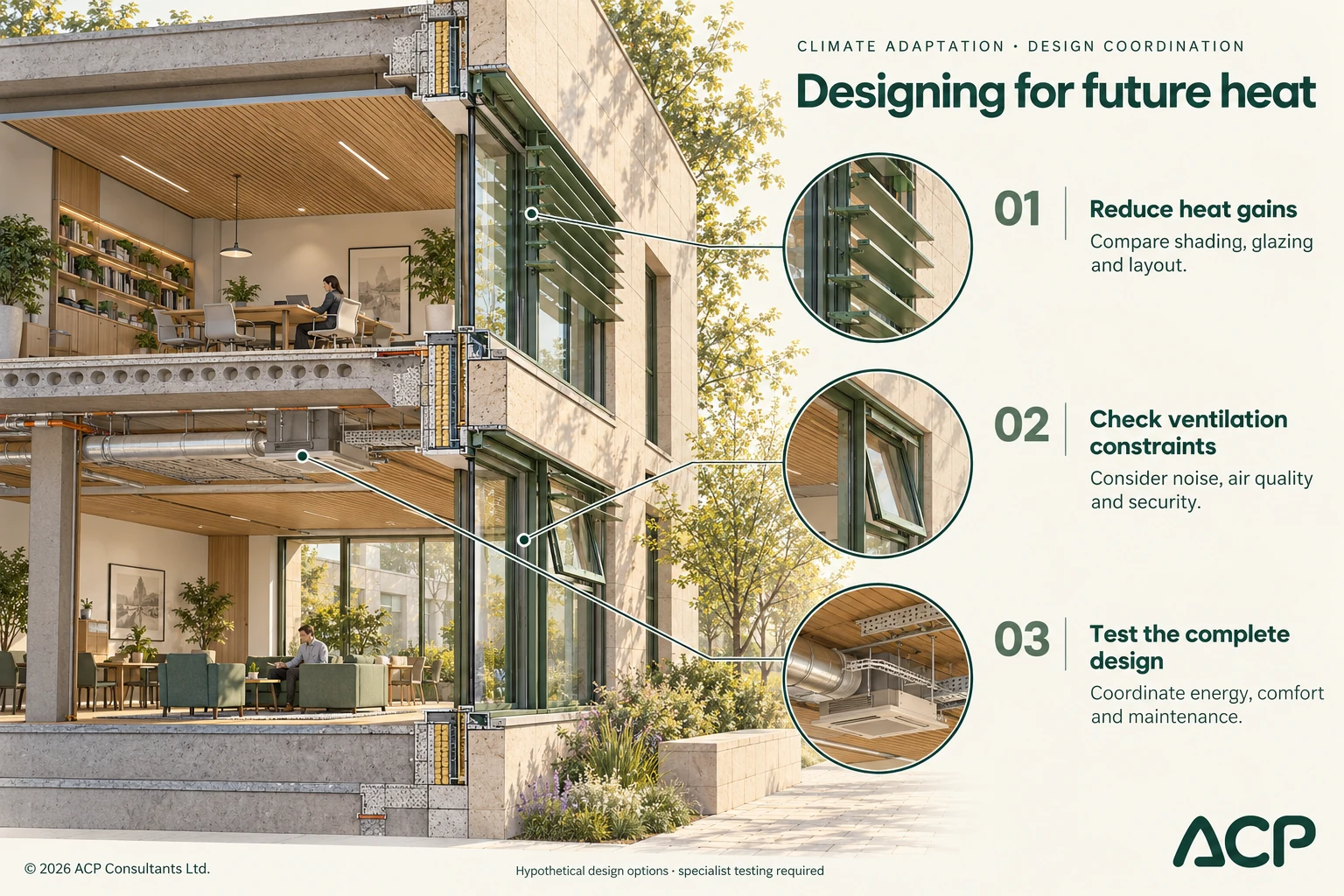
Next, test the complete response through the appropriate specialist assessments. For this reason, use a shared brief to coordinate energy, ventilation and noise before fixing the design.
From climate risk assessment to adaptation
In practice, an adaptation proposal needs a reason, an owner and a way to check whether it remains suitable. However, avoid moving a risk elsewhere or creating a new dependency that the team has not considered.
| Issue to investigate | Evidence to review | Response and follow-up |
|---|---|---|
| 01Summer heat | Evidence to reviewFirst, check sensitive uses, future weather assumptions, shading and ventilation constraints. | Response and follow-upNext, compare shading, glazing, layout and ventilation. Then record the specialist analysis and design-team decision still needed. |
| 02Intense rainfall | Evidence to reviewFirst, check levels, drainage proposals, access and applicable flood allowances. | Response and follow-upThen coordinate layout and drainage responses with specialist findings. Also record dependencies, maintenance and action ownership. |
| 03Landscape stress | Evidence to reviewFirst, check habitat objectives, soil and water conditions, establishment and management assumptions. | Response and follow-upNext, review planting and management with the ecology team. Finally, record monitoring needs and when the approach should be adjusted. |
Choose climate adaptation measures
Therefore, consider the options while layout and servicing decisions remain open. In particular, compare feasibility, maintenance, other environmental effects and how the response may need to change over time.
Record remaining climate risks
Residual risk is the risk remaining after proposed measures. Therefore, explain assumptions, outstanding checks and who should act if a review trigger occurs.
Similarly, green infrastructure may support adaptation, but its benefits depend on design and management. Therefore, consider biodiversity and climate co-benefits without treating biodiversity units as carbon savings.
Your climate change impact assessment report
Our climate change consultants agree deliverables at the outset. Above all, the report should connect evidence to decisions, explain limitations and identify further specialist input.
| Report element | What it records | Why it matters |
|---|---|---|
| 01Scope & policy | What it recordsThe proposal, boundaries and relevant requirements. | Why it mattersAs a result, the reader can see which question the report answers. |
| 02Evidence & assumptions | What it recordsSources, scenarios, periods, site information and limitations. | Why it mattersConsequently, the reader can trace the basis for the findings. |
| 03Risk assessment | What it recordsHazards, receptors, vulnerability and existing measures. | Why it mattersConsequently, the team can understand the priorities and any matrix categories. |
| 04Adaptation priorities | What it recordsOptions, selected responses and specialist dependencies. | Why it mattersAs a result, the project team has actions to carry into design or management. |
| 05Action & review record | What it recordsResponsibilities, outstanding decisions and review triggers. | Why it mattersFinally, the team can see what happens next and what needs revisiting. |
Climate assessments for development locations
First, confirm the site address, local authority and consent route. Although the core assessment method remains consistent, local policy, exposure and design constraints determine the project brief.
England: check the project context
The policy and lender checks above establish the applicable requirements. Next, our climate change consultants use local evidence to refine the site brief.
For London projects, urban heat, density and ventilation constraints may need particular attention. Therefore, check the applicable strategic and borough requirements against the proposal.
Use the location to refine the scope
For example, a coastal setting, exposed access or water-dependent operations may lead to different questions. However, a place name alone does not justify a separate method or a standard list of measures.
For projects elsewhere in the UK or overseas, identify the jurisdiction, consent route and funding arrangements. Then share these details so we can discuss scope and any local specialist input.
Climate assessment cost, timing and briefing
Consequently, fees and programme depend on the scope, available evidence and design stage. For example, EIA coordination, specialist modelling and revisions can affect the work required.
Allow time for design decisions
Therefore, agree the assessment brief before committing to a submission date. First, identify missing information, dependencies on other reports and the decisions the findings need to influence.
However, if the design is already advanced, share the latest drawings and submission deadline with our climate change consultants. We can then discuss the remaining choices and a suitable programme.
Climate assessment questions
Clear answers to help you commission the right evidence for your development.
Discuss your project →What is a climate risk assessment?
It examines how climate hazards could affect people, assets or activities, taking account of exposure and vulnerability. In practice, the purpose is to identify relevant risks and support proportionate design or management decisions.
Is a climate change impact assessment mandatory for planning?
Because requirements vary, there is no single answer for every project. First, check the relevant jurisdiction, local requirements, planning advice and EIA scope. In England, national policy addresses adaptation over a scheme’s lifetime, but the appropriate form of supporting evidence depends on the proposal.
Is this the same as an energy or sustainability statement?
Although these reports overlap, they serve different purposes. For example, energy and sustainability statements commonly address building energy strategy and planning sustainability requirements. By contrast, climate risk assessment examines exposure and resilience to changing conditions. Nevertheless, coordinate their assumptions and any shared design measures.
Does the assessment include carbon emissions?
Yes, but only where the agreed scope includes them. Project greenhouse gas assessment is a distinct workstream, although EIA may need both emissions and climate resilience evidence. Therefore, confirm the project phases, emissions boundaries and reporting method at the outset.
Which climate data should be used?
Above all, choose evidence that suits the location, timescale and decision. For example, UK Climate Projections can inform a UK site’s hazard assessment alongside local and specialist evidence. In particular, record the dataset, assumptions and limitations instead of applying one scenario or time horizon to every project.
Can a template replace a site-specific assessment?
Although a template can organise information, it cannot establish the site’s risks or justify design choices. Therefore, the assessment still needs relevant evidence, clear reasoning and a record of uncertainties and required actions.
Does climate assessment replace a flood risk assessment?
No. In addition to the climate assessment, specialist flood risk and drainage evidence may still be required. However, coordinate assumptions and use the applicable climate change allowances for the flood assessment. Therefore, a general climate report should identify this dependency clearly.
When should we appoint climate change consultants?
Appoint climate change consultants early, while the team can still influence layout, materials, servicing and adaptation choices. However, if the design is already advanced, share the current drawings and deadline so remaining decisions can shape the scope.
When should the climate assessment be updated?
First, review whether the change affects assessment assumptions, receptors, risk priorities or proposed measures. Consequently, the action record should identify who reviews these changes and which findings or design decisions need updating.