Odour assessments for planning and development
Get a proportionate odour assessment for your proposal. We advise on odour surveys, risk assessment and management plans, with a clear scope for each.
ACP’s odour consultants support developers, architects, planning teams and site operators. We assess proposed sources and development near existing activities, then explain the appropriate next steps.
UK and international odour experience. The planning and permitting guidance below focuses on England.
 © 2026 ACP Consultants
Original illustration
Practical odour assessment expertise
Our odour experience spans housing, food and animal-feed production, restaurants, waste recycling and animal waste processing.
Industrial, public-sector and private clients
Our team’s experience includes industrial, public-sector and private odour work. We bring that practical understanding to the relationship between site operations, neighbouring communities and development proposals.
Our international experience includes the UK, Malta, France, the Netherlands, Belgium, Thailand, Hong Kong and China. Local regulatory requirements and assessment methods must always be checked for the country concerned.
Recycling and waste processes
The team’s experience includes assessing odour from recycling and waste-processing activities.
This work links source assessment with the practical controls that operators can implement.
Whether the question concerns a restaurant extract or a complex processing facility, we start with the activity, the receiving environment and the decision you need to make.
Technical writing on industrial odour assessment
Our technical background includes earlier co-authored work on odour from asphalt plants. In particular, the article explains how the source, dispersion and nearby receptors shape an assessment.
Reference: Chakravartty, A. and Quinn, D. (2018). Assessing Odour from Asphalt Plants. Quarry Management, February 2018. Technical article, also available through Agg-Net.
Why it matters: A useful assessment connects site operations with realistic release conditions, weather and the people who could experience odour. As a result, this helps explain when qualitative assessment or dispersion modelling can support the decision. However, current projects must follow current guidance and site-specific evidence.
What is an odour impact assessment?
An odour impact assessment examines how an activity could affect people using nearby land or buildings. In particular, it brings together information about the source, surrounding uses and the ways odour could reach them.
For planning, the assessment helps explain whether the proposal is suitable for its location. It can also inform changes to layout, operations or controls before key design decisions become fixed.
Odour surveys: evidence for the assessment
An odour survey records conditions at particular places and times, while the wider assessment explains their meaning for the proposal.
Therefore, the report should make the reasoning clear, rather than simply present measurements or a model output.
When might you need an odour assessment?
Odour may need consideration when a development introduces a source or brings sensitive uses closer to an existing activity. For example, a council request, planning condition or design concern can help define the question. However, the appropriate scope remains site-specific.
You are proposing an odour-generating use
A new kitchen, waste process or industrial activity may affect nearby occupants. An odour risk assessment therefore considers what will operate, how emissions will arise and which controls form part of the proposal.
For example, useful starting information includes operating hours, materials, process details and extraction drawings.
You are developing near an existing source
New homes, schools or other sensitive uses may introduce people into an area affected by an established activity. Therefore, the brief needs to consider that source and how the proposed development will function.
Start with our checklist for development near an odour source.
Discuss the project early so you can identify missing information before commissioning detailed work. To clarify the scope, send the actual council request or condition wording, rather than relying on a generic report title.
Which odour assessment guidance applies?
The assessment should identify the guidance, edition and regulatory purpose it uses. In particular, planning, environmental permitting and nuisance investigations ask different questions, even when they concern the same activity.
| Framework | How we use it |
|---|---|
| IAQM planning guidance September 2026, version 2.0 | The current professional framework for assessing odour effects in planning. It covers proposed odorous activities and sensitive development near existing sources. It supports a reasoned judgement about effects and their significance. |
| Local planning policy and validation | Check the adopted development plan, relevant supplementary guidance, current validation list and environmental-health advice. These establish the local context and evidence expected for the particular proposal. |
| Commercial kitchen guidance | Use the current EMAQ+ kitchen exhaust guidance alongside the council’s requirements. The publisher currently lists Version 3. The older Defra kitchen document is withdrawn and should not be described as the latest guidance. |
| Environment Agency permitting guidance | For relevant permitted activities in England, use Odour management: comply with your environmental permit, published 3 December 2025, with applicable sector requirements. The former H4 guidance has been withdrawn. |
| Statutory nuisance | This is a separate legal test. A favourable planning assessment does not decide a nuisance complaint or establish compliance with every permit condition. |
What changed in the IAQM odour guidance?
The September 2026 edition is the first full revision of the 2014 guidance, following the minor 2018 update. Therefore, use the final version, rather than the consultation draft or a report template citing only the older edition.
A practical change concerns sniff-test programmes. Previously, the 2018 text specified a minimum of three separate days with a meteorological coverage condition. The 2026 guidance instead requires a justified programme suited to the source, survey purpose, weather, timing, access and uncertainties. As a result, a fixed number of visits alone cannot demonstrate an adequate assessment.
The underlying source–pathway–receptor approach and FIDOL factors remain important. For a current project, we review the chosen tools, assessment criteria, observations, uncertainty and management commitments against the revised guidance.
Sources: IAQM 2026, especially Appendix 2, Boxes A2.1–A2.2; superseded IAQM version 1.1 (2018); EMAQ+ kitchen exhaust report listing; Environment Agency’s current permitting guidance.
When are both noise and odour assessments needed?
A kitchen extract, production line or waste-handling operation can create both odour and noise. Councils may therefore expect coordinated evidence about emissions, fans, plant and operating hours. However, the need comes from the proposal and local requirements; it is not a universal rule for every application.
| Authority | What the published guidance says |
|---|---|
| Westminster | The council’s odour guidance addresses kitchen discharge arrangements, bespoke odour controls and operational management. Where mechanical ventilation is needed to maintain the kitchen environment, it calls for external plant details and an acoustic report. |
| Maidstone | Section B10 of the October 2026 checklist covers ventilation and extraction for hot-food premises and other relevant developments. It requests equipment position and design, odour abatement and acoustic characteristics. Part B information is recommended at application stage and may be sought before determination. |
We review the relevant council’s policies and information requirements before defining the scope. Where both disciplines are needed, the noise assessment and odour assessment should use the same plant schedule, drawings and operating scenarios.
Changes can affect both assessments. For example, an acoustic enclosure, attenuator or revised discharge route may alter airflow or the release position. Therefore, coordinate these decisions with the ventilation designer before finalising the evidence.
Local examples: Westminster’s odour guidance and Maidstone’s validation checklist, B10. However, these examples do not define the requirements of other authorities.
How do we approach odour risk assessment?
The starting point is the relationship between the source, the route odour could take and the people who may experience it. Although distance matters, it cannot answer the whole question.
The activity
First, identify the processes, materials, release points and operating pattern. Also consider changes over time and relevant abnormal operating situations.
The surroundings
Next, consider the site layout, neighbouring uses, buildings and weather conditions that could influence exposure.
The evidence
Finally, review what is known, what is assumed and what needs investigation. Then select methods that address those uncertainties.
A planning assessment should distinguish the presence of an odour from its likely effect on people. For this purpose, IAQM describes five useful considerations, often called FIDOL:
| Factor | A practical question |
|---|---|
| Frequency | How often might people experience the odour? |
| Intensity | How strong might it seem when present? |
| Duration | How long could exposure last? |
| Offensiveness | What is the character of the smell? |
| Location | Who uses the affected place, and for what purpose? |
Based on the FIDOL framework in IAQM, Guidance on the assessment of odour for planning, version 2.0 (2026). Therefore, the assessment must interpret the factors together.
No universal “safe distance”
The same separation distance can mean different things for different activities, release arrangements and surrounding uses. Therefore, a generic radius cannot establish whether a particular site is suitable.
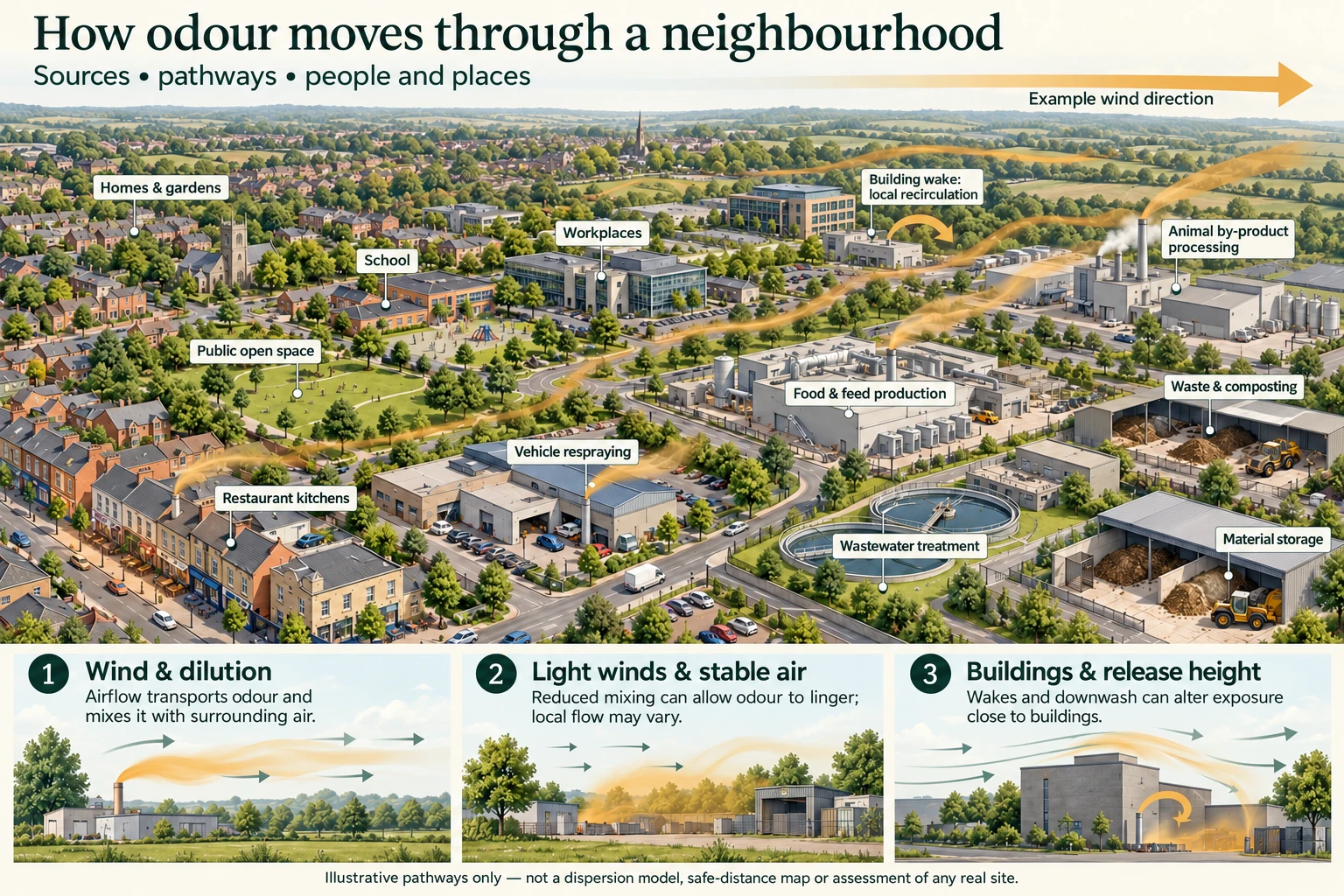
How odour travels through a neighbourhood
Odour is often a mixture of substances released by an activity. Because weather and buildings affect dispersion, people can experience the same release differently in different places. However, the nearest property is not necessarily the only relevant receptor.
 © 2026 ACP Consultants
Original illustration
Wind carries and dilutes
Wind direction affects which places lie downwind. Turbulent mixing dilutes emissions, while release height, velocity and temperature influence the plume. Therefore, a prevailing-wind arrow alone cannot establish the risk.
Light winds can limit dilution
Light winds and stable air can reduce dispersion. However, a simple straight plume is unreliable under calm or variable conditions. Therefore, assessment should consider these episodes as well as the more frequent weather patterns.
Buildings change the pathway
Airflow around buildings can create wakes, local recirculation and downwash. For example, a poorly positioned outlet may bring emissions towards nearby windows, roof terraces or air intakes. Terrain also matters.
Exposure changes with operations and time
Cooking peaks, deliveries, opening doors, material storage and process changes can produce different release patterns. Similarly, a brief intense episode and a persistent weaker smell may have different implications. Therefore, we connect operational records with weather and receptor use.
Odour is usually invisible. Therefore, the coloured paths in the illustration are explanatory symbols. They do not show measured pollutant concentrations, and the strength of a smell does not establish whether air is safe or unsafe to breathe.
Concepts informed by IAQM’s 2026 guidance, including its predictive assessment and sniff-testing appendices, and the Environment Agency’s dispersion modelling reporting guidance.
Odour surveys, sampling and dispersion modelling
There is no single method that answers every odour question. Therefore, a proportionate assessment explains why the selected evidence suits the site and whether different methods should support one another.
| Approach | What it can contribute | Important limitation |
|---|---|---|
| Desk review and qualitative risk assessment | Organise information about the activity, pathways, receptors and controls. Identify gaps and likely priorities. | The conclusion depends on the quality of information and the assumptions made. |
| Field observations or “sniff tests” | Record odour experienced at selected places during the survey, alongside relevant conditions. | A limited visit cannot describe every weather condition or operating situation. |
| Source sampling and laboratory analysis | Characterise selected emissions and, where appropriate, help establish inputs for further assessment. | A source result does not on its own describe the effect at a nearby home or garden. |
| Odour dispersion modelling | Explore predicted exposure using emissions, weather, buildings and other relevant inputs. Compare defined scenarios. | Results depend on the inputs and assumptions. Model output is not a guarantee of future conditions. |
| Complaint history and operating records | Help identify patterns, reported episodes and possible relationships with activities. | Records need context and validation. An absence of reports does not prove an absence of odour. |
| Targeted monitoring of specific compounds | Investigate a defined chemical indicator where its relationship to the source is established. | A measured compound is not automatically a measure of the whole odour mixture or its effects. |
Odour assessment methods matched to your site
- Build the source inventory. Identify stacks and vents, open or diffuse sources, door openings, handling, storage and other fugitive releases. Describe normal operations, peaks and credible abnormal situations.
- Map the receptors and pathways. Include relevant homes, gardens, schools, workplaces and outdoor areas. Check building heights, openings, air intakes, terrain and the local weather context.
- Select representative evidence. Match observations or sampling to relevant operations and conditions. For a future activity, assess the proposed design and justify any data borrowed from a comparable facility.
- Test the proposal and mitigation. Compare the relevant baseline and proposed arrangements. Where modelling is justified, document emissions, meteorology, buildings, model settings and sensitivity to uncertain inputs.
- Explain the residual effect. Bring the evidence together, account for receptor sensitivity and state the effects remaining after mitigation. Explain uncertainty and any conditions on which the conclusion depends.
Assessment criteria are tools for interpretation, not universal legal pass/fail limits. We therefore explain the selected criteria and the judgement linking the evidence to the planning conclusion.
When does dispersion modelling add value?
Modelling can help compare proposed arrangements or investigate exposure across locations and weather conditions. However, it needs a well-supported description of the emissions and operating scenarios.
For an existing source, relevant observations and records can help test whether the model represents the situation adequately. However, explain inconsistent findings and uncertainty rather than selecting only the result that supports the proposal.
What should an odour survey record?
A field record should identify each observation location and time, odour character, intensity and persistence, weather and relevant operations. In addition, the odour survey design should explain the selected visits, access limits and the conditions the evidence represents. For example, a quiet operating period or favourable wind direction can make an isolated visit misleading.
For more background, read our guide to odour surveys and assessment scope.
Method selection follows the site-specific approach described in IAQM’s planning guidance. For permitting investigations, also check the Environment Agency’s assessment guidance.
Our odour assessment process
Define the planning question
Share the location, proposed use, drawings and authority correspondence. We then identify the decision the assessment needs to support.
Agree the odour survey and assessment scope
We review available information, identify gaps and explain the proposed work. Where appropriate, the methodology can be discussed with the authority before detailed work begins.
Assess the proposal and controls
The assessment considers the relevant evidence, assumptions and effects. As a result, findings can inform practical changes to the scheme or operating arrangements.
Explain the findings and next steps
The report sets out the conclusion, limitations and recommendations. Then agree any further design review or authority-response work within the project scope.
Already have a council request?
Send the wording with your drawings. It is a useful starting point for discussing the work.
What should an odour assessment report cover?
The report needs to answer the agreed question so readers can follow its reasoning. However, the exact contents depend on the proposal, methods and relevant requirements.
The basis of your odour assessment
- The proposal, location and purpose of the work.
- Relevant sources, surrounding uses and existing conditions.
- The information reviewed and important gaps.
- The chosen methods and reasons for selecting them.
The findings and implications
- Results interpreted in the context of the site.
- Assumptions, limitations and their implications.
- Proposed mitigation and any remaining effects.
- Clear conclusions and recommended next steps.
Where modelling forms part of the work, the report should explain its inputs and scenarios. Where a conclusion depends on a particular layout or operating arrangement, make that dependency clear.
Detailed equipment design, installation, ongoing monitoring and later design revisions should not be assumed to form part of every assessment. Therefore, confirm the deliverables and exclusions in the scope.
Commercial kitchen odour assessments and extraction design
A kitchen odour assessment examines whether the proposed cooking and extraction arrangements could affect nearby people. It should therefore influence the design before the duct route, fan and treatment equipment are fixed.
We use the relevant kitchen risk-assessment approach alongside IAQM principles and local requirements. The current EMAQ+ report addresses both odour and noise from commercial kitchen exhaust systems. However, a supplier’s equipment description alone does not demonstrate that the whole installation is suitable.
| Assessment input | What to establish |
|---|---|
| Cooking and scale | Food types, cooking methods, equipment, throughput or covers, opening hours and peak service periods. Frying, grilling, roasting and reheating should not be treated as identical activities. |
| Neighbours and openings | Distances and relative heights of homes, windows, terraces, gardens and ventilation intakes. Consider the full discharge route and nearby buildings, not only the property boundary. |
| Capture and discharge | Canopy and extraction arrangements, airflow, duct route, outlet position, height and discharge direction. Explain any constraints and the proposed response. |
| Odour treatment | A justified treatment specification suited to the cooking load and discharge risk. Distinguish grease and particle removal from treatment of odorous gases; explain the role of each stage. |
| Noise and vibration | Fan duty, acoustic data, operating hours, attenuation and isolation. Check that the acoustic and ventilation designs remain compatible. |
| Maintenance and operation | Access for cleaning, filter replacement and inspection; named responsibilities; service records; and actions if extraction or treatment fails. |
From odour risk assessment to a workable scheme
First, establish the cooking activity, scale, nearby receptors and proposed exhaust arrangement. Then assess the odour risk and whether the discharge and treatment strategy need to change. Also record the assumptions so that a later change of menu, cooking equipment or operating hours can be reviewed.
Options may include improving capture, revising the outlet, controlling grease and particles, and selecting suitable gas-phase odour treatment. However, selection depends on the actual load and system design. For example, a generic promise to install carbon filtration does not establish sufficient capacity, contact time or maintenance provision.
Next, coordinate the drawings, equipment schedule, extraction plant noise assessment and operating plan. Where required, commissioning and checks under representative use should confirm that the installed system matches the agreed design. Therefore, include these later services explicitly in the project scope.
References: EMAQ+: Control of odour and noise from commercial kitchen exhaust systems, current Version 3 listing; Westminster kitchen guidance and linked technical guidance. The former Defra kitchen guidance is withdrawn.
Odour assessment across housing, industry and waste
Odour assessment for new housing
Consider future residents, gardens, balconies and ventilation. For example, existing operations, observations and available complaint records help establish site suitability. However, do not assume that the neighbouring operator can change its activity to suit a new housing layout.
Use our development near an odour source guide to prepare the initial brief.
Food and animal-feed production
Review ingredients, processing temperatures, exhausts, cleaning, storage and production cycles. In particular, include peak batches and changes in throughput. Therefore, the assessment should represent the actual process rather than rely on a broad factory description.
Animal by-products and waste processing
Receiving, unloading, storage, processing and wastewater can contribute different sources. For example, material condition, containment, storage time and abnormal operations can change the investigation and control strategy.
Recycling, composting and wastewater
Consider diffuse sources and intermittent handling alongside fixed extraction points. Therefore, an assessment should explain which operations and conditions its evidence covers, including the implications of missing information.
Vehicle respraying and solvent uses
Identify spray-booth extraction, cleaning, product handling and storage. Odour may need consideration alongside separate VOC emissions, air-quality and permitting requirements. However, a smell assessment does not establish compliance with those other duties.
Other industrial and agricultural sources
Describe the particular materials, release points, activities and nearby land uses. The choice of assessment tools and controls should therefore follow that evidence. A sector name or a generic separation distance is not enough.
Odour management plans and mitigation
Assessment identifies the issues; mitigation responds to them. Depending on the proposal, measures may involve the process, handling and storage, containment, extraction, treatment or operating procedures.
Any proposed measure needs to fit the activity and remain practical to operate and maintain. The assessment should also consider the effects that remain after those measures.
What is an odour management plan?
An odour management plan, or OMP, is a working document for controlling odour during operation. For example, it sets out actions, responsibilities, checks and responses. However, it does not replace an impact assessment.
In practice, an odour management plan connects each relevant source to its controls. It also explains what happens during foreseeable problems and how the operator reviews performance.
| Plan element | Question it should answer |
|---|---|
| Controls | What action applies to each relevant source or activity? |
| Responsibility | Who carries out the action and who checks it? |
| Records | What evidence shows that the control is operating? |
| Response | What happens if equipment fails or a problem is reported? |
| Review | When will the arrangements be checked and updated? |
For permitted activities in England, the Environment Agency’s OMP guidance explains the expected site-specific approach. In addition, planning requirements may call for an odour management plan. Therefore, agree the purpose before preparing a plan.
Prepare your odour assessment brief
You do not need every answer before making an enquiry. Instead, start with the information you have and flag anything that is uncertain.
For any project
- Site address and a location or red-line plan.
- Existing and proposed uses, with the latest layout.
- Planning stage and any council correspondence.
- Nearby activities or sensitive properties of concern.
- Existing reports and your programme.
If your proposal could generate odour
- The process, materials and operating hours.
- Relevant quantities, storage and handling arrangements.
- Extraction and discharge information, where available.
- Proposed odour controls and maintenance arrangements.
- Known changes or abnormal operating scenarios.
For development near another operator, distinguish confirmed information from assumptions. Our receiving-development brief checklist provides a more detailed starting point.
How much does an odour assessment cost?
The fee depends on the question, available evidence and work required. A limited review and a detailed study involving surveys or modelling have different scopes.
Send the proposal and any authority request so the quotation can explain the deliverables, assumptions and exclusions. As a result, this makes it easier to compare like-for-like work.
| Scope factor | Why it affects the work |
|---|---|
| Sources and surrounding uses | More complex relationships can require additional investigation and interpretation. |
| Existing information | Missing operational or design information can require further work before assessment. |
| Methods and access | Fieldwork, sampling, modelling and site arrangements have different resource requirements. |
| Design development | Revised layouts or controls can change the assessment assumptions. |
| Required outputs | A report, an OMP and ongoing support are different deliverables. |
How long does an odour assessment take?
The programme depends on the agreed scope, access, information and relevant operating or weather conditions. For example, an odour survey needs conditions that represent the question being investigated.
Agree the timetable at the outset, including time for design coordination and any responses within the scope. However, a report completion date is separate from the authority’s decision timetable.
Coordinate odour with the wider development
Odour decisions can affect plant position, ventilation, building layout and operations. Therefore, share consistent drawings and assumptions across the project team, especially when the design changes.
Air quality
Where emissions also raise air pollutant concerns, coordinate the relevant air quality assessment. However, an odour conclusion does not replace that separate work.
Noise
Fans, plant and operational activity may need noise assessment. Therefore, check that odour and acoustic proposals remain compatible.
Environmental impact assessment
Where a proposal requires environmental impact assessment, agree how the odour evidence contributes to the wider assessment.
Explore our environmental assessment services if your site raises several connected issues.
Odour assessment FAQs
Which IAQM odour guidance is current?
As reviewed in October 2026, the final September 2026 guidance, version 2.0, is the current IAQM planning edition. It updates the earlier 2014/2018 guidance. Its purpose is planning assessment; permitting guidance remains a separate framework.
Do restaurants need both noise and odour evidence?
They may do where kitchen emissions, fans or other plant could affect neighbours. Check the council’s requirements. Coordinating the two assessments helps keep the extract design, operating hours and mitigation consistent.
Is an odour assessment mandatory for every planning application?
No. The need depends on the proposal, its surroundings and the relevant planning requirements. Check the authority’s validation information and discuss a specific request before commissioning work.
Can a single odour survey show that there is no problem?
A visit records conditions at particular places and times. However, it cannot automatically represent every operating pattern or weather condition. Therefore, the assessment should explain whether further evidence is needed.
Do all projects need odour dispersion modelling?
No. The method should suit the question and the potential effects. Where modelling adds value, its inputs, assumptions and relationship to other evidence need clear explanation.
Can you assess a proposal before it is operating?
A future activity can be assessed using suitable predictive methods and design information. However, field observations cannot directly measure emissions from an activity that has not yet begun.
Does a pleasant smell mean an acceptable effect?
Not necessarily. Repeated or prolonged exposure can still affect the use of a place. The assessment considers the circumstances, rather than relying on whether the smell is usually described as pleasant.
Is an odour assessment the same as an air quality assessment?
They address related but different questions. Odour assessment considers smell and its effects on amenity. Work on specific air pollutants may be needed separately; smell alone is not a measure of health risk.
Can an odour management plan replace an assessment?
An OMP explains how operational controls will work. In contrast, an assessment examines the likely effects. Therefore, a project may need one or both, depending on its requirements.
Will the report guarantee planning permission?
No. The report provides evidence for the decision. The authority considers the application and other relevant matters; recommendations may also require changes to the proposal.
What if the design changes after the assessment?
Tell the assessor which drawings, plant or operating assumptions have changed. The team can then consider whether the findings remain applicable or further review is needed.
Discuss your odour assessment with ACP
Tell us your site location, proposed activity and planning stage. Include the latest drawings and any council request so we can discuss the appropriate assessment.
For an existing odour issue, explain when it occurs, the operations involved and any investigations already completed.
Odour guidance and source references
This page explains the assessment process in general terms. The appropriate scope and conclusions depend on the individual project.
- IAQM: Guidance on the assessment of odour for planning, version 2.0, September 2026.
- Environment Agency: Odour management — comply with your environmental permit.
- GOV.UK: nuisance smells and council investigations.
- Planning practice guidance: air quality.
- EMAQ+: commercial kitchen exhaust guidance, current publisher listing.
- Westminster: odour and kitchen extraction guidance.
- Maidstone: October 2026 local information checklist.
Last reviewed: 25 October 2026. This is general information, not a substitute for project-specific advice.