
Biodiversity Net Gain consultants for planning in England
Our Biodiversity Net Gain consultants help you understand what your site needs. Then move forward with clear, practical advice.
Our BNG consultancy supports developers, architects, planning consultants and landowners with surveys, assessments, metric calculations and delivery plans.
Our Biodiversity Net Gain consultants start with your site and planning stage, so you understand the work required and the decisions ahead.
A clear starting point
What is Biodiversity Net Gain?
Biodiversity Net Gain (BNG) means leaving habitats in a measurably better state after development. It connects ecological evidence with the way a site is designed, delivered and managed.
For non-exempt development in England, the statutory objective is at least 10% gain, measured using the statutory biodiversity metric. Also check local policy and the rules that apply to your planning route.
Our Biodiversity Net Gain consultants help you understand those requirements and turn them into coordinated surveys, calculations and practical plans. Start with our BNG assessment service if you need help defining the scope.
Requirements before reports
When does BNG apply?
The requirements depend on the application, not just the description “small development”. Therefore, establish the position before fixing the survey brief or design programme.
From 6 August 2026, an exemption covers qualifying sites of 0.2 hectares or below; priority-habitat impacts can prevent its use. New self-build and custom-build applications no longer have their previous exemption. Always check the full conditions and transitional arrangements.
A BNG exemption does not remove other ecology or protected-species requirements. So keep these checks alongside the planning advice for your site.
For the wider framework, use our BNG legislation and guidance and BNG process guide. The Small Sites Metric service addresses the separate question of which calculation method is suitable.
Use our BNG exemptions guide and screening tools to organise the evidence for an ordinary planning application.
Find the right support
BNG consultancy services for each project stage
BNG assessment and baseline surveys
Establish the habitats, constraints and information your proposal needs before progressing the assessment.
Statutory biodiversity metric
Calculate baseline and proposed units. Then test habitat options and keep the workbook aligned with the design.
Small Sites Metric
Check eligibility for the simplified method and prepare an appropriate calculation where it can be used.
Biodiversity Gain Plans
Bring the delivery strategy and supporting evidence together for the biodiversity gain condition.
Habitat management and monitoring
Define practical actions, responsibilities and monitoring for the habitats the scheme will deliver.
BNG reports for planning
Present the assessment findings, plans and calculations in a clear, coordinated reporting package.
Need a specialist input? Explore River Condition Assessment, habitat survey services or off-site biodiversity units. We will explain which inputs are relevant to your site.
How we work
How our Biodiversity Net Gain consultants coordinate your project
Understand your site
Send your site location, red-line plan, proposals and planning stage. Next, our Biodiversity Net Gain consultants review the available information and identify the decisions that need ecological input.
You receive a defined scope, with assumptions and exclusions explained before work begins.
Assess and coordinate
Once instructed, our Biodiversity Net Gain consultants undertake the agreed surveys and assessment. We also work with the project team to reconcile habitat mapping, the metric and proposed layout.
If the design changes, the evidence needs to change with it. We therefore explain the implications and any further work required.
Plan for delivery
We prepare the agreed reporting and plans for the relevant stage. In addition, clear responsibilities help connect planning requirements with habitat delivery on the ground.
Post-permission support and monitoring can be scoped where required.
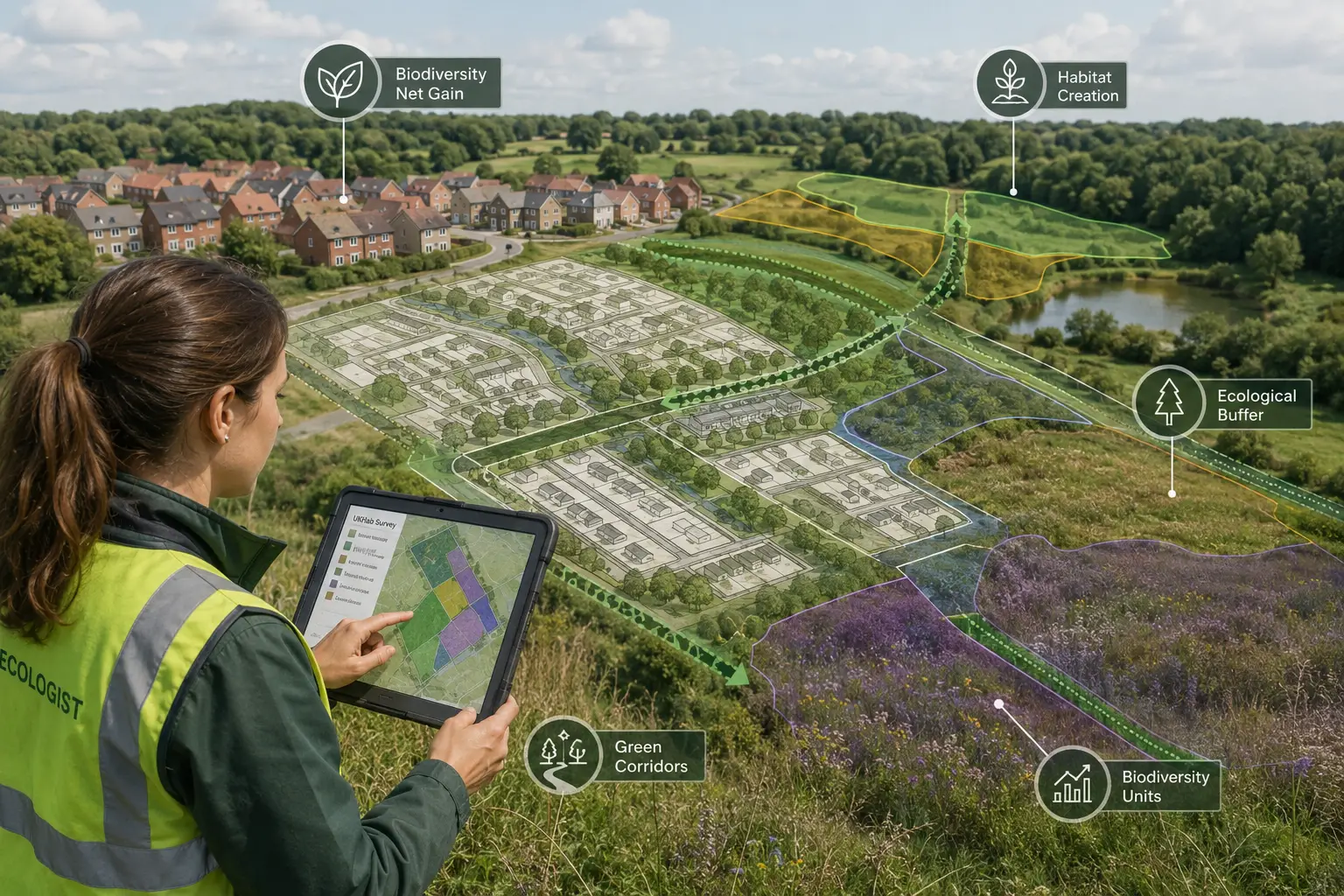
Survey · Design · Delivery
Connect the whole site
Illustrative development scenario: connecting site surveys, design and habitat enhancement.
- Start with habitatsUnderstand existing features and opportunities for retention.
- Coordinate the proposalsBring ecological evidence into layout and landscape decisions.
- Follow throughPlan the management that supports the intended habitat outcomes.
Evidence that connects
How is biodiversity net gain measured?
The statutory biodiversity metric compares habitat value before and after development. First, record habitat type, extent, condition and strategic significance. The workbook then applies the relevant distinctiveness scores and delivery-risk factors.
Area habitats, hedgerows and watercourses have separate unit accounts. Each relevant account needs its own gain target and trading-rule checks. Consequently, surplus grassland units cannot cover a hedgerow-unit shortfall.
Reliable inputs start with habitat identification and an evidenced condition assessment. Keep parcel references consistent between the survey, habitat mapping and workbook.
Watercourses can need specialist evidence. For example, an appropriately qualified assessor may need to undertake a River Condition Assessment. Ditches have their own condition-assessment route. Coordinate ecological findings with drainage, flood-risk or geomorphology advice where the proposal requires those inputs.
Then use the metric during design to compare feasible options. Our worked biodiversity-unit calculations explain the arithmetic. The metric user guide takes readers through the workbook and evidence checks.
The workbook and drawings must tell the same story
A habitat area in the metric should be traceable to the same boundary and revision on the habitat plan. For example, a design change can affect the result, the delivery strategy and the management requirements.
Use our habitat plan and metric reconciliation checklist to organise that review.
Three accounts · one coordinated strategy
Read each result in its own units
The full statutory metric measures area habitats in hectares and linear habitats in kilometres. The Small Sites Metric uses square metres and metres.
Grassland, woodland and other parcels
Map each habitat parcel, then record its extent, classification and condition where required.
Hedges and lines of trees
Record qualifying linear features in their own account, using the appropriate habitat category and condition criteria.
Rivers, streams, canals and ditches
Use the relevant watercourse category, assessment method and evidence for the feature being measured.
A simple numerical check: a baseline of 6.00 area units needs at least 6.60 area units for a 10% uplift. That is an additional 0.60 area units. Use the workbook’s risk-adjusted outputs, then check trading rules and every other relevant unit account.
Follow the official metric tools and current user guide for the applicable rules and calculation inputs.
The right information, at the right stage
Which BNG documents do you need?
The information needed with an application is not identical to the information needed before commencement. Therefore, agree the required package with the planning team and relevant authority.
A practical map of the BNG evidence package
Before submission
Confirm applicability, establish baseline habitats and prepare the relevant assessment, metric and plans. Check the authority’s validation requirements.
Design development
Keep habitat mapping, landscape proposals, drainage and the metric consistent. Record revisions, constraints and unresolved assumptions.
After permission
For development subject to the biodiversity gain condition, obtain approval of the Biodiversity Gain Plan before starting development, subject to applicable rules.
Delivery and management
Assign habitat creation, management, monitoring and reporting responsibilities. Align the HMMP, legal commitments and contractor information.
Check the council’s validation list alongside this evidence overview. See our Biodiversity Gain Plan service, HMMP service and BNG report guidance for the relevant deliverables.
Not sure which stage your project has reached? Share the plans and planning correspondence you already have.
Ask about your requirementsBeyond the calculation
Plan for habitats that can be delivered
Retain and improve
Consider existing habitats early. Then coordinate the layout, landscape and engineering proposals so habitat commitments are practical.
Resolve any shortfall
Explore the applicable on-site and off-site options. However, registered off-site units and statutory biodiversity credits are different products.
Secure the outcome
Match the evidence, delivery arrangements and management commitments. Also set out who will do what, and how progress will be checked.
For major development, apply the biodiversity gain hierarchy when selecting delivery options. For non-major development, on-site creation or enhancement and registered off-site gains can be considered at the same stage. In both cases, statutory credits remain a last resort.
Read more about off-site biodiversity units and the applicable BNG rules.
Record the start date for the 30-year commitment
Then align the HMMP, funding, monitoring dates and legal documents with the correct trigger.
- Ordinary planning · on-site
Significant enhancements: at least 30 years from completion of the development.
- Registered off-site gains
At least 30 years from completion of the habitat enhancement works.
- National infrastructure
Contributing on-site creation and enhancement: at least 30 years from completion of the habitat works.
Opportunities with responsibilities
BNG for landowners
Landowners can explore creating or enhancing habitats to supply off-site biodiversity units. A habitat bank combines ecological delivery with long-term land management, legal security and a viable commercial plan.
Start by examining the ecological baseline, realistic habitat targets, delivery costs and management responsibilities. Legal arrangements, registration and allocation evidence also need to fit the proposed business model.
Our Biodiversity Net Gain consultants can help you understand the ecological work and reporting needed. Also test local demand, eligible unit types, delivery costs and the timing of potential sales.
Scope, cost and programme
How much does biodiversity net gain cost?
The cost of Biodiversity Net Gain depends on the size of the development, the habitats present, the planning stage and the level of ecological work required. Every project is different, so the scope of surveys, biodiversity metric calculations and planning documentation should always be proportionate to the development and local planning authority requirements.
For a smaller development, first establish whether BNG applies and which assessment method is appropriate. Larger or more complex developments often require additional ecological surveys, Biodiversity Gain Plans, Habitat Management & Monitoring Plans, legal agreements and, where necessary, the purchase of off-site biodiversity units. Projects requiring long-term habitat creation may also incur monitoring fees to demonstrate successful habitat establishment throughout the management period.
The best way to reduce Biodiversity Net Gain costs is to consider biodiversity at the earliest stages of site design. Early ecological advice often identifies practical opportunities to retain habitats, reduce biodiversity losses and minimise the need for more expensive off-site compensation measures. Our Biodiversity Net Gain consultants provide clear fixed-fee quotations wherever possible and explain the scope of work before surveys begin.
What shapes the scope and fee?
Site and habitats
Area, habitat diversity, access and available baseline evidence affect survey and assessment work.
Planning and design stage
A fixed layout, missing evidence or later revisions can add coordination and assessment work.
Delivery strategy
Off-site units, legal arrangements and habitat management have costs separate from preparing the assessment.
Programme
Seasonal evidence, access, design decisions and authority requirements influence the timetable.
For the monitoring element, see our BNG monitoring fee calculator. Use its monitoring allowances alongside the assessment, habitat works, legal and unit-purchase costs in your project budget.
Built on TRUST
What to expect from your Biodiversity Net Gain consultants
Good advice should leave you clear about the requirement, the evidence and the next decision. That is why our Biodiversity Net Gain consultants explain the scope of our work and raise uncertainties early.
Our Biodiversity Net Gain consultants also work collaboratively with your planning and design team. Where a proposal risks an ecological problem, we explain the concern and help explore an appropriate response.
That approach reflects our commitment to clients, colleagues and the environment. Read about ACP and our TRUST values.
“ACP helped provide a statement to explain that the development was below the threshold and therefore exempt, saving me time and money!”
Paul Hunt · extract from an existing Google review displayed by ACPThe review describes the support provided for that client’s proposal.
Choosing Biodiversity Net Gain consultants for habitat delivery
Ask who will undertake the survey, classify habitats and review the metric. Their competence should match the habitats and assessment method. Also confirm what the quotation covers: site work, drawings, workbook, report, design revisions and post-permission support.
Good delivery goes beyond the headline percentage. The CIEEM, CIRIA and IEMA good-practice principles emphasise robust evidence, risk management, transparent decisions and lasting outcomes. In practice, connect habitats to local priorities, set achievable condition targets and fund the management needed to reach them.
Finally, agree how the team will respond if monitoring shows that habitat establishment is falling behind. Clear responsibilities and corrective actions help turn the approved strategy into a lasting ecological result.
Explore the campaign
Go deeper where your project needs it
The BNG process
Understand the stages and decisions from early review to delivery.
Legislation and guidance
Check the framework and sources behind the requirements.
BNG locations
Find the appropriate England, regional and local guidance.
For topical updates and practical coordination checklists, visit Insights & Guidance.
Your questions
Biodiversity Net Gain FAQs
Is Biodiversity Net Gain mandatory?
For non-exempt development in England, mandatory BNG applies through the relevant planning framework. Check the current exemptions, application date and planning route before deciding what your site needs.
When should a Biodiversity Net Gain assessment be completed?
Biodiversity Net Gain should be considered at the earliest stages of project design. As a result, early ecological advice can inform the site layout and identify planning risks before you submit an application.
What documents are usually required?
Requirements vary between developments but commonly include habitat surveys, biodiversity metric calculations, Biodiversity Gain Plans, Habitat Management & Monitoring Plans and planning reports.
Can Biodiversity Net Gain be achieved off-site?
Yes, off-site delivery can form part of the strategy. The applicable hierarchy and metric requirements still matter. See our off-site biodiversity units guidance and current government guidance for the route relevant to your development.
How long must Biodiversity Net Gain habitats be managed?
Maintain significant on-site enhancements under ordinary planning permissions for at least 30 years after development is completed. For registered off-site gains, the period starts when habitat enhancement works are completed. NSIP habitat creation and enhancement has its own trigger. Record the applicable dates in the plans and securing documents.
How much does Biodiversity Net Gain cost?
Costs vary depending on the size of the development, existing habitats, planning stage and the documentation required. Early ecological advice often reduces overall project costs by identifying practical biodiversity enhancements before planning applications are submitted.
Do all developments require Biodiversity Net Gain?
No. Exemptions and transitional arrangements can apply. Eligibility for the Small Sites Metric is a separate question and does not itself establish an exemption.
Can ACP Consultants help throughout the planning process?
Yes. We provide planning-focused Biodiversity Net Gain support from early feasibility through to planning approval and post-permission requirements, including habitat surveys, biodiversity metric calculations, Biodiversity Gain Plans, Habitat Management & Monitoring Plans and ongoing ecological advice.
Can Biodiversity Net Gain delay planning permission?
Incomplete evidence, unresolved design changes or seasonal survey constraints can affect a programme. Early ecological input helps identify those risks and agree the next survey, design or submission milestone.
Can Biodiversity Net Gain be designed into a development?
Yes. The most successful developments consider Biodiversity Net Gain during the earliest design stages. Retaining existing habitats, improving habitat connectivity and incorporating new ecological features into the layout often provides better biodiversity outcomes while reducing planning risk and the need for costly redesigns.
Who prepares Biodiversity Net Gain reports?
Biodiversity Net Gain reports should be prepared by experienced ecologists familiar with the Statutory Biodiversity Metric, UKHab habitat classification, planning policy and current Biodiversity Net Gain guidance. Reports should provide proportionate technical evidence that supports planning applications and demonstrates compliance with statutory requirements.
How long does a Biodiversity Net Gain assessment take?
Timescales and costs vary depending on the size of the site, habitat complexity, seasonal survey requirements and the planning stage. Smaller developments can often be assessed quickly, while larger or more complex sites may require additional ecological surveys and supporting documentation. Seeking advice early helps avoid unnecessary delays and ensures the correct information is available before planning submission.