
ELIGIBILITY FIRST · CLEAR EVIDENCE · PRACTICAL ADVICE
Small Sites Metric assessments for planning
Check the right route, understand your biodiversity units and move your planning submission forward.
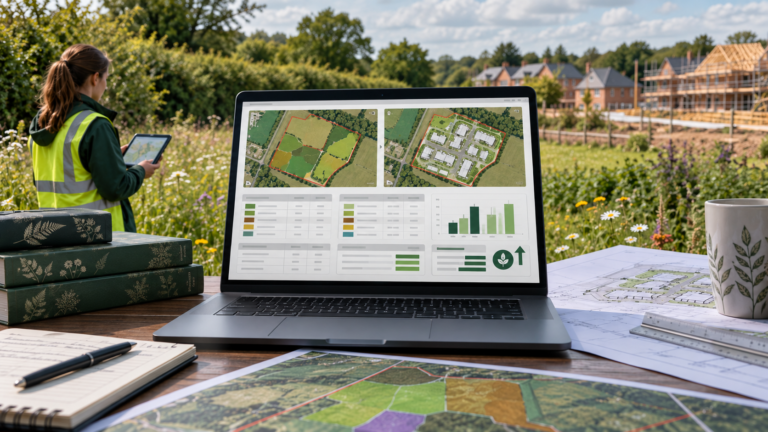
ACP Consultants prepares and reviews Small Sites Metric assessments for eligible developments in England. We check eligibility, connect habitat evidence to your plans and explain the results of the official SSM workbook.
Discuss your SSM assessment →TWO QUESTIONS BEFORE A CALCULATION
Check the application date, planning route, boundary and exemptions.
Exempt? Establish the evidence needed.If BNG applies, check the development and ecological criteria.
Eligible? The SSM is an available route.START WITH APPLICABILITY
Does your development need an SSM assessment?
A small development does not automatically need an SSM assessment. First, establish whether mandatory Biodiversity Net Gain applies. Then check whether the Small Sites Metric is suitable.
Householder development and other exemptions may apply. However, an exemption from mandatory BNG does not remove other ecological protections or planning requirements.
Use our BNG exemptions guide alongside the current government exemption guidance. For wider survey and planning support, see our BNG assessment service.
DEVELOPMENT AND HABITATS BOTH MATTER
When can the Small Sites Metric be used?
The SSM is a simplified statutory calculation tool for eligible minor development. Both the development classification and ecological criteria must be satisfied. A single small measurement does not establish eligibility.
Check the whole proposal
Review the legal definition of major development, including mixed-use proposals. The following triggers need particular attention.
| Development | Trigger to check |
|---|---|
| Housing | 10 or more dwellings; where numbers are unknown, a site of 0.5 hectares or more. |
| Buildings | Creation of 1,000 square metres or more of floor space. |
| Site area | Development on a site of 1 hectare or more. |
| Minerals and waste | These are major-development categories and are not SSM projects. |
Check the applicable definition in article 2 of the Development Management Procedure Order.
Check the ecological evidence
- Habitats covered by the tool. Only habitats included in the SSM may be present onsite.
- Priority habitats. These are excluded, apart from permitted hedgerows and arable field margins covered by the SSM.
- Protected sites and species. Statutory protected sites and European protected species must not be present onsite.
- Nearby constraints. Where statutory protected sites or priority habitats are within 500 metres, consider specialist ecological advice. The distance alone is not an automatic exclusion.
Use one metric for the whole onsite calculation. The full Statutory Biodiversity Metric is required where the SSM criteria are not met and remains an option for eligible sites.
SIMPLER INPUTS, RELIABLE EVIDENCE
What is different about the SSM?
The Small Sites Metric simplifies eligible assessments. It does not replace protected-species surveys, other ecological assessments or the planning authority’s review.
Fixed baseline condition
Existing habitat condition values are fixed in the SSM. Therefore, its baseline calculation does not require the formal condition assessments used with the full metric.
Competent habitat identification
The person completing the SSM must be competent, but need not be an ecologist. Accurate identification, mapping and measurements still matter.
The same statutory objective
Where mandatory BNG applies, the objective remains at least a 10% increase against the pre-development biodiversity value. Using a simpler workbook does not reduce that objective.
READ THE RESULT IN CONTEXT
What does an SSM assessment show?
The calculation compares baseline habitats with the proposed development and habitat provision. It identifies biodiversity gains, shortfalls and relevant trading-rule checks.
However, a positive headline percentage is not the whole assessment. Proposed habitats must be deliverable, and the relevant trading rules still apply. Retaining a hedgerow can avoid a loss; retention alone does not increase its value.
For the underlying terminology, read how biodiversity units are calculated and our biodiversity metric explainer.
Three separate unit types
- Area habitats
- Features measured by area, such as grassland and built surfaces.
- Hedgerows
- Qualifying hedgerows and lines of trees measured by length.
- Watercourses
- Relevant watercourse features covered by the tool.
A surplus in one module cannot simply cancel a shortfall in another.
How site plans support an SSM assessment
Compare the same illustrative boundary before and after a proposed development. Matching references help connect habitat evidence with the calculation.
Existing site
Proposed development
- Site boundary
- Grassland
- Building / hardstanding area
- Hedgerow
| Evidence checked | Connection to the assessment |
|---|---|
| Site boundary and measurements | Defines the assessment area and supports habitat measurements. |
| Habitat parcels and linear features | Supports selection of relevant workbook entries, with area and linear features recorded appropriately. |
| Retained, lost and proposed habitats | Explains the changes represented in the calculation. A1-L and A1-R are illustrative plan references. |
| Landscape proposals | Supports proposed habitat assumptions. New habitat creation or enhancement would need further detail. |
Illustrative example only. These plans explain how evidence connects to an assessment. They do not establish SSM eligibility, survey findings, development feasibility or a biodiversity result. No habitat areas or biodiversity units have been calculated.
FROM ELIGIBILITY TO ISSUE
How our Small Sites Metric service works
We begin with eligibility and evidence, then prepare the calculation and explain its practical implications. Each stage records the information used and any assumptions that remain.
- 01
Confirm the route
Review BNG applicability, SSM eligibility and the proposed scope.
- 02
Establish the evidence
Review habitat information, arrange fieldwork where needed and map relevant features.
- 03
Prepare the calculation
Enter baseline habitats and model the proposed development.
- 04
Review the results
Check gains, shortfalls and trading requirements. Assess revisions where agreed.
- 05
Check and issue
Review consistency and issue the agreed workbook and supporting information.
If the design changes, return to the calculation and review the result again. Agreeing the revision allowance helps the assessment keep pace with the design.
CLEAR SCOPE AND OUTPUTS
What you receive
Our Small Sites Metric service brings together the workbook, supporting evidence and advice on the results. We confirm the exact deliverables in your quotation.
| Output | What it gives your team |
|---|---|
| Completed SSM workbook | Baseline and proposed habitat entries for an eligible development, using the official statutory tool. |
| Unit results and rule checks | A summary of gains, shortfalls and trading-rule issues for the relevant modules. |
| Evidence and assumptions | Consistent parcel references, measurements, drawing revisions and recorded assumptions. |
| Supporting habitat plans | The mapping and plans specified in your agreed scope. |
| Practical next steps | Advice on further evidence, design changes or habitat information needed. |
A Biodiversity Gain Plan and Habitat Management and Monitoring Plan are separate documents. Do not assume they are included unless specified.
Already have an SSM workbook or council comments? We can scope a review of the calculation and its supporting evidence.
Ask about an SSM review →RESOLVING A SHORTFALL
Can an SSM project use off-site units?
Yes. An eligible project can use the SSM for its onsite calculation and rely on registered off-site gains where appropriate. The SSM has no off-site section. Instead, the off-site provider uses the full statutory metric for the gain site and allocation evidence.
Your Biodiversity Gain Plan must bring the onsite and off-site evidence together, including the correct units, registration and allocation details.
Read our off-site biodiversity units guide for the wider process.
THE WORKBOOK IN YOUR PLANNING PACKAGE
How does the assessment support planning?
The SSM supports several stages, but each asks a different question. Establish the baseline at application, demonstrate the proposed gain before commencement, then deliver the agreed habitats.
At application
Provide the pre-development biodiversity value, completed metric calculation and onsite habitat plan where BNG applies. Address baseline dates, degradation and the authority’s validation requirements.
Before commencement
For non-phased development subject to the gain condition, the authority must approve the Biodiversity Gain Plan before work starts. Phased schemes have additional requirements.
During delivery
Significant onsite gains and registered off-site gains require at least 30 years’ maintenance. Align habitat works, management and monitoring responsibilities with the permission and legal commitments.
A completed workbook is not permission to start. Confirm approvals and conditions with your planning adviser. See the government’s BNG planning guidance.
HELP US UNDERSTAND THE SITE
What information do we need?
Send what you already have, including your target submission date. Missing documents do not prevent an initial enquiry, but they may affect the work required.
- Site address, red-line boundary and latest development layout.
- Proposed use, dwelling numbers, floor space and application date.
- Planning history, council comments and any existing SSM workbook.
- Ecological reports, habitat plans and dated photographs.
- Landscape plans, planting schedules and habitat proposals.
Editable drawings and workbooks help us check measurements. Use clear revision dates. We can advise on additional BNG surveys or habitat mapping where evidence is incomplete.
SCOPE, FEES AND PROGRAMME
Small Sites Metric costs and timing
We provide a project-specific quotation. The cost depends on available evidence, survey needs, habitat complexity and the amount of design review.
A supported workbook review differs from a new assessment requiring fieldwork and mapping. Separate gain plans or management plans also involve additional work where needed.
Send your boundary, proposal and target submission date. We confirm the deliverables, information needed and revision allowance before agreeing a fee and programme.
What can affect the programme?
- Missing or outdated habitat evidence.
- Further survey or mapping requirements.
- Changes to the boundary, access or development layout.
- Revisions to landscape and habitat proposals.
- Additional documents and responses to council comments.
For broader project planning, see our BNG guide for small developers.
YOUR QUESTIONS
Small Sites Metric FAQs
These answers explain how evidence, design changes and planning stage affect an SSM commission.
Does an ecologist have to complete the SSM?
Not necessarily. The SSM must be completed by a competent person who can identify the habitats and use the tool correctly. They must also recognise when a site does not qualify or needs specialist advice.
For example, uncertainty about priority habitat or protected species should be resolved before selecting the metric. Simplified inputs do not make an uncertain habitat identification reliable. ACP can review the available evidence and confirm whether an SSM assessment or further ecological work is appropriate.
Will a site visit be needed?
A site visit will often be needed to establish reliable habitat evidence. However, the scope depends on the quality, coverage and age of the information already available. An existing survey may be useful if it covers the whole development boundary and remains representative.
Send any habitat plans, ecological reports and dated photographs with your enquiry. We can identify gaps and explain what fieldwork is needed. Photographs alone may not show every relevant feature or resolve questions about habitat type, protected species or eligibility.
Can ACP review an existing workbook?
Yes. Send the editable SSM workbook together with the plans and habitat evidence used to prepare it. Include council comments, the application reference and any changes made since the original calculation.
We can scope a review of eligibility, habitat entries, measurements, assumptions and results. If the drawings and workbook use different layouts, they may need updating together. We will explain whether a targeted correction is sufficient or whether additional evidence and a more substantial revision are needed.
Can we start before the design is final?
Yes. Early habitat information and an initial calculation can help the design team compare layouts before key decisions are fixed. For example, reviewing access and building positions may reveal opportunities to retain habitats that would otherwise be lost.
The initial results depend on the assumptions and drawings used. As the layout and landscape proposals develop, relevant habitat measurements and workbook entries need updating. Agree the number of design iterations in the scope, and keep a clear record of which drawing revision supports each calculation.
Can the SSM support an outline application?
Potentially, where the development meets the SSM criteria and enough information is available to support the calculation. Unknown dwelling numbers, the site area and the scope of the outline proposal all need checking before eligibility can be confirmed.
Some design details may remain unresolved, so assumptions should be clearly recorded and revisited as proposals develop. Do not assume that all biodiversity information can wait until reserved matters. Discuss the application requirements with the planning authority, especially where the permission allows phased development.
What happens if our plans change?
Review which habitats, measurements and proposals are affected, then update the relevant plans and workbook together. A change to the boundary, building footprint, access or landscaping can alter the biodiversity result and may affect SSM eligibility.
If a Biodiversity Gain Plan has already been approved, check the effect on that approval and any associated conditions or legal agreements. Send ACP the revised drawings and a summary of the changes. We can identify the assessment work needed and the planning matters to discuss with your adviser or authority.
YOUR NEXT STEP
Let’s scope your SSM assessment
Tell us about the site, proposed development and planning timetable. We can review the available information and confirm the appropriate scope.
You do not need every document ready before contacting us. You can email supporting plans and workbooks when we discuss your project.
We handle your enquiry details in accordance with our Privacy Policy. You can email supporting plans and workbooks to hello@acp-consultants.com.
OFFICIAL SOURCES
Tools and further guidance
- Defra: official SSM workbook and user guide
- GOV.UK: using the statutory metric and SSM
- GOV.UK: current BNG exemptions
- Planning practice guidance: Biodiversity Net Gain
- GOV.UK: legal agreements for BNG
Disclaimer date:
Important: This page concerns development in England. BNG requirements depend on the proposal, planning route, application date and habitats affected. Check exemptions and Small Sites Metric eligibility for your individual project.
ACP Consultants can review eligibility, prepare SSM calculations and provide supporting habitat evidence and planning advice within the agreed scope. Acceptance of submissions and approval of Biodiversity Gain Plans remain matters for the relevant planning authority or decision-maker.
Government guidance and statutory tools can change. This page provides general guidance. The disclaimer date updates automatically and does not indicate a new technical review. Obtain project-specific advice before relying on a calculation or proceeding with development.