
Environmental impact assessment consultants
Environmental impact assessment consultants for screening, scoping and Environmental Statement coordination.
Our EIA consultants connect environmental evidence with the decisions your project needs. In practice, we support developers, landowners and planning teams throughout the assessment process.
Start with your site, planning stage and any council correspondence.
See the whole picture.
Shape a better proposal.
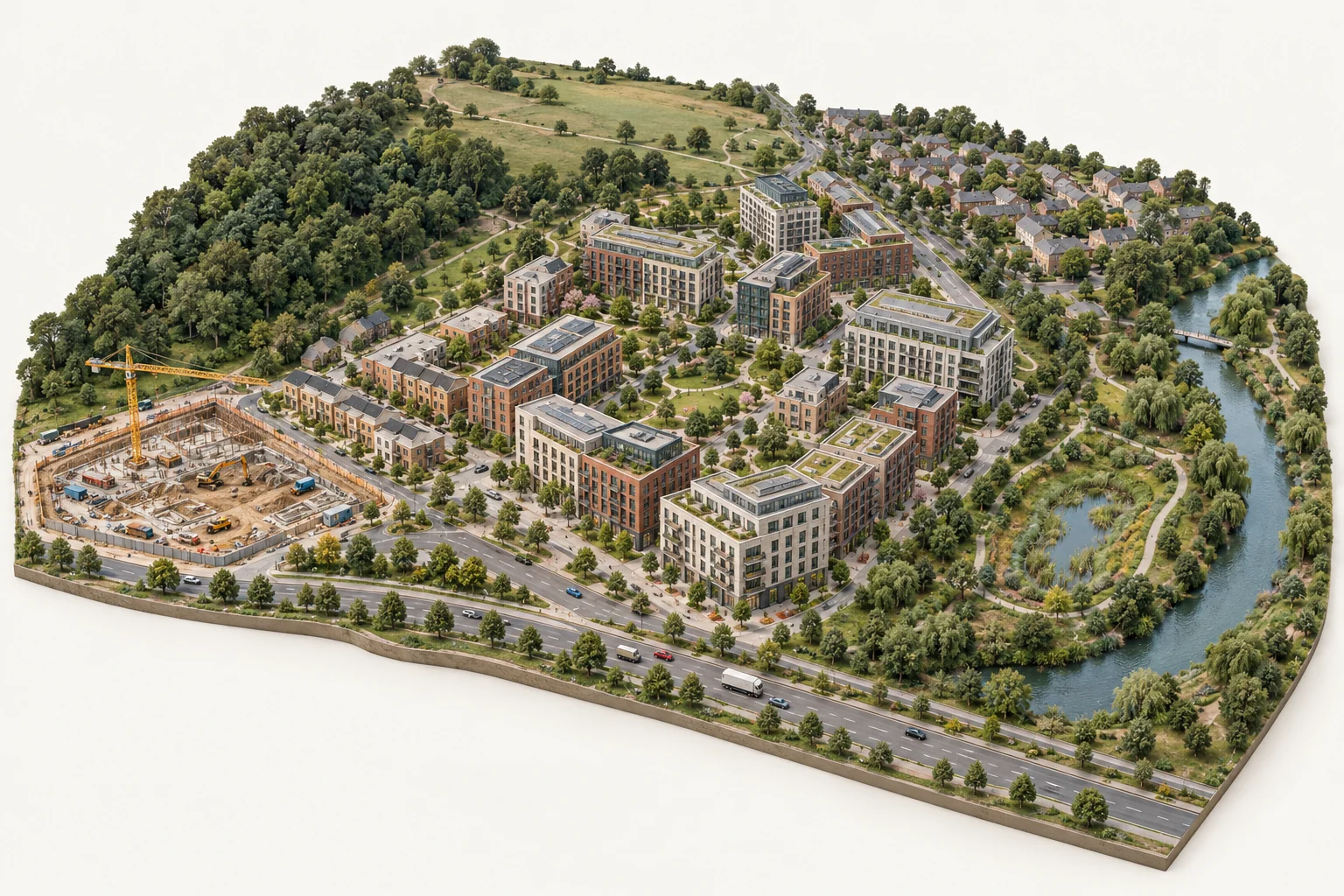
 Illustrative mixed-use urban extension
Topics to consider. Screening and scoping determine what this project would need.
Start with the right question
Does your project need environmental impact assessment?
Environmental impact assessment (EIA) examines likely significant environmental effects before a development decision.
For town and country planning in England, Schedule 1 development requires EIA. By contrast, Schedule 2 proposals need consideration against the relevant criteria, thresholds and sensitive-area provisions. In short, screening establishes whether EIA is required; a threshold alone does not settle that question.
If you are unsure, send us the project description and any planning advice you have received. First, we can discuss the assessment route and the information needed to take it forward.
Read the government’s EIA guidance. Other consent regimes and UK jurisdictions have their own requirements.
Support matched to your stage
Environmental impact assessment support
For example, you may need help with one stage or with the wider assessment. Together, we agree the scope around your proposal, current evidence and next decision.
EIA screening
Bring together the site plan, development description and relevant environmental information. Then we can prepare supporting screening material and address gaps in the project brief.
A clear evidence package for the screening request. However, the planning authority or Secretary of State makes the formal determination.
EIA scoping
Identify the issues to assess, the methods to discuss and the information each specialist needs. Next, we help organise the scoping report and coordinate responses.
A focused assessment brief and programme. A formal scoping opinion can guide the work, although requesting one is optional.
Environmental Statement coordination
Align the project description, specialist chapters, drawings and assumptions. Then bring the findings, mitigation and non-technical summary into a coherent submission.
A coordinated Environmental Statement package, with responsibilities, document versions and outstanding actions clearly tracked.
For a changing project, we can also discuss further information, assessment updates and the evidence behind proposed construction controls.
Tell us which stage you need help withSee the whole route
How environmental impact assessment works
Environmental impact assessment informs a project as it develops. As a result, consultation, design changes and new evidence can send the team back to earlier questions.
- 01
EIA screening
Check whether EIA is required and identify the relevant consent regime.
- 02
EIA scoping
Next, identify likely significant effects, relevant topics and the evidence needed. However, a formal scoping opinion is optional.
- 03
Assess & refine
Then investigate the baseline, predict effects and review alternatives and mitigation with the design team.
- 04
Prepare the statement
After that, coordinate the findings, supporting documents and non-technical summary for submission.
- 05
EIA consultation
The authority consults on the application and environmental information. Consequently, responses may identify a need for further information.
- 06
EIA decision & delivery
The decision-maker considers the environmental information. If consent is granted, relevant conditions and commitments guide delivery.
Original process graphic · Typical town and country planning route in England. Each project needs an agreed programme.
The value of coordination
Different assessments.
One consistent proposal.
A set of separate reports does not automatically describe the same project.
Building heights, operating hours, construction phases and access arrangements can affect several assessments at once. Therefore, we establish shared assumptions and track design changes across the evidence.
As a result, the team can identify gaps, resolve inconsistencies and understand which conclusions need review when the proposal changes.
Ecology & biodiversity
Connect habitat and species evidence with the layout and construction approach. However, keep the roles of EIA and BNG clear.
Ecology surveysHow BNG and EIA fit togetherAir, noise & land
Share relevant receptors, development assumptions and scenarios across pollution and ground-condition assessments.
Air quality assessmentNoise surveys and assessmentsContaminated land assessmentHealth & other interfaces
Consider health and wellbeing alongside the other topics relevant to the agreed EIA scope. Also coordinate inputs from the wider project team.
Health impact assessmentPlanning and development servicesLook beyond the site boundary
EIA topic checklist
Use these prompts to start a proportionate review. In particular, the proposal, location and likely significant effects determine the scope. However, every topic does not automatically need a separate assessment or chapter.
Population & human health
Communities, vulnerable groups, wellbeing and access to local facilities.
Ecology & biodiversity
Habitats, species, protected sites and ecological connections.
Land, soil & ground
Land take, soil quality, contamination and ground stability.
Water & flood risk
Surface water, groundwater, drainage, water quality and flooding.
Air quality & dust
Construction dust, emissions, odour and sensitive nearby uses.
Noise, vibration & light
Construction and operational disturbance, including artificial lighting.
Traffic & access
Vehicle movements, public routes, congestion and safe access.
Landscape & visual effects
Landscape character, townscape, views and visual receptors.
Archaeology & cultural heritage
Buried remains, historic buildings, landscapes and their settings; designated and undesignated assets.
Climate change
Greenhouse gas emissions and resilience to future climate conditions.
Resources, waste & assets
Materials, energy, water demand, waste and existing infrastructure.
Major accidents & disasters
Relevant hazards, project vulnerability and consequences for people or the environment.
Consider relevant construction, operation and decommissioning phases, interactions between effects, and cumulative effects with existing or approved development. Therefore, record why a topic is included or excluded.
Informed by the Planning Inspectorate’s EIA screening checklist and Historic England’s Planning and Archaeology advice. These prompts support an initial review; they do not replace a screening decision or project-specific scoping.
What makes the assessment useful
EIA evidence: from baseline to conclusions
An impact is a change. In contrast, the assessment explains what that change means for the people, places and environmental features affected.
Good environmental impact assessment coordination makes the reasoning visible. Specifically, it connects the baseline, assessment methods, design response and effects that remain after mitigation.
See a design-change exampleConsider construction and operation separately. Also include decommissioning where relevant, and distinguish temporary effects from lasting changes.
Look beyond the site boundary too. For example, cumulative assessment considers relevant effects alongside other existing or approved projects. Similarly, several effects from one proposal can interact at the same receptor.
Significance needs a justified, topic-appropriate method and professional judgement. Therefore, a single generic score cannot replace that reasoning.
Baseline & receptors
Describe current conditions and the people or environmental features that may be affected. Also explain data gaps and relevant future conditions without the development.
Effects & significance
Explain the scale, duration and likelihood of change alongside receptor sensitivity. In each case, state the method, assumptions and uncertainty behind each conclusion.
Alternatives & mitigation
Explain reasonable alternatives studied. First, consider how design can avoid or reduce adverse effects, then identify any further measures needed.
Residual effects & follow-through
Set out the effects that remain after mitigation. Then identify responsibilities and appropriate monitoring, so commitments can be carried into delivery.
Make the connections visible
EIA example: a changed access route
Imagine a redevelopment team moving its construction access closer to homes and an existing habitat edge. As a result, the coordinator needs to trace that change through the evidence.
Original coordination exampleHypothetical layout. No predicted impact or significance is shown.
Describe the change
Record the revised route, vehicle assumptions, working hours and drawing version. Also keep the original information available for comparison.
Check the connected assessments
Ask whether the route changes exposure at nearby homes or affects habitat. Then review the relevant noise, dust, ecology and access assumptions together.
Carry the response into delivery
Update affected drawings, assessment text and construction commitments together. Finally, check the effects that remain after any revised controls.
Moving a route closer to a receptor does not, by itself, establish a significant effect. Instead, the evidence and assessment method determine the conclusion.
Make the output useful
What should the Environmental Statement explain?
The statement should explain the proposal, its likely significant effects and the measures intended to address adverse effects. It also describes relevant reasonable alternatives studied and the reasons for the chosen option.
A non-technical summary makes the key information accessible. In addition, the Regulations require competent experts and a statement of their relevant expertise or qualifications.
Regulation 18 sets out the core requirements. However, the final package depends on the project and applicable assessment scope.
Keep the package connected
- Project description: a consistent account of the proposed development.
- Evidence and methods: traceable sources, assumptions and limitations.
- Assessment findings: clear conclusions and relevant interactions.
- Mitigation: commitments connected to drawings and delivery responsibilities.
- Submission documents: aligned chapters, appendices and a non-technical summary.
Beyond the assessment
Carry EIA commitments into construction
Assessment commitments need a practical route into site instructions. For example, a construction environmental management plan (CEMP) can organise relevant controls, responsibilities, inspections and reporting.
Discuss the planning conditions, assessment commitments and contractor information together. A CEMP may also be needed for a project that does not require EIA.
Discuss your construction environmental requirementsPlan the work early
What affects EIA fees and timescales?
Environmental impact assessment costs and timescales depend on what needs to be assessed, surveyed and coordinated.
The fee depends on the task, complexity and evidence already available. For example, a screening request has a different scope from coordinating a full Environmental Statement.
Meanwhile, survey seasons, design changes, consultation and additional information can affect delivery. Agree the dependencies early and distinguish assessment preparation from the authority’s decision timetable.
Prepare the information for a scoped quotationFour questions that shape the scope
- What decision comes next?
- Screening, scoping, submission or a response to new information.
- What evidence can we use?
- Existing reports, survey coverage, data age and limitations.
- What could change?
- Layout, construction methods, operational assumptions or phasing.
- What must the programme allow for?
- Specialist work, access, seasonal surveys, design reviews and consultation.
Working with ACP
Working with our EIA consultants
Before appointing an EIA consultant, agree what the work includes and how the team will manage it. A useful brief makes these three things clear.
Deliverables & exclusions
Identify the documents, specialist assessments and review stages included in the appointment. Also record what relies on information from others.
Who coordinates what
Agree responsibility for the project description, shared assumptions, technical chapters and document versions. In particular, make gaps and unresolved decisions visible.
Programme & change control
Allow for surveys, design reviews and consultation. Then agree how a change to the proposal will trigger a review of affected evidence.
Prepare for the conversation
Build your EIA project brief
Choose the task you want to discuss and the information you already have. Then use the checklist to prepare your enquiry.
Your starting point
A useful brief starts with the basics
Gather the site location, proposal, planning stage and any authority request. If information is missing, note the gap so it can be discussed.
- Identify the site and relevant planning authority.
- Describe the proposed works and current planning stage.
- Bring any council correspondence and existing assessments.
This preparation aid does not determine whether EIA is required or set the assessment scope. It runs in your browser and does not send or save your information. Sending an enquiry is a separate step.
Before you commission
EIA questions, answered
For advice on a particular proposal, share the site details and the planning question you need to resolve.
Is an EIA the same as an Environmental Statement?
No. EIA is the assessment and decision-making process. Instead, the Environmental Statement presents the developer’s environmental information within that process. An “EIA report” often refers to this statement; confirm the precise document the authority needs.
Who decides whether EIA is required?
The relevant planning authority normally makes the screening decision. However, the Secretary of State can also issue a direction. In either case, ACP can support the request and its evidence.
Do I need an EIA if the site is below a threshold?
A threshold is only part of the screening framework. In addition, sensitive-area provisions and the proposal’s likely significant effects also need consideration. Share the site location and development description so the applicable route can be discussed.
Can existing reports be used?
They may provide useful evidence. However, the team needs to review their scope, age, methods and relationship to the current proposal. Therefore, send the reports alongside your latest drawings so any gaps can be identified.
What if the design changes during the assessment?
Record the change and tell the coordinator before relying on earlier conclusions. Then relevant specialists can review the implications and identify which assessments, drawings or commitments need updating.
Does a CEMP replace an Environmental Statement?
No. A CEMP addresses construction controls and delivery arrangements. For example, it can help implement relevant commitments, but it does not replace the environmental assessment or its reporting.
Does EIA replace BNG or health impact assessment?
No. These address different requirements and questions. Nevertheless, coordinate shared evidence where useful, while keeping the relevant assessment methods and outputs distinct. See our BNG and EIA guide and health impact assessment service.
Are Environmental Outcomes Reports replacing EIA?
The government’s March 2026 roadmap aims to introduce Environmental Outcomes Reports by the end of 2027. However, that timetable does not itself replace the current EIA requirements. Therefore, check the applicable rules for your project as reforms progress. Read the official roadmap.
Sources and scope
Clear guidance, with context.
England-focused commissioning guidance. Core sources checked on 24 October 2026; topic checklist and archaeology guidance checked on 25 October 2026.
- GOV.UK: Environmental Impact Assessment — the planning process and screening/scoping guidance.
- 2017 EIA Regulations, regulation 18 — Environmental Statement requirements.
- EIA Regulations, Schedule 4 — baseline, alternatives, effects, mitigation and supporting information.
- Environmental Outcomes Reports roadmap — reform intentions and timetable.
This page explains common commissioning considerations for town and country planning in England. The applicable requirements depend on the proposal, location and consent route. Other regimes and UK jurisdictions need separate consideration. Examples and the brief builder support preparation; project-specific advice follows an agreed scope.