Outer ear and tragus
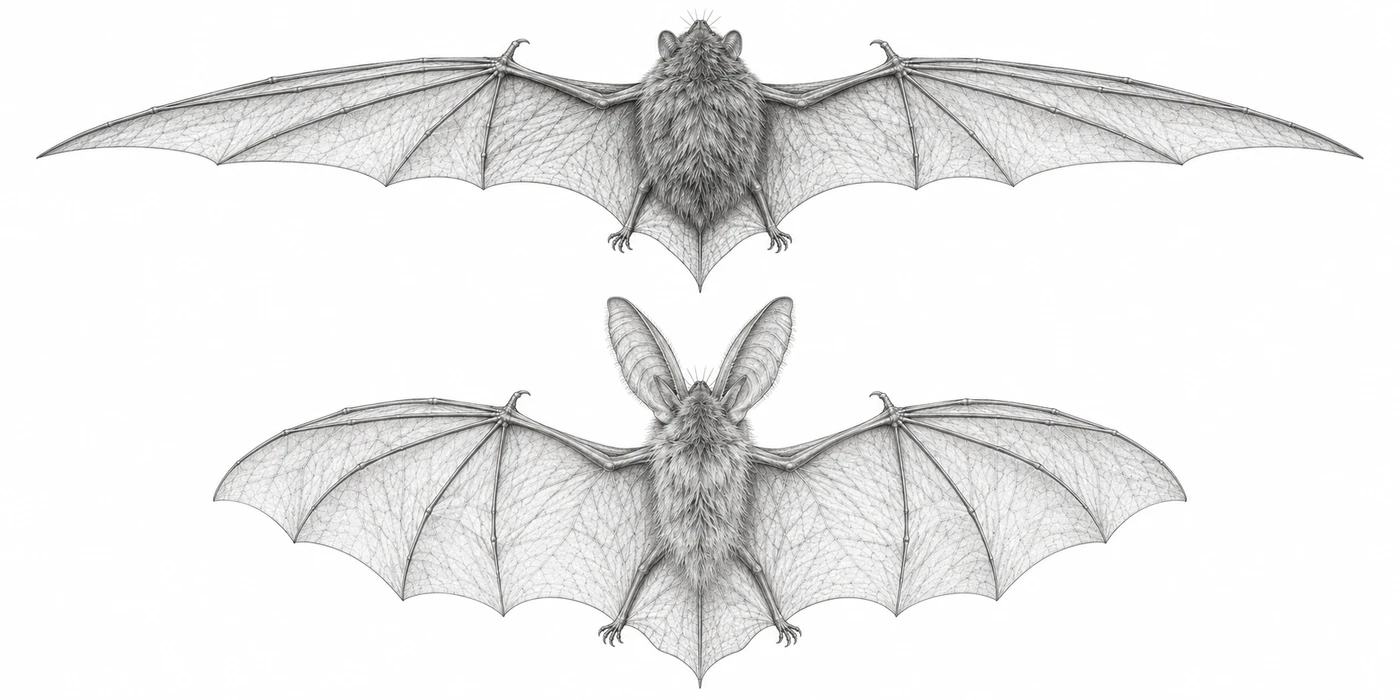
The outer ear collects returning sound. The tragus is the smaller projection within its opening, not a second ear. Specialists use its shape alongside other evidence.
The outer ear collects returning sound. The tragus is the smaller projection within its opening, not a second ear. Specialists use its shape alongside other evidence.

Prominent ears suit listening for faint sounds, including prey-generated noise. Brown and grey long-eared bats remain difficult to separate; large ears alone do not identify the species.

Horseshoe bats direct nasal echolocation through a complex facial structure. Their noseleaf differs from a pipistrelle's plain muzzle. Greater and lesser horseshoes still need appropriate evidence.

Barbastelles have broad ears joined at their bases. This is a useful group-level visual clue. Bechstein's bat also has large ears, but a different head structure.
Forearm reference range: 30–35 mm
A small bat with short ears, a compact muzzle and usually dark facial skin. Its forearm reference range is 30–35 mm. This is a measurement made by trained workers, not a scale that can be estimated reliably from a flying bat or thumbnail illustration.
Common pipistrelles catch small flying insects over gardens, hedges, woodland margins, farmland and urban greenspace. Agile turns and short feeding circuits are useful observations. Summer roosts often occupy narrow building crevices; trees and bat boxes are also used. A tiny entrance can lead to a much larger hidden roosting space.
Common and soprano pipistrelles overlap strongly in appearance. Examine several good calls, their structure and recording context; retain an uncertain pipistrelle label when evidence is insufficient. A frequency peak alone neither identifies a roost entrance nor establishes how that roost is used.
Females form summer maternity groups, generally producing one pup in June or early July. Maternity groups may change roost. Males defend mating territories later in summer and autumn. Winter records include building and tree crevices. These are typical patterns; weather, latitude and the particular roost alter timing.
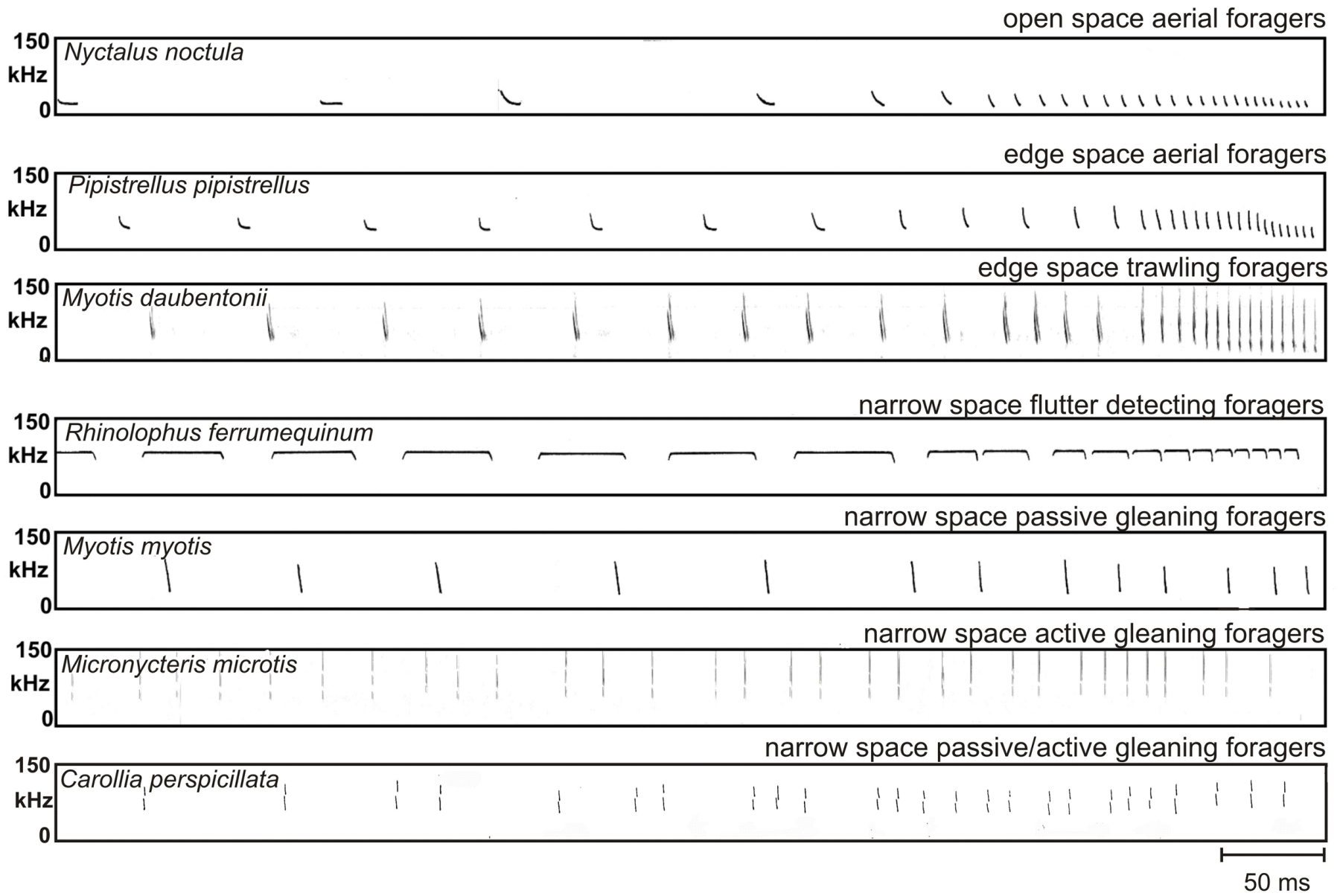
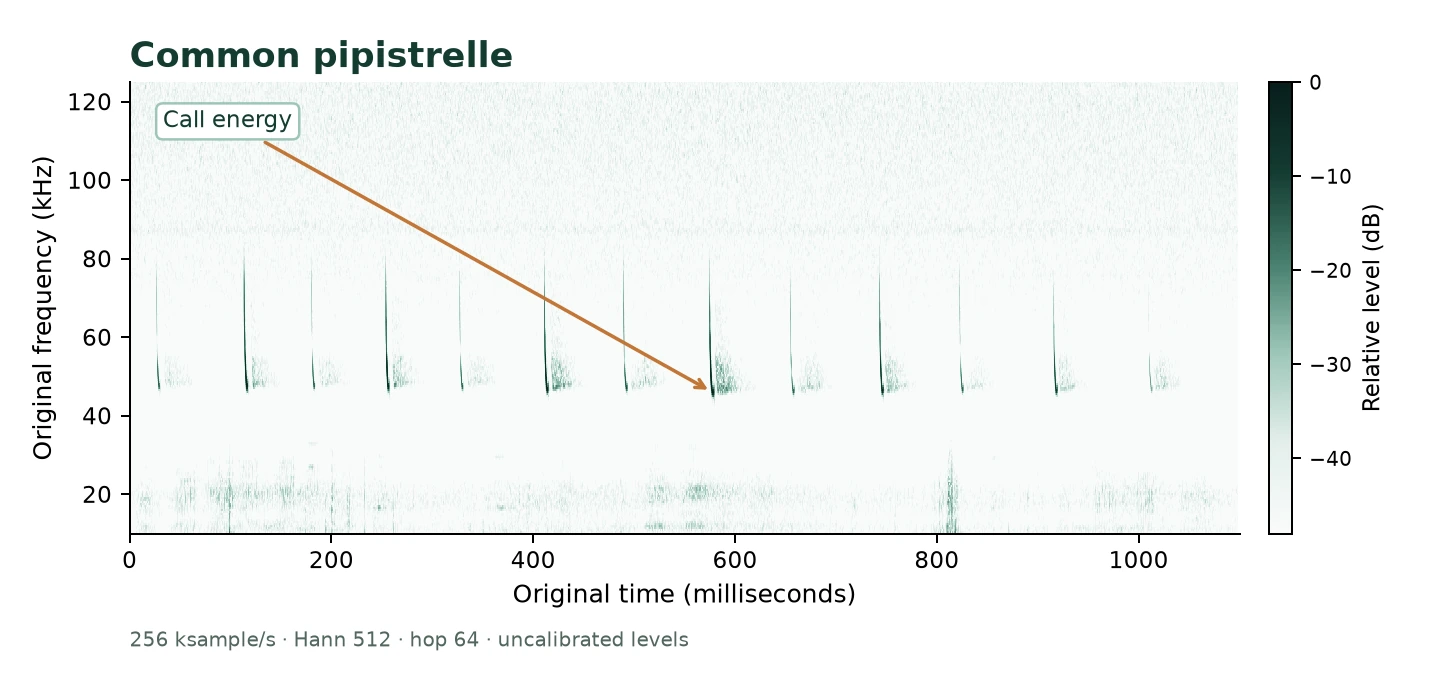
Search-flight echolocation often has its strongest energy near 45 kHz, with a falling sweep and flatter tail in suitable open conditions. That familiar frequency is a clue, not a verdict. Near obstacles, calls can become shorter and more steeply modulated.
Male songflights form part of mating behaviour. However, a 2020 field study also linked short, high-frequency social calls to chasing and food-patch defence. Consequently, a social call recorded over a feeding area should not automatically be labelled courtship.
Evidence: Bat Conservation Trust: Common pipistrelle Götze, Denzinger & Schnitzler (2020), high-frequency social calls
Recording credit: (c) Uploads from the Somerset Bat Groups events and members, some rights reserved (CC BY)
10× slower · 11.0 seconds
Hear regularly spaced clicks when slowed. The measured calls sweep down towards a flatter tail. This field sequence has greatest energy near 47.5 kHz within the stated analysis band; “45 kHz bat” is a shorthand, not a fixed identity test.
(c) Uploads from the Somerset Bat Groups events and members, some rights reserved (CC BY) · CC BY 4.0. Recorded in United Kingdom; this is not an ACP project recording. iNaturalist research; community identification, not independent ACP confirmation.
Original 256 ksample/s; channel 1. Excerpt 6.526–7.626 seconds. Playback is 10× slower, with frequency divided by ten and duration multiplied by ten. Gain was normalised, then resampled to 32 kHz for MP3. No denoising was applied.
The spectrogram uses original samples, a 512-sample Hann window and a 64-sample hop. Levels are relative to the strongest plotted component, not calibrated dB SPL. Original files and processing records are retained.

Forearm reference range: 29–34 mm
A small, short-eared pipistrelle with a 29–34 mm reference forearm range. Facial skin may look paler than in common pipistrelle, but colour and subtle proportions cannot establish identification from a distant view.
Soprano pipistrelles frequently feed around rivers, lakes, wet woodland and connecting vegetation, taking small flies and other airborne prey. They also visit gardens and parks. Building crevices, trees and bat boxes provide roosts; maternity gatherings can be much larger than those commonly reported for common pipistrelle.
Water-associated habitat increases plausibility but is not diagnostic. Common pipistrelles also visit water, and soprano pipistrelles use other settings. Record observed behaviour and acoustic evidence separately so an attractive habitat description does not become an unsupported species identification.
Females normally give birth to one pup in June or early July. Young subsequently learn to fly and forage while adults meet the energetic demands of lactation. Males advertise mating territories later in summer. Winter records include building or tree crevices; an empty summer count does not establish winter absence.
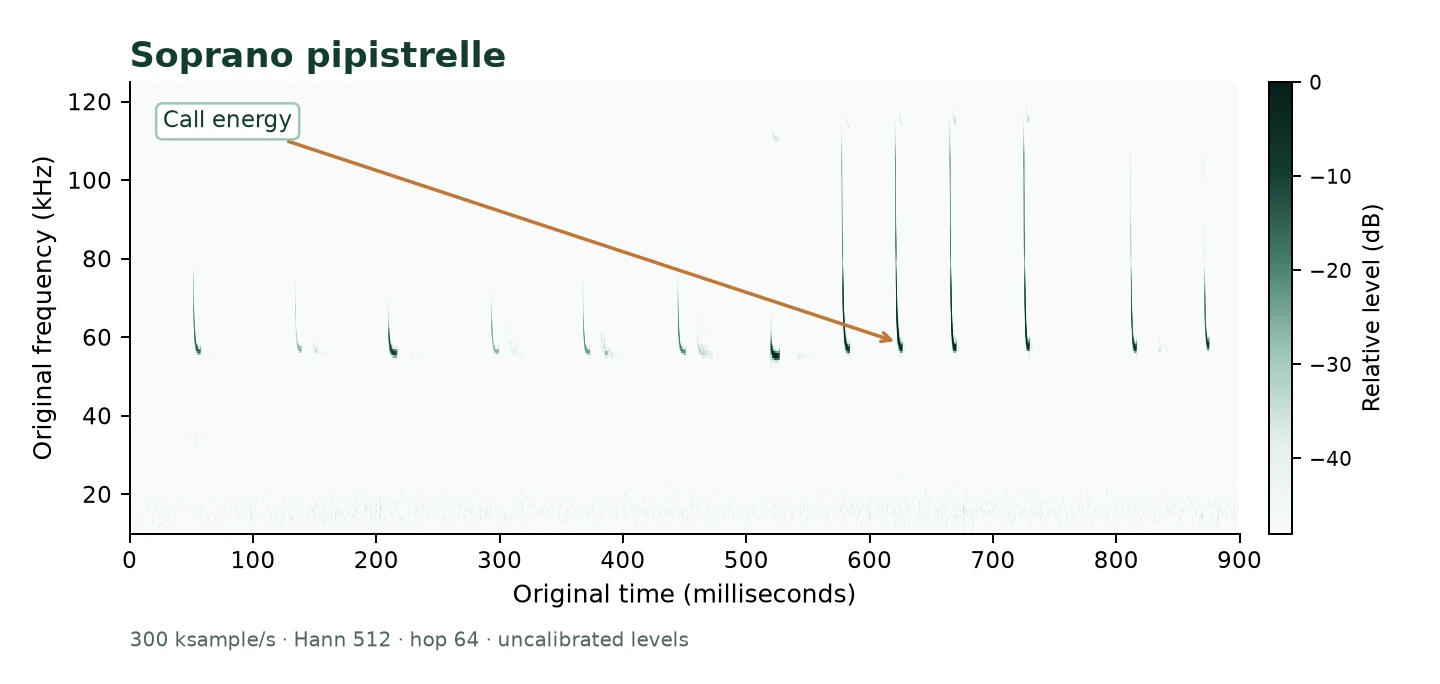
Suitable search-flight sequences often concentrate energy near 55 kHz. Examine sweep, duration and the changing sequence together. Short cluttered calls are poor material for a simple “45 versus 55” rule.
Male songflights and repeated social calls occur around mating territories. Echolocation and social calls serve different immediate purposes, although other bats can obtain information from both. This account does not assign a mating function to every complex call recorded during the active season.
Evidence: Bat Conservation Trust: Soprano pipistrelle
Recording credit: Jespersen, Docherty, Albertsen, Hallam & Jakobsen (2022)
10× slower · 9.0 seconds
Compare these downward sweeps with the common pipistrelle example. Their lower portion sits higher on the frequency scale. This excerpt peaks near 58 kHz in the analysis band, illustrating why the familiar “55 kHz” label is approximate.
Jespersen, Docherty, Albertsen, Hallam & Jakobsen (2022) · CC BY 4.0. Recorded in Denmark; this is not an ACP project recording. Species label from published research dataset; not independently confirmed by ACP.
Original 300 ksample/s; channel 3. Excerpt 5.550–6.450 seconds. Playback is 10× slower, with frequency divided by ten and duration multiplied by ten. Gain was normalised, then resampled to 32 kHz for MP3. No denoising was applied.
The spectrogram uses original samples, a 512-sample Hann window and a 64-sample hop. Levels are relative to the strongest plotted component, not calibrated dB SPL. Original files and processing records are retained.

Forearm reference range: 32–38 mm
A relatively robust pipistrelle with a 32–38 mm reference forearm range, reddish-brown fur and usually dark facial skin. Its size overlaps other pipistrelles. A head sketch illustrates broad proportions but cannot show all the fine characters needed to distinguish an unfamiliar individual.
It often hunts around substantial freshwater bodies, wet woodland, river corridors and woodland edges. Prey includes aquatic flies and other flying insects. Roosts occur in tree and building crevices. Some British maternity sites have been shared with soprano pipistrelles, so one roost can contain more than one species.
Combine acoustic structure, possible social song, habitat and independent evidence. Do not infer migration direction or distance from one detector pass. The same recording cannot establish whether a nearby building contains a breeding colony, a mating site or a temporary resting bat.
The species is migratory, but it also breeds in the UK. A local record therefore cannot automatically be dismissed as a migrant passing through. Maternity activity occurs in summer; male advertisement and seasonal movements are conspicuous later in the year. British winter roost knowledge remains incomplete.
Search-flight calls often peak around 38 kHz in appropriate sequences, lower than typical common and soprano pipistrelle examples. Frequency overlap, call context and recording quality still matter. Use several clean calls and retain the original recording for specialist review.
Males produce complex advertisement songs from roosts and in flight. Russ and Racey’s Northern Ireland study found species-specific responses and variation between individuals and sites. This supports a communication role; it does not translate each recorded phrase into a certain human-language meaning.
Evidence: Bat Conservation Trust: Nathusius’ pipistrelle Russ & Racey (2007), male Nathusius’ pipistrelle song
Open recording XC1033967 by Christian Kahle
Field recording with other bat species also reported in the background. Species identity is the source label; ACP has not independently confirmed it.
This mixed-species recording is provided at its original source; it is not treated as an isolated diagnostic call. Source licence: CC0. Use the archive’s slowed playback where supplied; ordinary playback can omit ultrasound.
Forearm reference range: 34–42 mm
The ears are strikingly long, but a resting bat may fold them back or tuck them beneath its wings. The visible upright projection can be the tragus rather than the whole ear. Reference forearm length is 34–42 mm; broad wings and a broad tail membrane support slow manoeuvring.
Brown long-eared bats hunt around woodland, orchards and other vegetation, taking prey from surfaces as well as in flight. Sensitive hearing helps them locate insect movements. Larger moths may be carried to a feeding perch, leaving discarded wings. Such remains are evidence to interpret, not an automatic species identification.
Grey long-eared bats are a close visual comparison, and juvenile brown long-eared bats may look grey. Colour alone is inadequate. Record useful features without approaching or disturbing the bat; reliable separation can require specialist anatomical or genetic evidence.
Small maternity groups occupy suitable buildings and trees in summer; males may be present too. A single pup is usually born around late June or July. Mating occurs in autumn and can continue during winter activity. Underground shelters, buildings and trees can provide winter roosts.
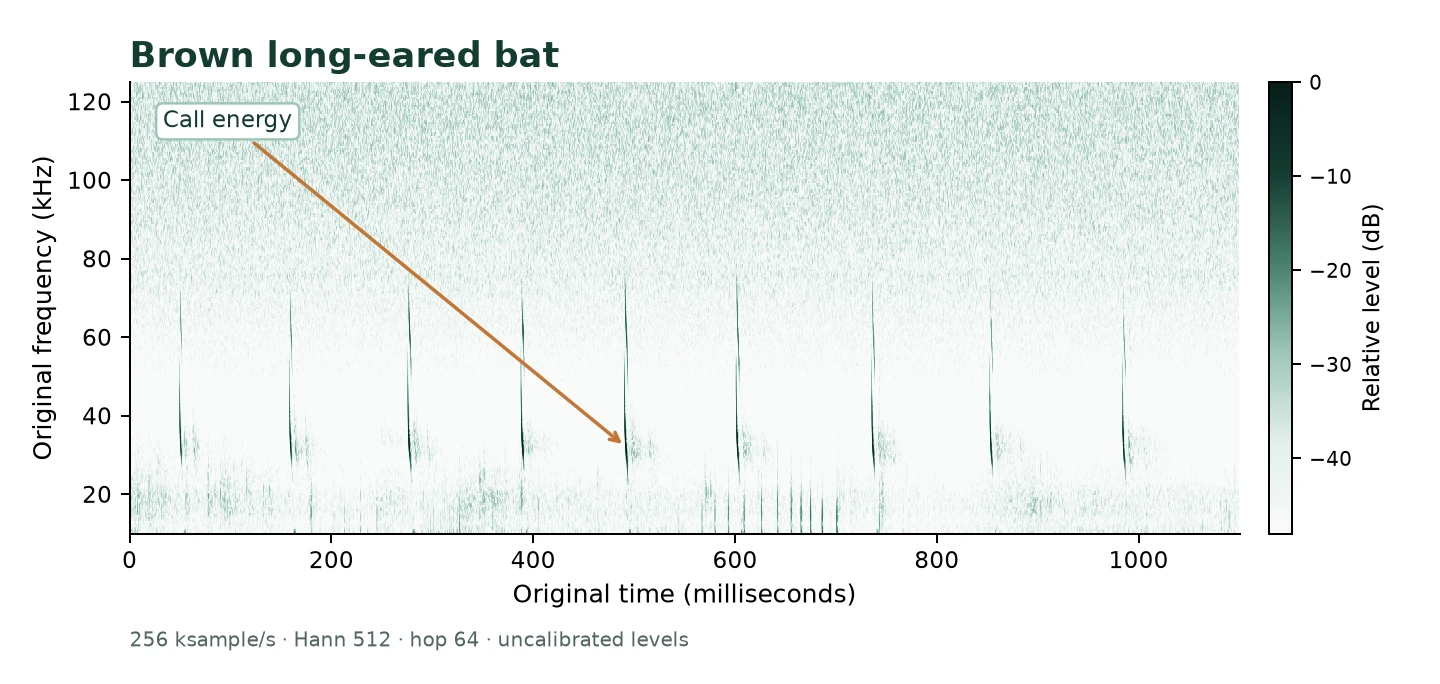
Quiet, broadband echolocation can be missed by a detector that records louder species well. Absence of acoustic records is therefore weak evidence of absence. A clear recording may show more than one harmonic; parallel traces do not necessarily represent several bats.
Furmankiewicz and Jones tested calls at maternity roosts. Returning bats responded more to social and echolocation playback than to control noise. The researchers interpreted social calling as helping maintain associations among familiar roostmates, rather than simply announcing a new roost.
Evidence: Bat Conservation Trust: Brown long-eared bat Furmankiewicz & Jones (2022), contact calls among roostmates
Recording credit: (c) Uploads from the Somerset Bat Groups events and members, some rights reserved (CC BY)
10× slower · 11.0 seconds
Broad downward sweeps and faint calls illustrate why long-eared bats can be difficult to detect. This community-labelled example does not provide a reliable sound-only distinction from grey long-eared bat.
(c) Uploads from the Somerset Bat Groups events and members, some rights reserved (CC BY) · CC BY 4.0. Recorded in United Kingdom; this is not an ACP project recording. iNaturalist research; community identification, not independent ACP confirmation.
Original 256 ksample/s; channel 1. Excerpt 1.553–2.653 seconds. Playback is 10× slower, with frequency divided by ten and duration multiplied by ten. Gain was normalised, then resampled to 32 kHz for MP3. No denoising was applied.
The spectrogram uses original samples, a 512-sample Hann window and a 64-sample hop. Levels are relative to the strongest plotted component, not calibrated dB SPL. Original files and processing records are retained.

Forearm reference range: 37–45 mm
A long-eared bat with a 37–45 mm reference forearm range and often a darker, longer-looking muzzle than brown long-eared bat. Both species can fold their ears away. Thumb proportions, tragus characters and other fine features matter more than a simple grey-versus-brown colour rule.
British populations are concentrated in southern England. Foraging studies associate the species with grassland, meadows, gardens and woodland edges, where it catches moths and other insects. Large older roof voids are important roosts, but bats may conceal themselves beside timbers rather than remain visible in the open.
Because this is a rare species, apparently persuasive photographs deserve careful checking. Do not use its restricted known range to rule it out absolutely, or use a grey face to confirm it. Preserve evidence and seek appropriate specialist verification before attaching a definite name.
Breeding groups gather in spring; a single pup is generally born around late June or early July. Males can occur within maternity groups. Buildings may remain relevant outside summer, and underground winter records also occur. A seasonal calendar should show changing use rather than an assumed empty period.
Echolocation is quiet and overlaps other long-eared bats. Detectors can under-record activity, while a noisy or distant sequence may lose important structure. A low number of passes is not directly comparable with the same number from a louder open-air species.
Social calls can add evidence, but not every long-eared vocalisation separates the British species. A proposed identification needs a recognised call type and adequate supporting context.
Evidence: Bat Conservation Trust: Grey long-eared bat Middleton, Froud & French (2022), Social Calls survey guidelines.
Open recording XC844370 by Adrià López-Baucells
Hand-release recording: calls close to release can differ from undisturbed search flight. Species identity is the source label; ACP has not independently confirmed it.
This recording is linked at its source because its non-commercial licence does not grant ACP commercial reuse. Source licence: CC-BY-NC-ND. Use the archive’s slowed playback where supplied; ordinary playback can omit ultrasound.

Forearm reference range: 34–41 mm
A medium-sized Myotis with relatively large feet, a pinkish face and a 34–41 mm reference forearm range. The feet and tail membrane are functionally important when taking prey close to water. The anatomical drawing explains this feeding adaptation rather than suggesting that face shape alone is diagnostic.
Low, repeated flights over relatively smooth water are a familiar clue. Bats take insects in the air and at the surface, including aquatic midges. Trees, bridges, tunnels and other structures can provide roosts. The wider landscape matters: water, sheltered flight lines and suitable roosts need to work together.
Distinguish observed trawling behaviour, a probable acoustic identification and a confirmed roost record. Those are different levels of evidence. Record water conditions and flight height as well as the sound file; neither an isolated sweep nor a rippling surface is a complete identification.
Maternity groups occupy summer roosts, while males and non-breeding females can form separate gatherings. Autumn mating and swarming connect seasonal populations. Many winter records come from underground sites, where bats may hide deep in crevices. A visible count can underestimate the bats using a site.
Echolocation consists of rapidly repeated broadband sweeps. Rhythm and water-surface behaviour support interpretation, but other species also drink or hunt over water. Call recordings need examination in context, especially when the microphone misses the high-frequency beginning of a pulse.
A 2022 laboratory study of Daubenton’s larynges demonstrated different vibrating structures for high-frequency sounds and very low-frequency agonistic vocalisations. This explains how one bat can produce very different calls. It does not mean a detector can assign every growl to an observed argument.
Evidence: Bat Conservation Trust: Daubenton’s bat Håkansson et al. (2022), laryngeal structures and vocal range
Recording credit: (c) Uploads from the Somerset Bat Groups events and members, some rights reserved (CC BY)
10× slower · 11.0 seconds
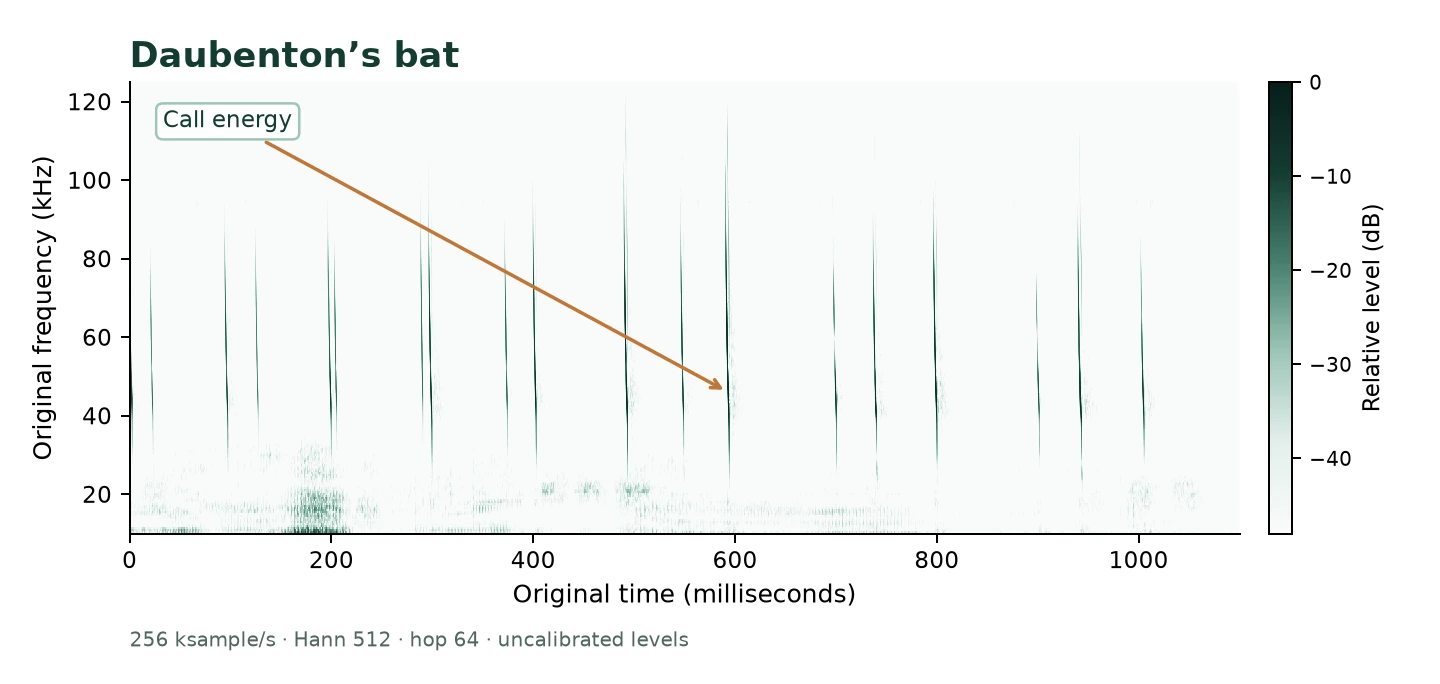
Steep frequency sweeps are visible. The source identifies Daubenton’s bat, but similar Myotis calls overlap. Acoustic shape must be considered with recording context and independent evidence.
(c) Uploads from the Somerset Bat Groups events and members, some rights reserved (CC BY) · CC BY 4.0. Recorded in United Kingdom; this is not an ACP project recording. iNaturalist research; community identification, not independent ACP confirmation.
Original 256 ksample/s; channel 1. Excerpt 1.822–2.922 seconds. Playback is 10× slower, with frequency divided by ten and duration multiplied by ten. Gain was normalised, then resampled to 32 kHz for MP3. No denoising was applied.
The spectrogram uses original samples, a 512-sample Hann window and a 64-sample hop. Levels are relative to the strongest plotted component, not calibrated dB SPL. Original files and processing records are retained.

Forearm reference range: 36–43 mm
A pale-bellied Myotis with a pink face and a 36–43 mm reference forearm range. Broad wings and the tail membrane aid manoeuvring near vegetation. Close anatomical characters require specialist observation; they are not a reason to handle a bat encountered in a building or winter site.
It often searches among trees and foliage, taking prey from surfaces as well as in flight. Diet can include spiders and insects that were not flying when captured. Roosts occur in trees, bridges and building crevices, including joints between substantial timbers. The bat can remain almost completely concealed.
Distinguish dawn reunion at a maternity roost from autumn swarming. Similar-looking circling does not establish the same function. Use season, site use, behaviour and acoustic evidence together before describing a gathering as breeding, mating or hibernation activity. Record uncertainty when the observations cannot resolve those alternatives.
Maternity groups form in late spring and may change roost repeatedly. A single pup is typically born around late June or early July. Autumn swarming is important, while mating can also occur in winter. Underground crevices provide hibernation sites, sometimes with bats in unexpectedly angled positions.
Quiet, steep frequency-modulated pulses can resemble other Myotis. A wide frequency sweep is useful descriptive information but not a species diagnosis. Keep clear sequences and examine the full recording rather than selecting one apparently distinctive pulse.
A German field study described four recurring social-call types at a maternity site and an autumn swarming site. Short contact-like calls dominated the maternity setting; variable trills were more frequent in autumn. Suggested functions were inferred from context, not demonstrated for every individual call.
Evidence: Bat Conservation Trust: Natterer’s bat Schmidbauer & Denzinger (2019), social calls during swarming
Recording credit: (c) Uploads from the Somerset Bat Groups events and members, some rights reserved (CC BY)
10× slower · 11.0 seconds
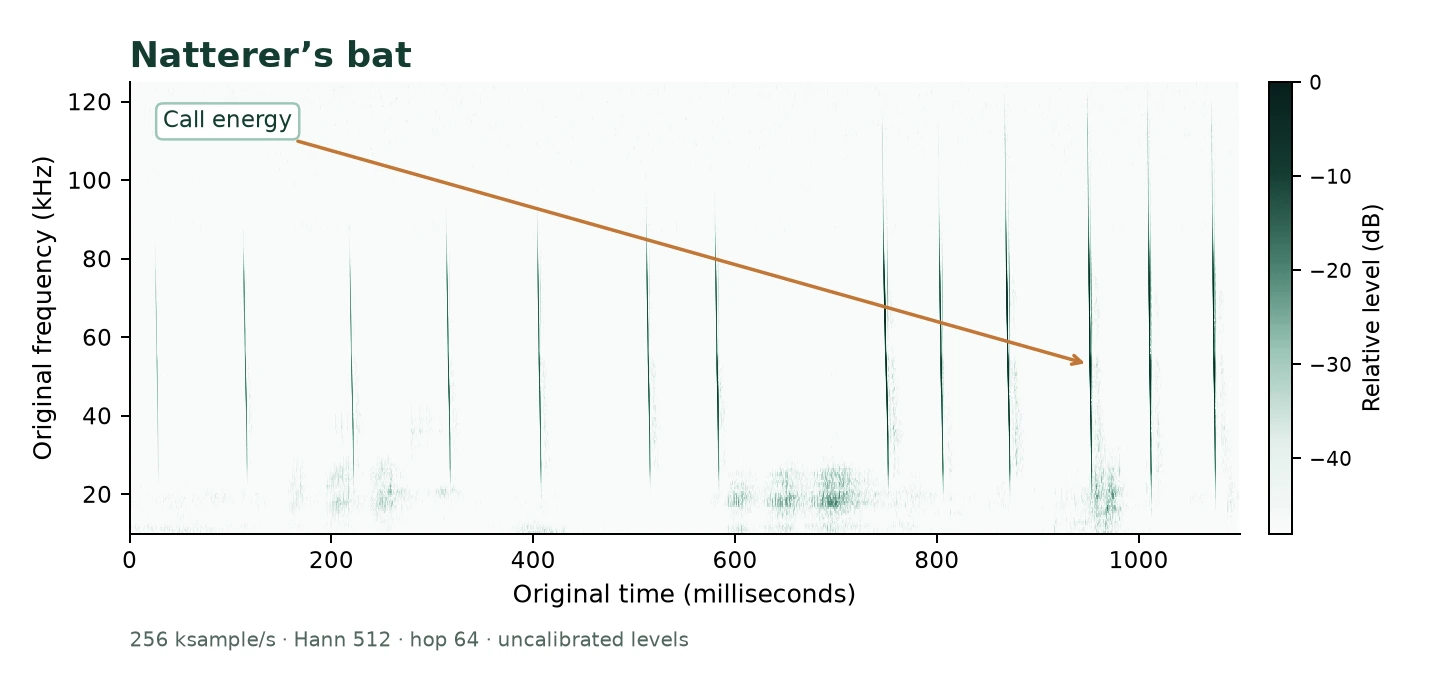
Broad, steep sweeps cover a wide frequency span. These are source-labelled Natterer’s calls, not a universal identification template. A different microphone or angle can hide part of each sweep.
(c) Uploads from the Somerset Bat Groups events and members, some rights reserved (CC BY) · CC BY 4.0. Recorded in United Kingdom; this is not an ACP project recording. iNaturalist research; community identification, not independent ACP confirmation.
Original 256 ksample/s; channel 1. Excerpt 13.899–14.999 seconds. Playback is 10× slower, with frequency divided by ten and duration multiplied by ten. Gain was normalised, then resampled to 32 kHz for MP3. No denoising was applied.
The spectrogram uses original samples, a 512-sample Hann window and a 64-sample hop. Levels are relative to the strongest plotted component, not calibrated dB SPL. Original files and processing records are retained.

Forearm reference range: 30–37 mm
A small Myotis with dark facial features, grey-brown fur and a 30–37 mm reference forearm range. It overlaps Brandt’s and Alcathoe bats in size and appearance. The name does not provide an obvious field mark that a distant observer can use to separate these species.
It often follows woodland edges, hedgerows and repeated feeding routes, taking small insects and sometimes spiders. Building crevices, trees and other sheltered structures provide roosts. Mixed-species use of a building is possible, so droppings beneath one roof do not necessarily come from one species.
A small-Myotis identification can be the most defensible outcome. Keep original files, habitat notes and non-disturbing observations. Do not fill a species field merely because a recording programme offers a name; an unresolved record is scientifically more useful than an unjustified precise one.
Females gather in summer maternity roosts and usually produce one pup around June or early July. Mating occurs mainly in autumn but has also been observed in winter. Caves and tunnels provide known winter sites; the winter whereabouts of much of the population remain uncertain.
Broadband echolocation can sound like dry clicks on a heterodyne detector. Frequency coverage and changing rhythm overlap other small Myotis. A recording near 45 kHz is not sufficient to separate whiskered, Brandt’s or Alcathoe bats, or to distinguish every cluttered pipistrelle call.
Social calls may overlap those of other small Myotis and remain incompletely understood. Distinctive-looking syllables therefore require corroborating evidence.
Evidence: Bat Conservation Trust: Whiskered bat Middleton, Froud & French (2022), Social Calls survey guidelines.
Open recording XC1003031 by Andreas Estensen
Hand-release recording: calls close to release can differ from undisturbed search flight. Species identity is the source label; ACP has not independently confirmed it.
This recording is linked at its source because its non-commercial licence does not grant ACP commercial reuse. Source licence: CC-BY-NC-SA. Use the archive’s slowed playback where supplied; ordinary playback can omit ultrasound.

Forearm reference range: 31–39 mm
A small Myotis with a 31–39 mm reference forearm range. Golden-tipped fur and pinkish facial areas overlap its lookalikes. Fine anatomical characters need specialist examination, sometimes supported by genetics.
Brandt’s bats use woodland and frequently forage near water, taking small insects and occasionally prey from foliage. Trees and buildings provide roosts, including narrow spaces beneath tiles or within walls. A colony may share a building with other species while occupying a different concealed part of it.
Historic records need taxonomic context. The often repeated 42-year longevity record is now attributed by BCT to the separated Siberian species Myotis sibiricus, not automatically to British Brandt’s bats. Likewise, an old “whiskered/Brandt’s” record should retain its original uncertainty unless new evidence resolves it.
Maternity groups raise a single pup per female in summer, with births generally around June or early July. Mating is chiefly associated with autumn, although winter mating has been observed. Known winter shelters include caves and tunnels; many animals may be hidden in crevices.
Echolocation resembles whiskered and Alcathoe bats and overlaps other Myotis in clutter. Call rhythm and frequency range should be described, but they should not be treated as a reliable stand-alone separation. Recording quality cannot remove genuine biological overlap between species.
British social-call guidance cautions against diagnosing the small-Myotis group from social sounds alone. A species-exclusive repertoire or fixed meaning for every trill is not established here.
Evidence: Bat Conservation Trust: Brandt’s bat Middleton, Froud & French (2022), Social Calls survey guidelines.
Open recording XC1003030 by Andreas Estensen
Hand-release recording: calls close to release can differ from undisturbed search flight. Species identity is the source label; ACP has not independently confirmed it.
This recording is linked at its source because its non-commercial licence does not grant ACP commercial reuse. Source licence: CC-BY-NC. Use the archive’s slowed playback where supplied; ordinary playback can omit ultrasound.

Forearm reference range: 29.7–34.6 mm
A very small Myotis with a 29.7–34.6 mm reference forearm range. Mature individuals can show a reddish-brown back and pinkish facial areas. Size overlaps other small Myotis, and the subtle combination of features is poorly represented by a small portrait or an unscaled photograph.
Alcathoe bats are associated with deciduous woodland, often near water, and summer tree roosts are known. Their British presence was established with genetic evidence after similar animals had long been grouped with whiskered or Brandt’s bats. This history reminds us that apparent familiarity does not guarantee correct identification.
BCT’s 2024 monitoring report says these small Myotis cannot be separated visually or acoustically during its standard surveys. Exceptional records need appropriate specialist evidence, often genetic. Preserve the sampling and identification context, and avoid presenting a guessed name as evidence of a new breeding population.
Summer maternity activity and autumn swarming are reported. However, British ecological knowledge is still developing, so a universal local breeding calendar would overstate certainty. Distinguish what has been observed at a particular site from the broader seasonal pattern described for the species.
Calls are frequency-modulated and can overlap other Myotis, particularly in vegetation. A broad high-to-low sweep is not an Alcathoe signature on its own. Identification software should not turn limited or ambiguous recordings into apparently confirmed new distribution records.
Social-call overlap within small Myotis remains incompletely understood. No species-exclusive key is offered here; uncertainty must not be filled with behaviour borrowed from another species.
Evidence: Bat Conservation Trust: Alcathoe bat BCT National Bat Monitoring Programme Annual Report 2024 Middleton, Froud & French (2022), Social Calls survey guidelines.
Open recording XC822581 by Vladimír Nemček
Hand-release recording: calls close to release can differ from undisturbed search flight. Species identity is the source label; ACP has not independently confirmed it.
This recording is linked at its source because its non-commercial licence does not grant ACP commercial reuse. Source licence: CC-BY-NC-SA. Use the archive’s slowed playback where supplied; ordinary playback can omit ultrasound.

Forearm reference range: 38–47 mm
A woodland Myotis with conspicuously large ears, a pinkish face and a 38–47 mm reference forearm range. Its ears differ from the extremely elongated ears of Plecotus. Sensitive hearing supports feeding close to clutter, where listening for prey movements can be valuable.
Mature deciduous woodland supplies feeding areas and networks of tree cavities. Individuals can use several roosts rather than one permanently occupied hole. The practical habitat unit is a connected woodland and roost network, not simply the tree where a bat happened to be recorded.
Frequent movement between roosts does not mean woodland is unimportant when one cavity is empty. Conversely, one probable call does not map the roost network. A defensible interpretation distinguishes confirmed occupancy, likely foraging use and areas requiring targeted evidence. Record the survey method alongside any claimed absence.
Maternity groups form in spring and raise young in summer, often changing tree roosts. Long-term European research describes stable female social communities despite frequent splitting and reunion. Hibernation is poorly observed; trees are thought to be important, and some underground records occur.
Quiet broadband echolocation makes ordinary detector surveys relatively insensitive. Acoustic resemblance to other Myotis adds a separate identification difficulty. Low detectability and uncertain species assignment must both be considered before interpreting a small number of recorded calls.
A 15-year social-genetic study followed long-lived female associations and very limited immigration into established communities. This is evidence about social organisation, not a universal colony-size rule. Social sounds may assist communication, but this account does not claim that every sound reveals group membership.
Evidence: Bat Conservation Trust: Bechstein’s bat Kerth & van Schaik (2012), closed societies in Bechstein’s bats
Open recording XC830023 by Vladimír Nemček
Hand-release recording: calls close to release can differ from undisturbed search flight. Species identity is the source label; ACP has not independently confirmed it.
This recording is linked at its source because its non-commercial licence does not grant ACP commercial reuse. Source licence: CC-BY-NC-SA. Use the archive’s slowed playback where supplied; ordinary playback can omit ultrasound.
Forearm reference range: 35–45 mm
A dark bat with broad ears meeting across the forehead and a short, distinctive muzzle. Reference forearm length is 35–45 mm. This head structure differs strongly from the long-eared and horseshoe groups, although a distant silhouette cannot reveal all the features shown in a close illustration.
Barbastelles hunt mainly moths across wooded landscapes and connected feeding areas. Roosts commonly occur in tree crevices or beneath loose bark, with building records also known. A colony may use multiple roosts, so tree structure and the surrounding network both matter.
Clear sequences and suitable recording geometry matter even for a recognisable species. Retain several calls, the surrounding sequence and survey context. A weak or missing alternate pulse may reflect detection angle; one distinctive-looking trace does not locate a roost or quantify the number present.
Females form maternity groups during summer, while males often roost separately. Colonies can divide and re-form as the season progresses. Winter records include underground shelters and tree or building cavities; activity can occur during mild spells. The timing and visibility of occupation vary between sites.
Characteristic sequences can alternate two echolocation types. A microphone-array study found differently directed emissions associated with the mouth and nose, both of relatively low output. This helps explain why call appearance and strength change with the microphone’s position relative to the bat.
Alternating echolocation pulses should not automatically be labelled two bats or a social exchange. Social vocalisation and sonar are distinct analytical questions. The field study’s proposed roles for the two sonar beams remain interpretations of the measured pattern, not direct translations of bat intent.
Evidence: Bat Conservation Trust: Barbastelle Seibert et al. (2015), bidirectional echolocation
Recording credit: (c) Uploads from the Somerset Bat Groups events and members, some rights reserved (CC BY)
10× slower · 11.0 seconds
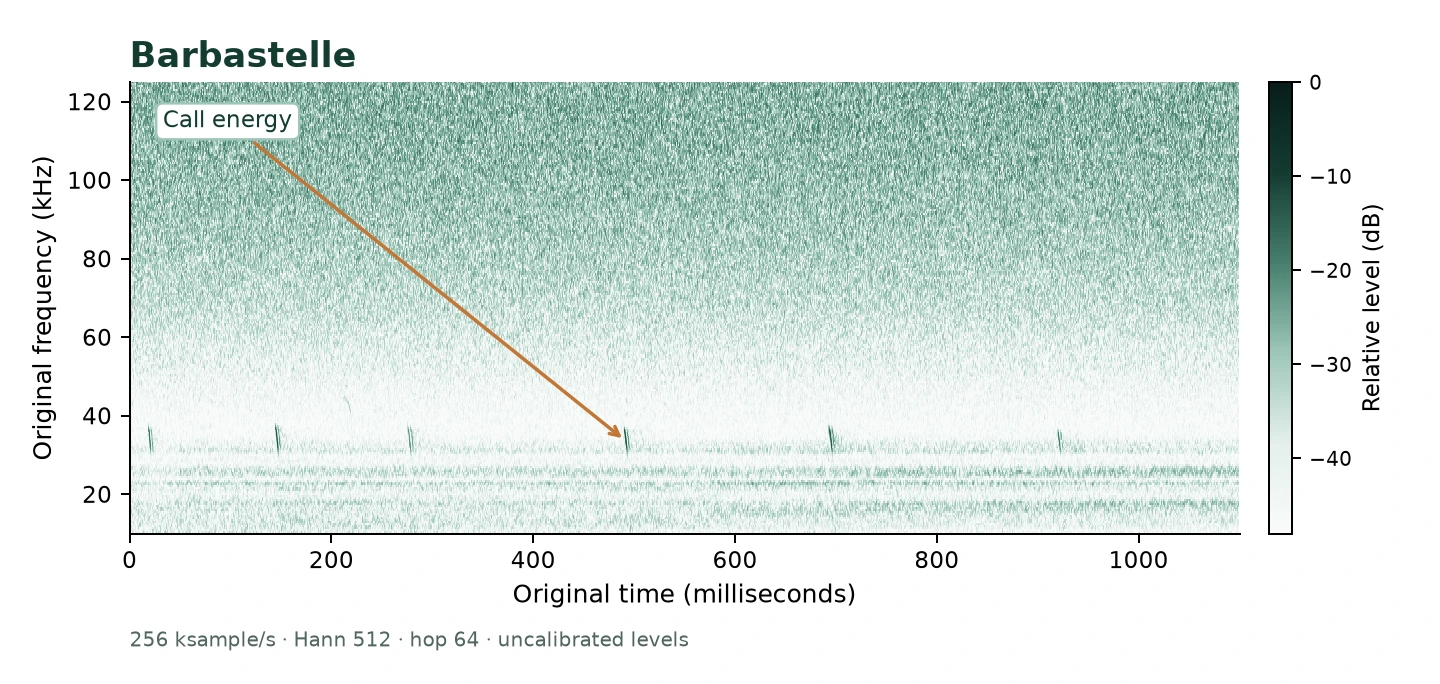
Short pulses are visible against substantial background noise. This is a field recording, not a cleaned reference tone. Compare whole sequences; the strongest spectral band can include background energy.
(c) Uploads from the Somerset Bat Groups events and members, some rights reserved (CC BY) · CC BY 4.0. Recorded in United Kingdom; this is not an ACP project recording. iNaturalist research; community identification, not independent ACP confirmation.
Original 256 ksample/s; channel 1. Excerpt 0.107–1.207 seconds. Playback is 10× slower, with frequency divided by ten and duration multiplied by ten. Gain was normalised, then resampled to 32 kHz for MP3. No denoising was applied.
The spectrogram uses original samples, a 512-sample Hann window and a 64-sample hop. Levels are relative to the strongest plotted component, not calibrated dB SPL. Original files and processing records are retained.

Forearm reference range: 47–52 mm
A large bat with narrow, pointed wings, short ears and a 47–52 mm reference forearm range. Often powerful and direct above the canopy, its flight should be interpreted alongside acoustic evidence: apparent size depends on distance.
Noctules catch insects in open air and use tree cavities, including decay holes and woodpecker holes. Food changes seasonally: smaller flies can be important in spring, with beetles and moths featuring later. Suitable feeding areas may be well away from the day roost.
Keep behavioural and acoustic evidence together. A high-flying bat detected over a site may be travelling, feeding or passing through. It does not automatically demonstrate a nearby tree roost, while the lack of calls at ground-level microphones may under-represent high-altitude use.
Summer maternity groups can change roosts, carrying small young between sites. Births generally occur in late June or July. Males occupy and defend mating roosts later in summer. Winter roosts include trees and other cavities, and occasional mild-weather feeding can occur outside the main active season.
Search-flight calls often include conspicuously low-frequency components, with typical examples near 20 kHz. Call form changes with situation and can overlap other open-air bats. A clipped or distant sequence should not be identified by one low-frequency point alone.
Males advertise from roost entrances and in flight during mating. Roosts can also produce audible social noise. Context distinguishes this from foraging sonar; low calls alone do not prove a tree contains a mating group.
Evidence: Bat Conservation Trust: Noctule
Recording credit: Jespersen, Docherty, Albertsen, Hallam & Jakobsen (2022)
10× slower · 12.5 seconds
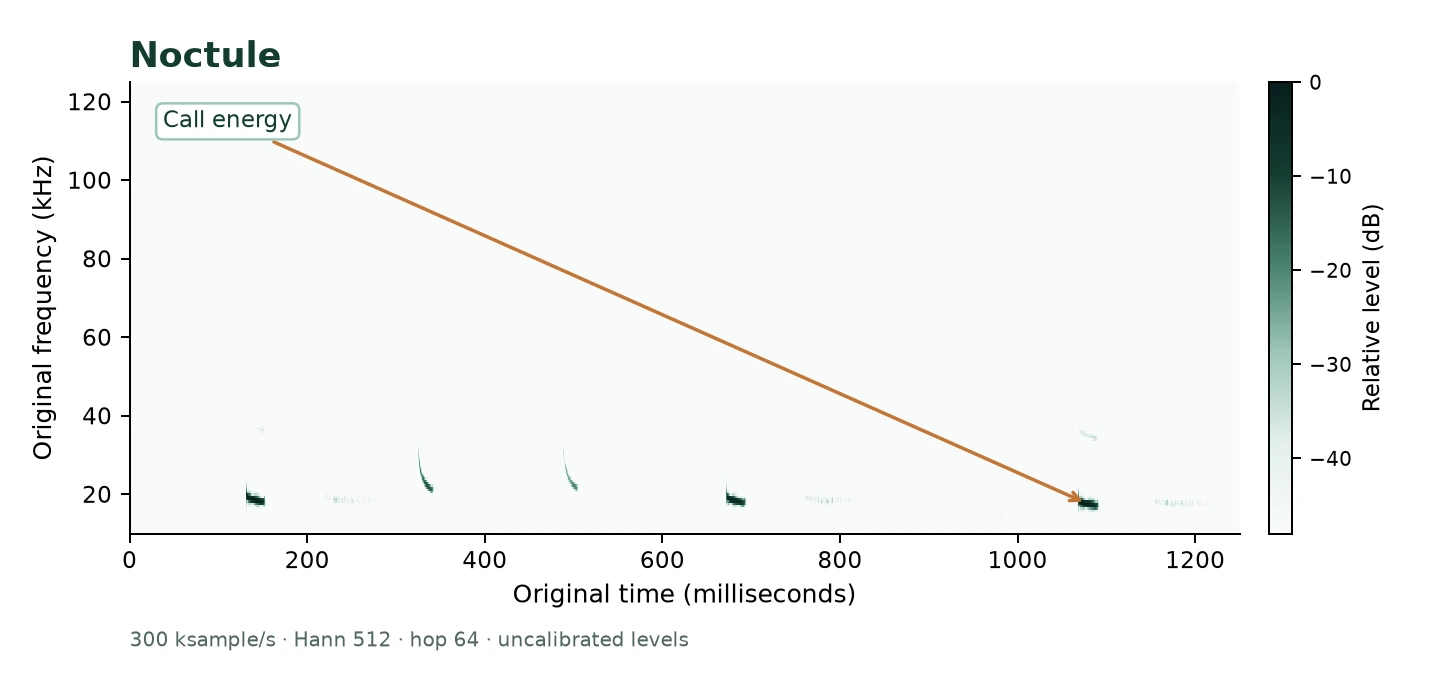
Listen for the slower rhythm and lower audible pitch. Several pulses sit near 18–20 kHz, while others sweep more strongly. A single low-frequency call still needs comparison with other open-air bats.
Jespersen, Docherty, Albertsen, Hallam & Jakobsen (2022) · CC BY 4.0. Recorded in Denmark; this is not an ACP project recording. Species label from published research dataset; not independently confirmed by ACP.
Original 300 ksample/s; channel 3. Excerpt 9.350–10.600 seconds. Playback is 10× slower, with frequency divided by ten and duration multiplied by ten. Gain was normalised, then resampled to 32 kHz for MP3. No denoising was applied.
The spectrogram uses original samples, a 512-sample Hann window and a 64-sample hop. Levels are relative to the strongest plotted component, not calibrated dB SPL. Original files and processing records are retained.

Forearm reference range: 38–47 mm
A smaller Nyctalus than noctule, with a 38–47 mm reference forearm range and sometimes golden-tipped or reddish-brown fur. “Small noctule” is not a reliable visual measurement when distance is unknown.
Leisler’s bats fly rapidly in relatively open situations and use tree holes as well as buildings and bat boxes. Roost occupation may shift over short periods. The species is uncommon in Britain, while Ireland is an important stronghold; those differences should not be flattened into one UK abundance claim.
A convincing identification does not establish the function of the site. Separate evidence of a calling male, a maternity group, commuting activity and feeding. Record what was observed and the season; avoid inferring a full roost network or colony size from one vocal sequence.
Maternity groups raise young in summer, with births often around June. Males advertise during late summer and autumn, using roost-centred flights and calls. Winter roosts include tree holes and building cavities. Movement between sites means a single inspection or emergence count is only a snapshot.
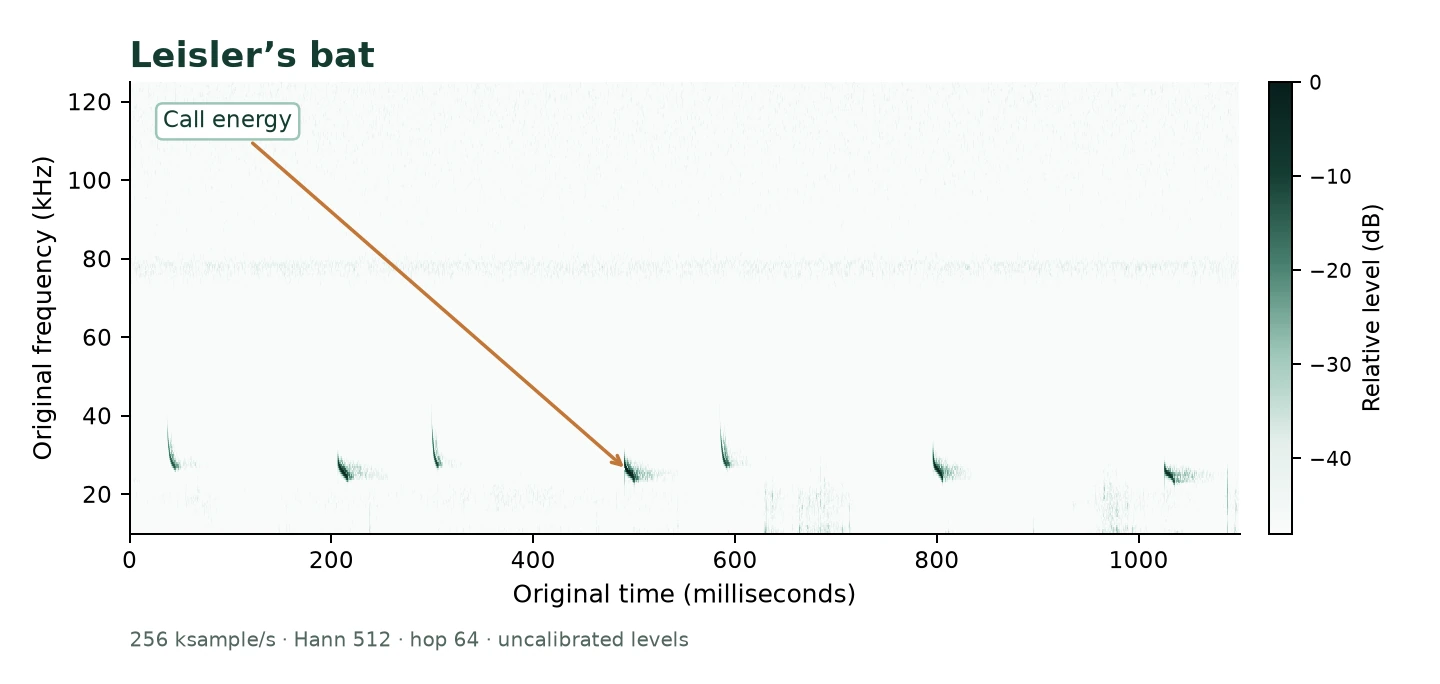
Appropriate search-flight sequences often contain energy near 25 kHz, but overlap noctule and serotine. Consider duration, sweep, rhythm and changes across a pass; automatic labels need critical review.
Male advertisement calls may be audible to people and differ from normal echolocation. Calling can occur from a roost and during repeated flights nearby. A recorded social event deserves its own description rather than being combined uncritically with feeding-pass totals.
Evidence: Bat Conservation Trust: Leisler’s bat
Recording credit: (c) Uploads from the Somerset Bat Groups events and members, some rights reserved (CC BY)
10× slower · 11.0 seconds
The excerpt contains lower-frequency calls with changing slopes and spacing. The source labels Leisler’s bat. Its overlap with noctule and serotine makes good-quality sequences and context important.
(c) Uploads from the Somerset Bat Groups events and members, some rights reserved (CC BY) · CC BY 4.0. Recorded in United Kingdom; this is not an ACP project recording. iNaturalist research; community identification, not independent ACP confirmation.
Original 256 ksample/s; channel 1. Excerpt 5.765–6.865 seconds. Playback is 10× slower, with frequency divided by ten and duration multiplied by ten. Gain was normalised, then resampled to 32 kHz for MP3. No denoising was applied.
The spectrogram uses original samples, a 512-sample Hann window and a 64-sample hop. Levels are relative to the strongest plotted component, not calibrated dB SPL. Original files and processing records are retained.

Forearm reference range: 48–55 mm
A large, broad-winged bat with a 48–55 mm reference forearm range, dark facial skin and a substantial muzzle. The current BCT account uses Cnephaeus serotinus; Eptesicus serotinus remains important when finding older research and records. A naming change should not split one biological species in an evidence register.
Serotines hunt around vegetation, pasture and other insect-rich habitat. Beetles can become important prey in summer. British roosts are strongly associated with buildings, often hidden beneath roofing or within walls. A long-used cavity roost can leave surprisingly little visible evidence in the accessible roof space.
Because roosting animals can remain deeply concealed, absence of droppings or visible bats is not a complete assessment. Equally, a broad-winged bat over pasture is not proof of a building roost. Keep anatomical, acoustic and site-use conclusions proportionate to their separate evidence.
Maternity groups build during spring and early summer; females normally raise one pup. Birth timing varies and can be later than a simple June-only calendar suggests. Autumn dispersal and mating follow. Winter whereabouts are incompletely known, although building cavities are thought to be important.
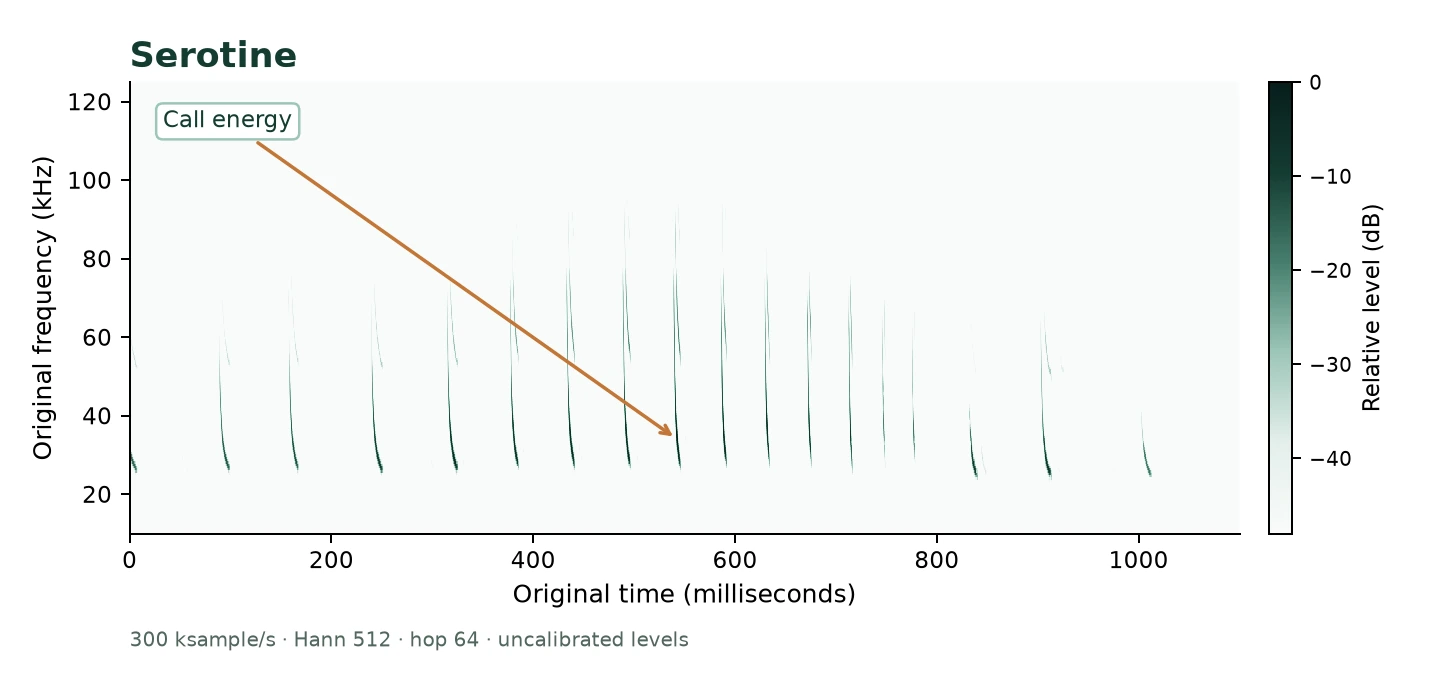
Clear echolocation sequences often peak around 25–30 kHz. Irregular rhythm and call shape help, but the wider open-air bat group provides plausible alternatives. A single low-frequency call should not be treated as a certain serotine record.
Social sounds occur, but the species’ mating behaviour is less completely documented than familiar advertisement systems in some pipistrelles and Nyctalus. This profile avoids assigning every audible chatter or unusual pulse a fixed reproductive meaning. The call and its context need separate evidence.
Evidence: Bat Conservation Trust: Serotine BCT Bat Group Bulletin 246, 30 January 2026
Recording credit: Jespersen, Docherty, Albertsen, Hallam & Jakobsen (2022)
10× slower · 11.0 seconds
The changing sweep shapes illustrate call flexibility in a field sequence. The research dataset uses the older name Eptesicus serotinus; this guide follows the current BCT name Cnephaeus serotinus.
Jespersen, Docherty, Albertsen, Hallam & Jakobsen (2022) · CC BY 4.0. Recorded in Denmark; this is not an ACP project recording. Species label supplied with published research dataset; original name Eptesicus serotinus.
Original 300 ksample/s; channel 1. Excerpt 5.825–6.925 seconds. Playback is 10× slower, with frequency divided by ten and duration multiplied by ten. Gain was normalised, then resampled to 32 kHz for MP3. No denoising was applied.
The spectrogram uses original samples, a 512-sample Hann window and a 64-sample hop. Levels are relative to the strongest plotted component, not calibrated dB SPL. Original files and processing records are retained.

Forearm reference range: 54–61 mm
A large horseshoe bat with a 54–61 mm reference forearm range and a complex noseleaf around the nostrils. The noseleaf is associated with nasal sound emission. Its anatomy differs from the tragus-bearing ear illustrated for many other British bats; these structures should not be confused.
It hunts flying insects and can launch from feeding perches, returning with larger prey. Connected vegetation, feeding habitat and suitable roosts are important. Summer breeding groups commonly occupy spacious buildings with flight access, while underground or sheltered sites can be used during poor weather.
Distinguish a horseshoe-type sonar sequence from an assessment of roost function. A species record does not describe colony size, reproductive status or the connected winter network. Avoid approaching hanging bats or exposing sensitive roost locations merely to obtain a better identification photograph.
Maternity groups assemble in late spring; births occur during summer. Females may take several years to breed and do not necessarily breed annually. Autumn mating, winter hibernation and movements between underground sites create a network of seasonal requirements rather than one permanently sufficient roost.
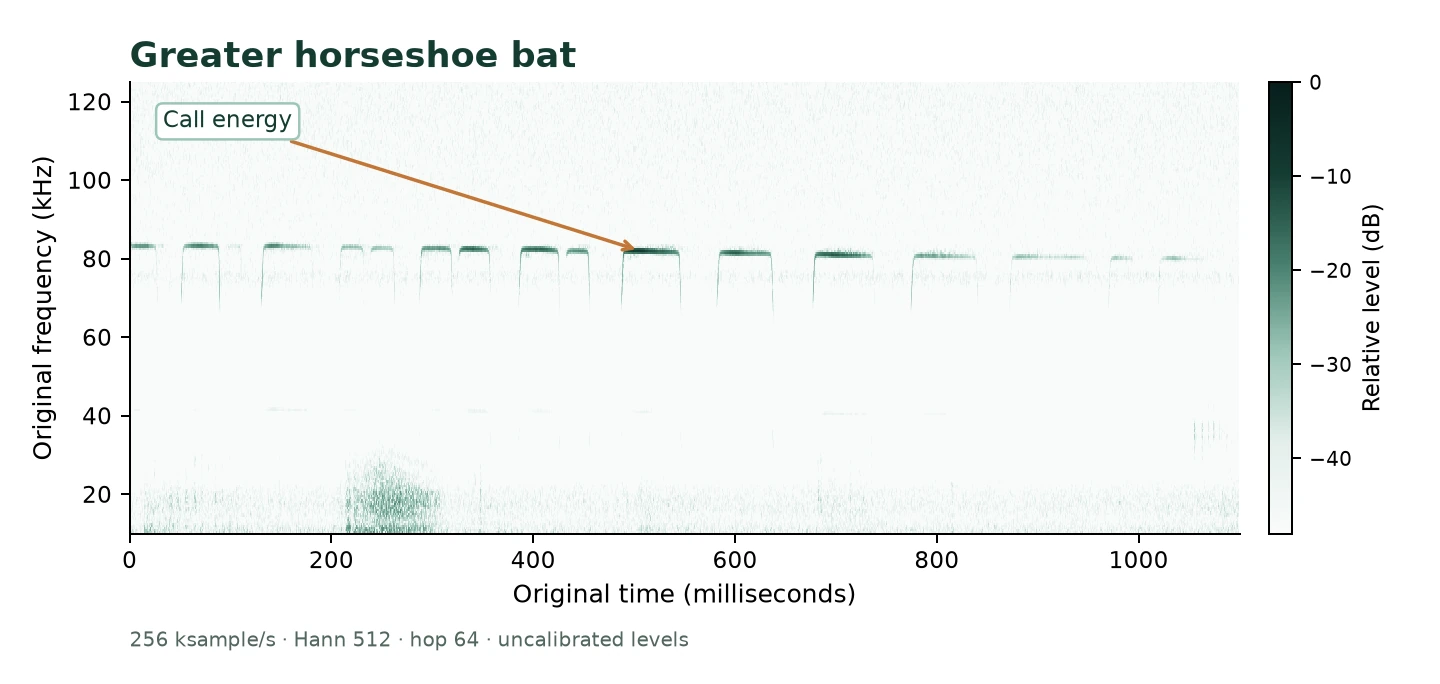
Echolocation contains a long, relatively constant-frequency component, typically near 82 kHz in British examples, with shorter modulated portions. Actual frequency and visibility of components vary. Suitable recording settings and microphone placement are essential for observing the complete call.
Specialist guidance relates developmental calls and mating-associated trills to season and roost setting. An unfamiliar sound alone does not establish a pup or mating site.
Evidence: Bat Conservation Trust: Greater horseshoe bat Middleton, Froud & French (2022), Social Calls survey guidelines.
Recording credit: (c) Uploads from the Somerset Bat Groups events and members, some rights reserved (CC BY)
10× slower · 11.0 seconds
Longer, nearly horizontal components near 82 kHz stand out in this excerpt. Short frequency-modulated edges also matter; do not compare this value with a peak measured from another harmonic.
(c) Uploads from the Somerset Bat Groups events and members, some rights reserved (CC BY) · CC BY 4.0. Recorded in United Kingdom; this is not an ACP project recording. iNaturalist research; community identification, not independent ACP confirmation.
Original 256 ksample/s; channel 1. Excerpt 9.493–10.593 seconds. Playback is 10× slower, with frequency divided by ten and duration multiplied by ten. Gain was normalised, then resampled to 32 kHz for MP3. No denoising was applied.
The spectrogram uses original samples, a 512-sample Hann window and a 64-sample hop. Levels are relative to the strongest plotted component, not calibrated dB SPL. Original files and processing records are retained.
Forearm reference range: 35–42 mm
A small horseshoe bat with a 35–42 mm reference forearm range and a distinct nasal leaf structure. Its folded-wing resting outline differs from a flying silhouette, and apparent size without scale is unreliable. A head illustration shows broad anatomy, not a substitute for independent identification evidence.
Lesser horseshoe bats often fly close to vegetation in sheltered landscapes, hunting small insects along woodland and connected routes. Summer colonies commonly use rural buildings with suitable flight access. Temporary feeding roosts can hold insect remains even when no maternity colony is present.
A suitable roof is only one part of the ecological picture. Record access, nearby cover and evidence of seasonal use separately. Do not equate all hanging groups with maternity colonies or assume an apparently unused summer room is unimportant during another season or weather condition.
Maternity groups gather in spring and include some males. Births generally fall between mid-June and mid-July, but not every adult female necessarily breeds. Autumn mating and winter use of caves, mines, tunnels or cellars follow. Some individuals remain in winter sites well into spring.
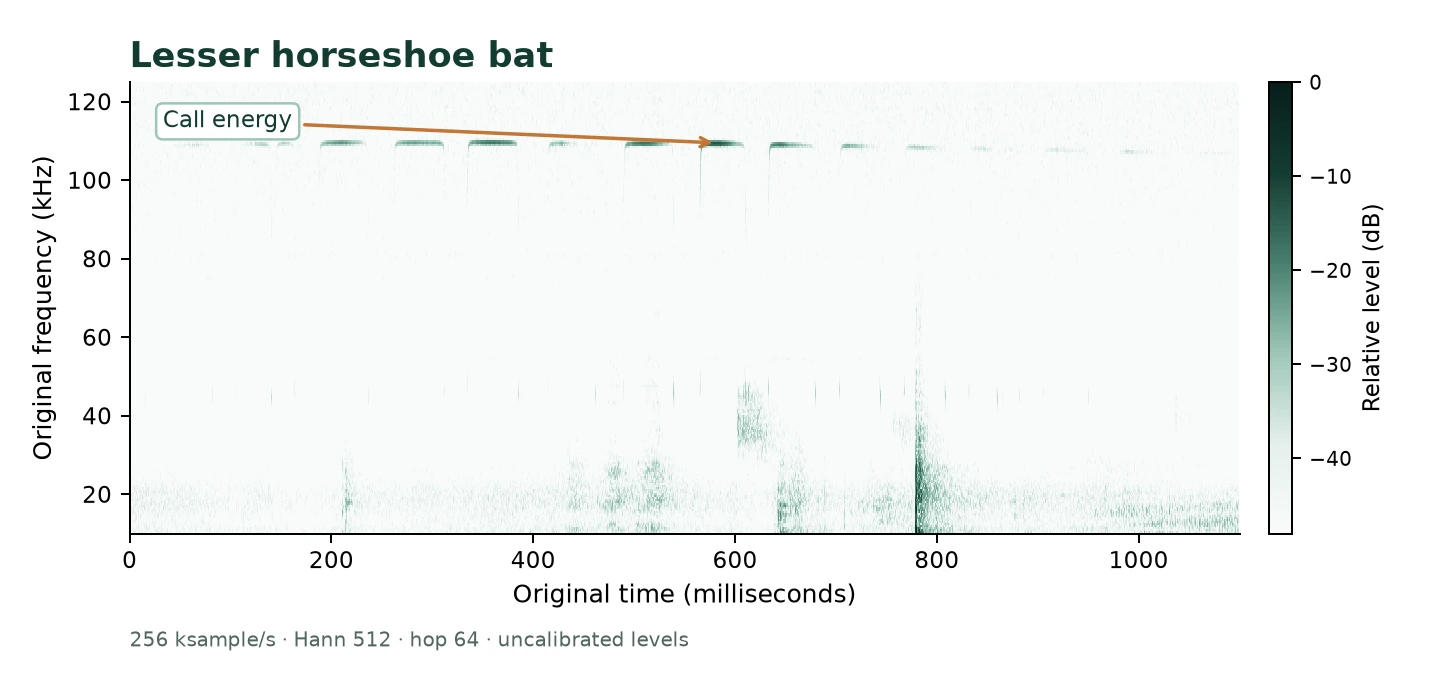
Calls have a long, relatively constant-frequency component, commonly around 110 kHz in British examples. A detector or recording system must cover the relevant frequency range adequately. Weak high-frequency reception can make an active species appear scarce or absent.
Specialist social-call guidance links developmental and trill calls with breeding or mating contexts. These interpretations require suitable call identification and information about season and roost setting.
Evidence: Bat Conservation Trust: Lesser horseshoe bat Middleton, Froud & French (2022), Social Calls survey guidelines.
Recording credit: (c) Uploads from the Somerset Bat Groups events and members, some rights reserved (CC BY)
10× slower · 11.0 seconds
The narrowband components are near 110 kHz in this recording. A detector needs sufficient ultrasonic bandwidth and sample rate to preserve them. Ordinary phone audio cannot record this band.
(c) Uploads from the Somerset Bat Groups events and members, some rights reserved (CC BY) · CC BY 4.0. Recorded in United Kingdom; this is not an ACP project recording. iNaturalist research; community identification, not independent ACP confirmation.
Original 256 ksample/s; channel 1. Excerpt 2.282–3.382 seconds. Playback is 10× slower, with frequency divided by ten and duration multiplied by ten. Gain was normalised, then resampled to 32 kHz for MP3. No denoising was applied.
The spectrogram uses original samples, a 512-sample Hann window and a 64-sample hop. Levels are relative to the strongest plotted component, not calibrated dB SPL. Original files and processing records are retained.

Forearm reference range: 57–68 mm
A very large Myotis with a 57–68 mm reference forearm range, large ears, prominent tragus and pale underparts. It is exceptionally rare in Britain. Apparent size in an unscaled photograph cannot establish this identification.
Continental European populations often forage close to the ground, taking large ground-dwelling prey. Spacious roofs and caves can support maternity groups abroad. These observations explain the species’ ecology, but BCT explicitly notes that its British foraging ecology is poorly known.
Potential records merit specialist verification and careful handling of location information. Separate a reported sound, a verified individual, a winter roost and a confirmed breeding colony in the record. Each answers a different question, and none should be silently promoted to the next level of certainty.
Current British evidence includes occasional winter records, while a present breeding population has not been established. Continental summer maternity behaviour must be labelled as such. A winter visitor or persistent individual cannot demonstrate British reproduction or annual occupation of a wider area.
Echolocation uses frequency-modulated calls that overlap the wider Myotis group. BCT gives roughly 34 kHz as a heterodyne listening reference, not a universal peak or identification threshold. Exceptional recordings need critical examination and independent supporting evidence.
European accounts describe males attracting females to mating roosts in autumn. This page does not transfer those observations into a claim about an unverified British mating site. Social and behavioural information is useful only when the species and observation context are secure.
Evidence: Bat Conservation Trust: Greater mouse-eared bat
Open recording XC1049571 by Vladimír Nemček
Hand-release recording: calls close to release can differ from undisturbed search flight. Species identity is the source label; ACP has not independently confirmed it.
This recording is linked at its source because its non-commercial licence does not grant ACP commercial reuse. Source licence: CC-BY-NC-SA. Use the archive’s slowed playback where supplied; ordinary playback can omit ultrasound.
Real photographs · four evidence lessons
Use these credited reference photographs alongside the species portraits. Each teaches a useful feature and a limit. They depict species found in Britain, but are not presented as ACP survey photographs or as records from a particular British site.
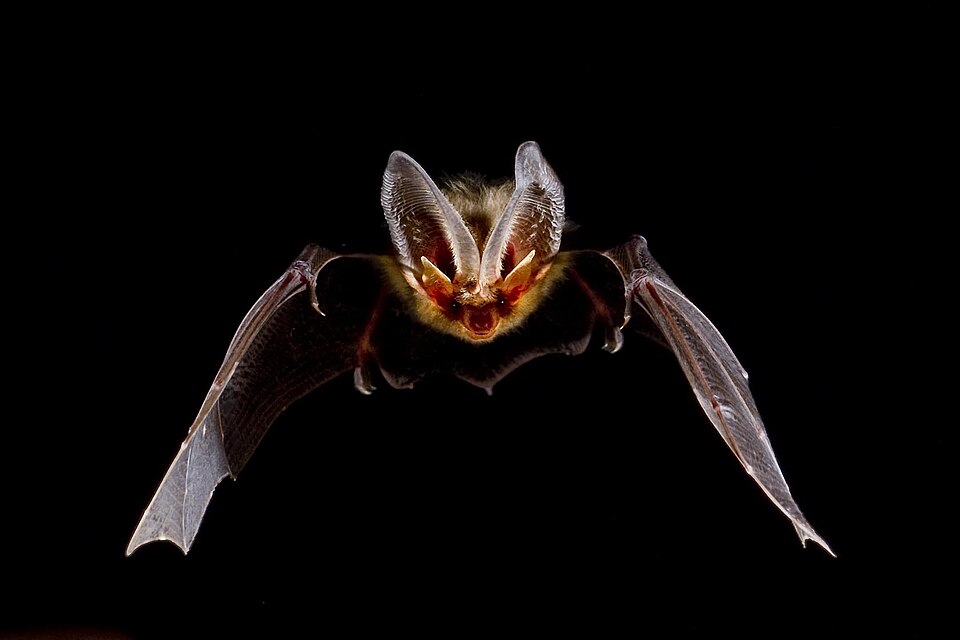
Notice: The external ears dominate the head. The smaller pointed structures inside them are the tragi; they are not a second pair of ears.
Common trap: An animal can fold its ears at rest, leaving mainly the tragi visible. Brown and grey long-eared bats also overlap in colour and other features.
Brown long-eared bat · Grey long-eared bat
Photograph: Joxerra aihartza · original file and source record · CC BY-SA 3.0. Thumbnail sizing only; photograph otherwise unchanged. Species label: Plecotus auritus, as recorded by the source. BCT species guidance.
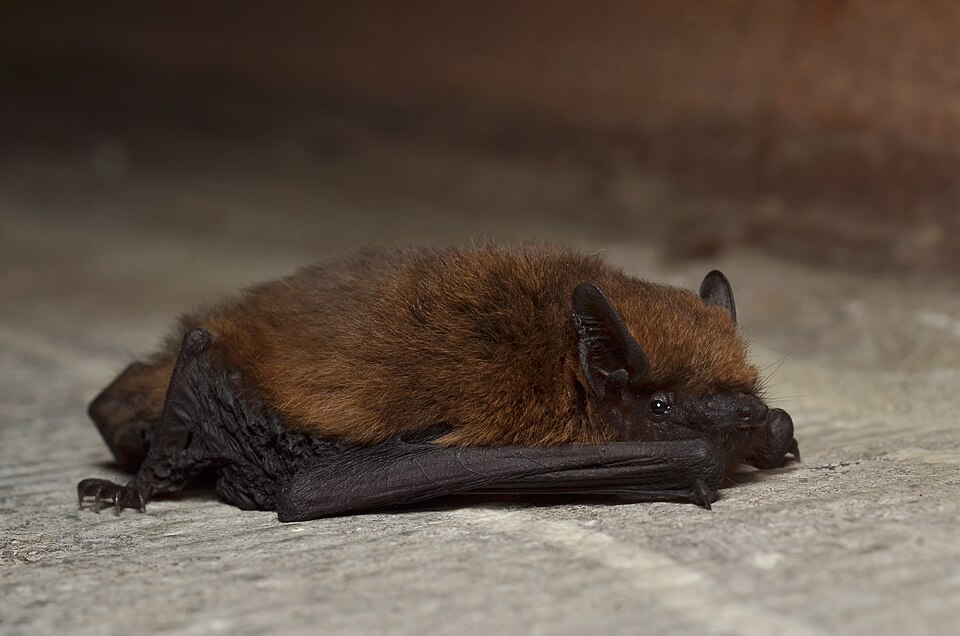
Notice: The short ear, dark face and folded wing are visible. There is no reliable size reference in this photograph.
Common trap: Common and soprano pipistrelles can look very similar. Fur colour varies with lighting, age and the camera; a brown bat is not automatically a common pipistrelle.
Common pipistrelle · Soprano pipistrelle · Nathusius’ pipistrelle
Photograph: Gilles San Martin from Namur, Belgium · original file and source record · CC BY-SA 2.0. Thumbnail sizing only; photograph otherwise unchanged. Species label: Pipistrellus pipistrellus, as recorded by the source. BCT species guidance.
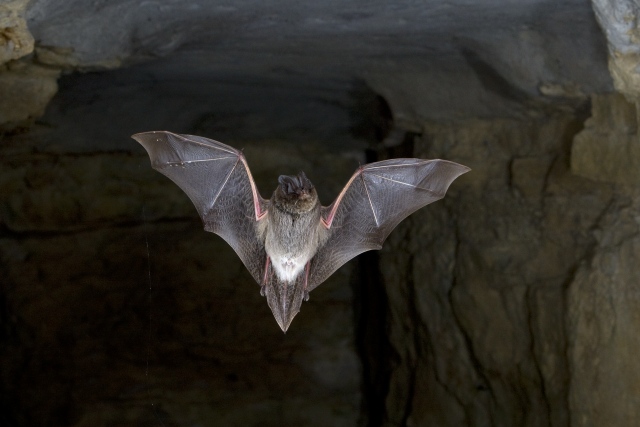
Notice: Look at the broad ears above the compact muzzle. A useful close view needs to show where the ears join across the forehead.
Common trap: This flying view makes the small facial features harder to inspect. Wing position and foreshortening can also make the body seem unusually broad or short.
Photograph: C. Robiller / Naturlichter.de · original file and source record · CC BY-SA 3.0. Thumbnail sizing only; photograph otherwise unchanged. Species label: Barbastella barbastellus, as recorded by the source. BCT species guidance.
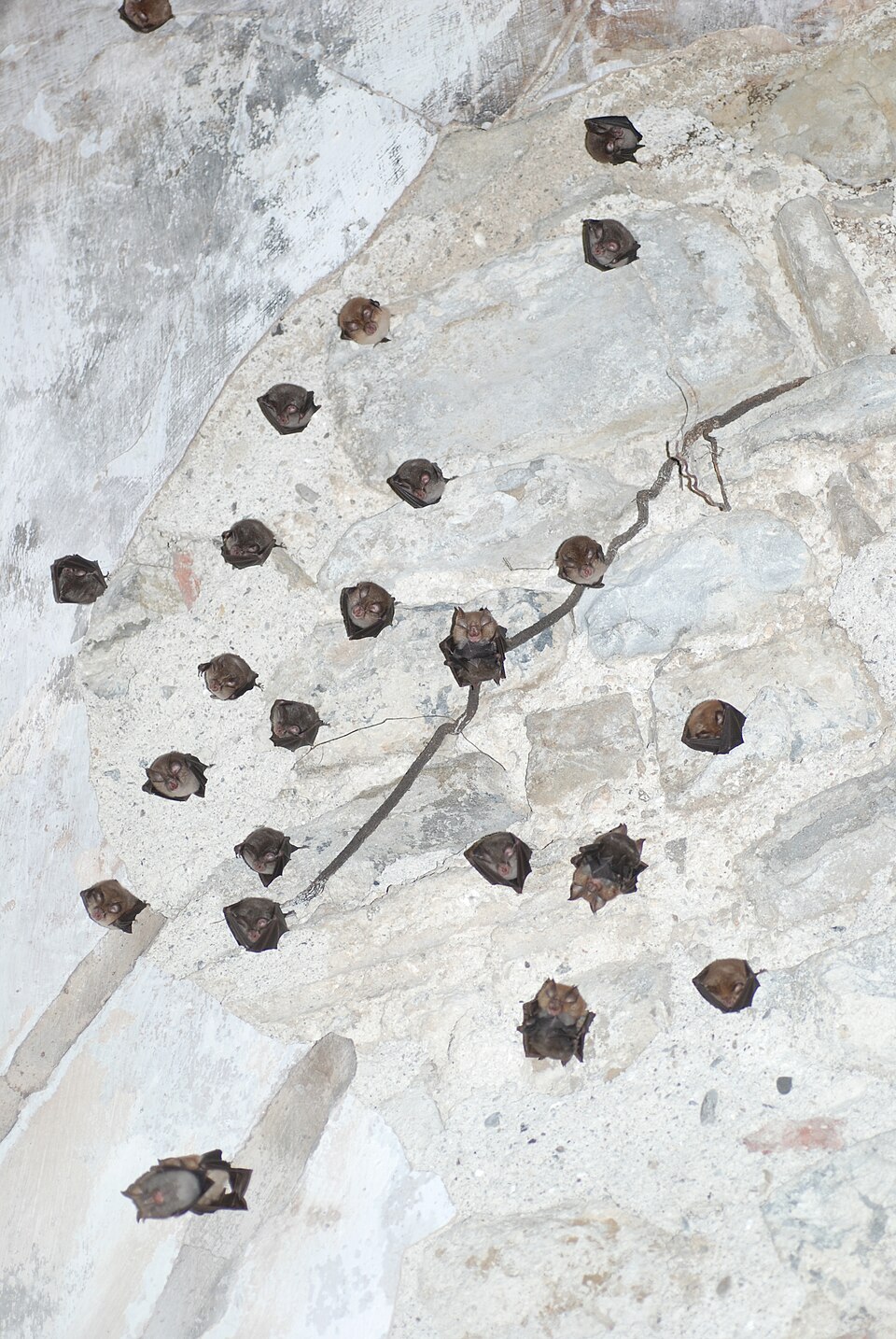
Notice: Compare the hanging poses and how much of each face is exposed. Wing wrapping is a useful contextual feature in horseshoe bats.
Common trap: The bats are at different positions and distances. Their apparent sizes cannot separate greater and lesser horseshoe bats, and the small faces do not resolve noseleaf details here.
Greater horseshoe bat · Lesser horseshoe bat
Photograph: Qgroom · original file and source record · CC BY 1.0. Thumbnail sizing only; photograph otherwise unchanged. Species label: Rhinolophus hipposideros, as recorded by the source. BCT species guidance.
Several species share visible features and call patterns. The guide keeps uncertainty explicit when evidence is weak or contradictory. It does not turn a limited observation into a confident species record.
No. You select observed features; the tool suggests comparisons and further evidence. It does not accept uploads or run an automatic classifier. The WAV workbench can measure a recording, but those measurements also need informed interpretation.
Follow the licence linked with each photograph. Keep the photographer’s credit, source and licence links, and state any changes. Share-alike terms apply to adaptations where specified. ACP’s copyright on its own illustrations does not replace these third-party licences.
Photo sources, reuse permissions and the BCT guidance were checked on 17 November 2026. Identifications follow the named source records and have been checked for consistency with the visible teaching features; ACP has not examined the individual animals or independently verified their DNA.
Start here · sound made visible
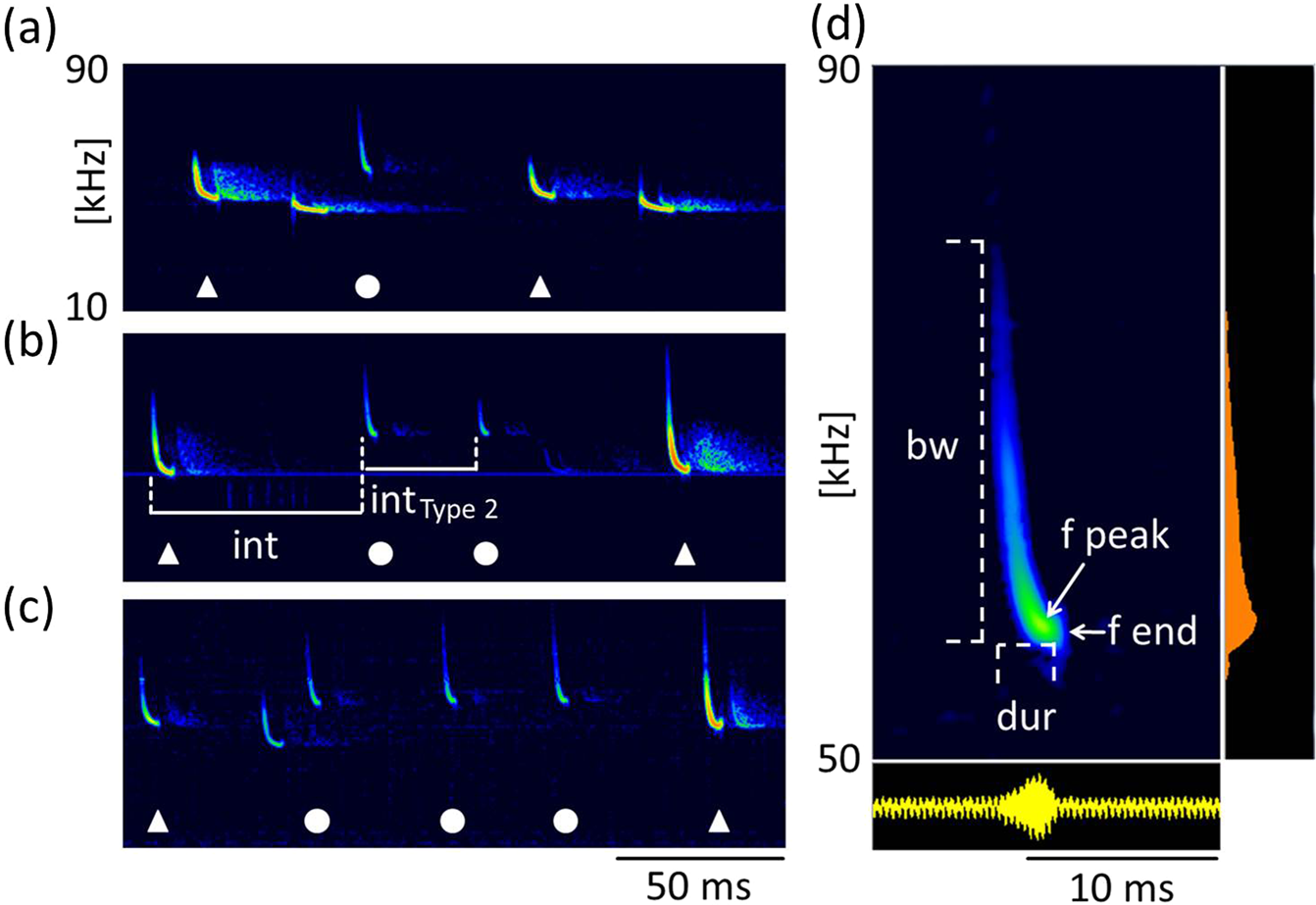
Bat sounds are pressure changes travelling through the air. British bats make echolocation calls with the larynx, then emit them through the mouth or nostrils. Returning echoes carry information about surrounding objects and prey.
Frequency describes how quickly the pressure oscillates. One kilohertz (kHz) means 1,000 cycles per second. Much bat echolocation lies above the usual upper limit of human hearing, so we need an ultrasonic detector to record it.
Bats also use social vocalisations. Some components can be audible to people, and low-frequency noctule calls may be heard by some listeners. Hearing varies: a bat you cannot hear may still be calling.
A detector changes what reaches your ears. These examples are played ten times slower than the original. A 50 kHz component becomes 5 kHz, while a 1-second sequence lasts 10 seconds. The sound is authentic, but its pitch and pace are transformed for listening.
For the science behind these sounds, explore our bat echolocation and acoustics guide. It includes wave physics, detector methods, worked calculations and interactive tools.
 © 2026 ACP Consultants Ltd.
A phone microphone or ordinary sound-level meter is not a bat detector. A suitable ultrasonic microphone, recording bandwidth and sampling rate are needed. A phone connected to an Echo Meter Touch can record ultrasound through that accessory; the phone's own microphone cannot substitute for it.
Real recordings · four starting points
Start at a comfortable listening volume. None of the players starts automatically. Read left to right for time, and bottom to top for frequency. The pictures use the original ultrasonic frequencies, while the players use audible, slowed copies.
Pipistrellus pipistrellus
10× slower · 11.0 seconds
Recording credit: (c) Uploads from the Somerset Bat Groups events and members, some rights reserved (CC BY)
Hear regularly spaced clicks when slowed. The measured calls sweep down towards a flatter tail. This field sequence has greatest energy near 47.5 kHz within the stated analysis band; “45 kHz bat” is a shorthand, not a fixed identity test.
(c) Uploads from the Somerset Bat Groups events and members, some rights reserved (CC BY) · CC BY 4.0. Recorded in United Kingdom; this is not an ACP project recording. iNaturalist research; community identification, not independent ACP confirmation.
Original 256 ksample/s; channel 1. Excerpt 6.526–7.626 seconds. Playback is 10× slower, with frequency divided by ten and duration multiplied by ten. Gain was normalised, then resampled to 32 kHz for MP3. No denoising was applied.
The spectrogram uses original samples, a 512-sample Hann window and a 64-sample hop. Levels are relative to the strongest plotted component, not calibrated dB SPL. Original files and processing records are retained.
Pipistrellus pygmaeus
10× slower · 9.0 seconds
Recording credit: Jespersen, Docherty, Albertsen, Hallam & Jakobsen (2022)
Compare these downward sweeps with the common pipistrelle example. Their lower portion sits higher on the frequency scale. This excerpt peaks near 58 kHz in the analysis band, illustrating why the familiar “55 kHz” label is approximate.
Jespersen, Docherty, Albertsen, Hallam & Jakobsen (2022) · CC BY 4.0. Recorded in Denmark; this is not an ACP project recording. Species label from published research dataset; not independently confirmed by ACP.
Original 300 ksample/s; channel 3. Excerpt 5.550–6.450 seconds. Playback is 10× slower, with frequency divided by ten and duration multiplied by ten. Gain was normalised, then resampled to 32 kHz for MP3. No denoising was applied.
The spectrogram uses original samples, a 512-sample Hann window and a 64-sample hop. Levels are relative to the strongest plotted component, not calibrated dB SPL. Original files and processing records are retained.
Nyctalus noctula
10× slower · 12.5 seconds
Recording credit: Jespersen, Docherty, Albertsen, Hallam & Jakobsen (2022)
Listen for the slower rhythm and lower audible pitch. Several pulses sit near 18–20 kHz, while others sweep more strongly. A single low-frequency call still needs comparison with other open-air bats.
Jespersen, Docherty, Albertsen, Hallam & Jakobsen (2022) · CC BY 4.0. Recorded in Denmark; this is not an ACP project recording. Species label from published research dataset; not independently confirmed by ACP.
Original 300 ksample/s; channel 3. Excerpt 9.350–10.600 seconds. Playback is 10× slower, with frequency divided by ten and duration multiplied by ten. Gain was normalised, then resampled to 32 kHz for MP3. No denoising was applied.
The spectrogram uses original samples, a 512-sample Hann window and a 64-sample hop. Levels are relative to the strongest plotted component, not calibrated dB SPL. Original files and processing records are retained.
Pipistrellus pygmaeus
10× slower · 7.2 seconds
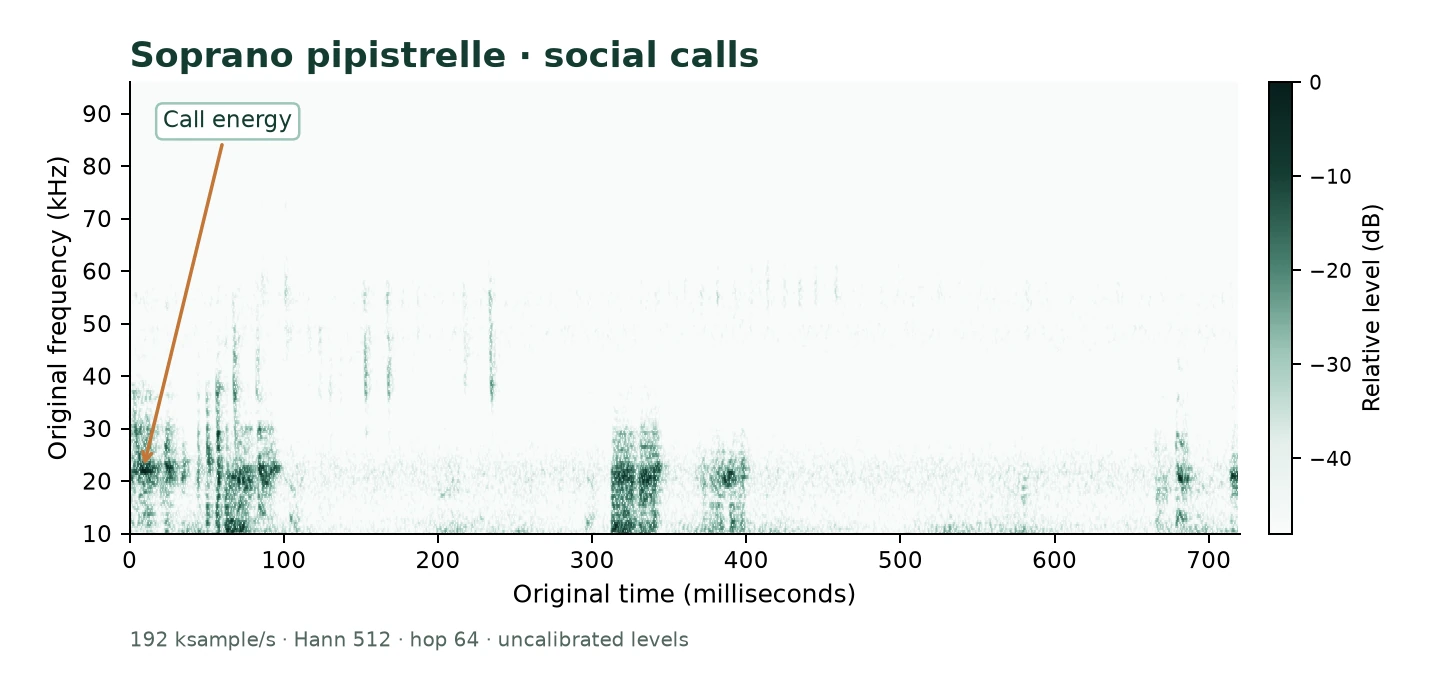
Recording credit: Christian Kahle, XC1031662 (2025)
Listen for the varied, clustered sounds and compare their structure with the regular search-call examples. The recordist reports bats at a roost, and the repository labels these as soprano pipistrelle social calls. We have not independently confirmed the species or the function of each syllable.
Christian Kahle, XC1031662 (2025) · CC0 1.0. Recorded in Germany; this is not an ACP project recording. Repository and community label: soprano pipistrelle social calls; species not independently confirmed by ACP.
Original 192 ksample/s; channel 1. Excerpt 0.050–0.770 seconds. Playback is 10× slower, with frequency divided by ten and duration multiplied by ten. Gain was normalised, then resampled to 32 kHz for MP3. No denoising was applied.
The spectrogram uses original samples, a 512-sample Hann window and a 64-sample hop. Levels are relative to the strongest plotted component, not calibrated dB SPL. Original files and processing records are retained.
Explore all 18 species above. Eleven profiles include reusable recordings and measured spectrograms. The other seven link to attributed examples at the original sound archive. A source's species label is evidence to assess, not a guarantee: overlapping Myotis and long-eared calls are especially difficult.
These are selected European recordings of species found in Britain; they are not all British recordings. The crops, licences and original sampling rates are documented. No artificial sound is presented as a real bat call, and no sensitive roost coordinates are reproduced.
Physics: OpenStax, sound waves. Recording methods: BCT detector guidance. Dataset discovery: ChirosetEurope (2026); original sources and rights are linked with each example.