
ACP Insights & Guidance
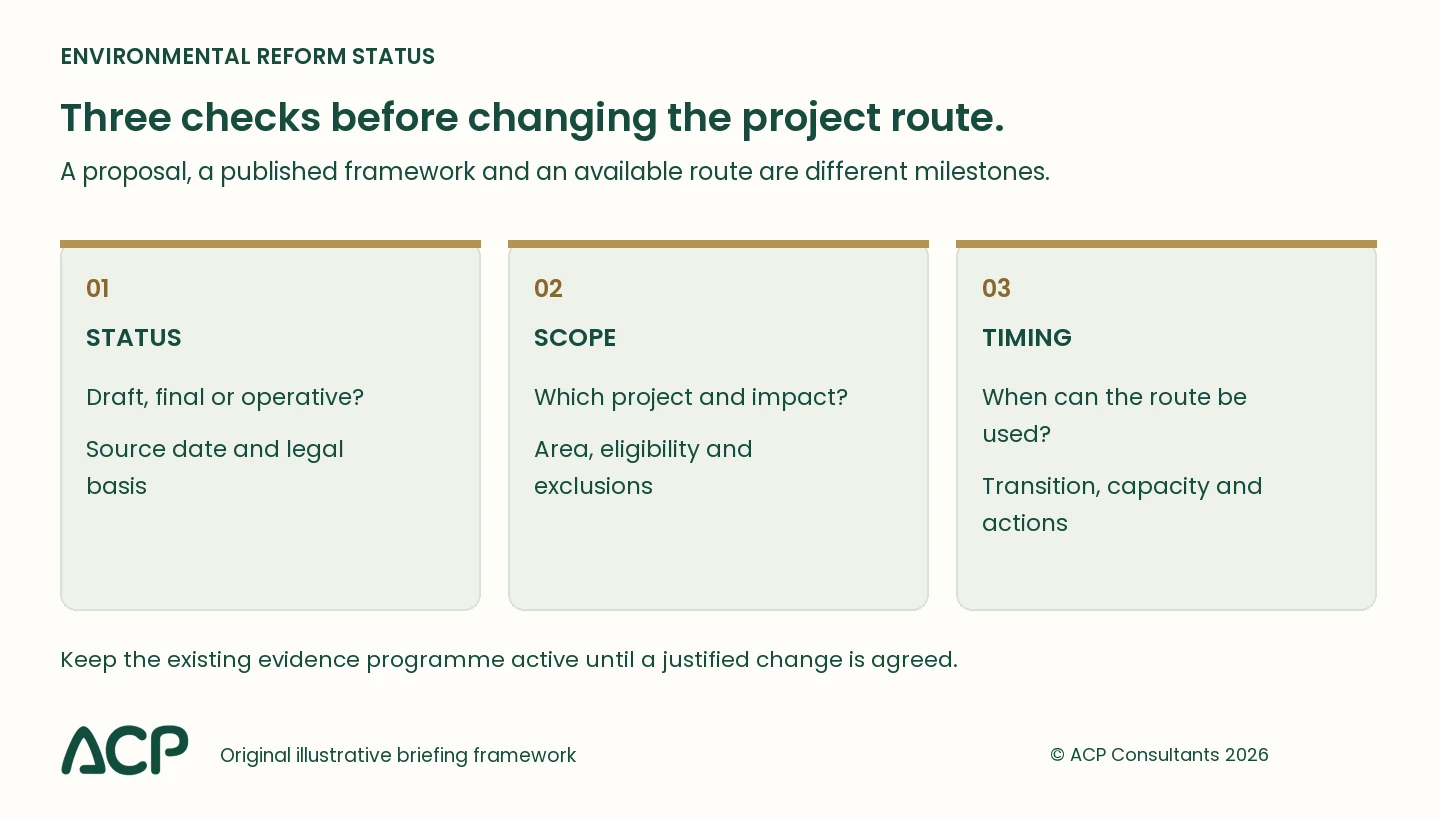
Environmental outcomes reports and Environmental Delivery Plans address different parts of environmental reform. For a project team, the key question is what currently applies. Separate the published policy direction from an operative, applicable route before changing the assessment brief.
The practical answer
Status checked 29 October 2026. The EOR roadmap targets the end of 2027 and says current assessment legislation continues until implementation. Norfolk’s first draft EDP consultation has closed; the official collection does not yet identify a final made plan. Recheck these time-sensitive positions before release or a project decision.
Environmental outcomes reports: the roadmap
The government’s roadmap sets an intention to bring forward Environmental Outcomes Reports by the end of 2027. It addresses replacement of EIA under the town and country planning and NSIP regimes, alongside Strategic Environmental Assessment.
However, the roadmap explicitly says that current environmental assessment legislation and guidance continue until the new system is implemented. It also anticipates consultation, testing and managed transition. Therefore, the target date is not a reason to stop a current EIA process.
The roadmap treats Habitats Regulations requirements, BNG and Environmental Delivery Plans as separate considerations outside the EOR assessment framework. Coordination may reduce duplication, but these terms should not be presented as one interchangeable approval.
Norfolk’s draft EDP: consultation closed
The Defra consultation hub confirms that the Norfolk nutrient EDP consultation closed at 9.29am on 27 October 2026. It concerns specified protected sites associated with the Broads and River Wensum. Its geographic and environmental scope is specific, rather than a national exemption from assessment.
At the source check for this article, the official collection listed the Norfolk item as a closed consultation. A final made Norfolk EDP was not identified there. Therefore, this briefing does not treat the draft as an available operational route.
The draft proposes a strategic approach to nutrient impacts through conservation measures funded by a levy. However, the final plan, applicable development types, mapped coverage, conditions and capacity must be checked before a project relies on it.
On 26 October 2026, the Office for Environmental Protection published its consultation response. It welcomed the plan’s intent but questioned whether the evidence demonstrates the intended nature outcomes. Its concerns include timing, the relationship between measures and affected features, monitoring and corrective action. Therefore, distinguish this scrutiny from an approval decision and check the eventual government response.
Check the nutrient evidence before changing route
First, establish whether the proposal affects a nutrient-sensitive protected site. Identify the catchment, relevant nutrient and current authority requirements. A reform announcement does not answer those questions for an individual development.
Next, confirm the appropriate calculator and retain its version, inputs and assumptions. Natural England’s calculator guidance records March 2026 updates; some authorities also use their own calculators. Ask the specialist to review material changes in the proposal or wastewater arrangements.
| Decision | Evidence to retain |
|---|---|
| Which requirement applies? | Catchment, protected site, relevant nutrient and current authority advice. |
| What does the proposal generate? | Applicable calculator version, inputs, assumptions and reviewed nutrient budget. |
| How will the impact be addressed? | The proposed mitigation route, eligibility, delivery evidence and required documentation. |
| What would justify a different route? | A final applicable arrangement, confirmed scope and the advisers’ recorded decision. |
Distinguish an EDP levy from Natural England’s existing nutrient mitigation credit scheme. The latter serves eligible development in the Tees and Poole Harbour catchments, with continuous applications. It does not establish eligibility for the proposed Norfolk EDP.
Before changing route, verify a final applicable arrangement, coverage, development type, impacts and available capacity. Keep the specialist’s reasoning with the project record. Meanwhile, check the permissions needed for nutrient mitigation measures; a proposed wetland is not automatically deliverable.
Keep the assessment routes distinct
| Topic | What the project team should establish |
|---|---|
| Environmental outcomes reports | Current requirements remain relevant until implementation; track regulations and transition arrangements. |
| Environmental Delivery Plans | Check whether a final plan exists and covers the location, development and specific impact. |
| EIA screening and scoping | Continue the applicable consent-route process and maintain a coherent project description. |
| Other environmental duties | Identify the effects, species, habitats and policy requirements that remain outside any proposed alternative route. |
In particular, a document with a recent publication date may still be a consultation draft. Read its status statement and operative provisions. Also check the latest official collection rather than relying only on an earlier announcement.
Maintain a dated project status register
First, list each environmental decision that the project needs. Also give it an owner and identify the current evidence requirement. Then record any reform that could affect that decision.
- Official document title, publisher, link and date checked.
- Jurisdiction, consent regime and affected environmental issue.
- Current status: proposal, consultation, final instrument or operative arrangement.
- Any outstanding commencement, transition or eligibility question.
- Evidence and advice needed before changing the project programme.
- Next review point and the person responsible for it.
This register is an original coordination tool. It helps prevent a tentative policy assumption from becoming an unqualified instruction. In addition, keep supporting correspondence and specialist advice beside the entry.
An illustrative programme decision
A Norfolk housing proposal awaiting a route review
Imagine a housing team considering whether the draft EDP could change its nutrient evidence strategy. It also has ongoing ecology and drainage work. This fictional example does not determine eligibility or the route for any real development.
First, the planner identifies the exact proposal and current requirements. Next, the team checks the latest official EDP status and whether its location and impacts fall within the relevant scope.
If a final applicable route becomes available, the team reviews its terms, timing and consequences before changing the brief. Meanwhile, it records which other assessments remain necessary. This avoids assuming that one nutrient measure resolves every environmental question.
Keep the evidence programme current
First, maintain a shared project description, baseline evidence and assumptions register. These are useful foundations for current assessment and for reviewing future changes. Also make the reasoning behind mitigation and monitoring decisions easy to follow.
When a new official document appears, compare the applicable provisions with the previous position before announcing a change. Then ask the planning and environmental advisers whether the project needs a revised scope. A headline alone is insufficient evidence.
Finally, refresh this status check before publication, submission or a material programme decision. Reform milestones can move, and a consultation outcome may change the detail. Then record the new evidence and the decision it supports.
Continue the applicable environmental impact assessment process and review BNG obligations separately. An announcement about one route does not automatically settle another.
Common questions
Does an EDP announcement remove nutrient neutrality evidence requirements?
No general conclusion follows from an announcement. Check the current requirements and whether a final, applicable route is available for the project. Record the specialist advice before changing the evidence programme.
Have environmental outcomes reports already replaced EIA?
The checked roadmap says current legislation and guidance continue until the new system is implemented. Its end-2027 target is a reform milestone, not confirmation that replacement has already occurred.
Are EORs and Environmental Delivery Plans the same?
No. They have different purposes and processes. The EOR roadmap explicitly treats EDPs as a separate consideration outside the EOR assessment framework.
Does the closed Norfolk consultation mean the draft is approved?
No. Closing a consultation is not the same as making or commencing a final plan. Check the official publication and the route’s operative requirements.
Would an EDP cover every effect of a development?
Do not assume so. The final plan’s area, development types and specified impacts determine its scope. Other environmental requirements can remain.
Should a project pause all surveys while waiting for reform?
There is no general basis for that decision. Review the applicable requirements, seasonal evidence needs and programme with the project advisers before changing commissioned work.
References and scope
Dated England planning briefing. This article distinguishes published proposals and status evidence; it does not determine legal applicability, EDP eligibility or a project’s consent route. Recheck official status at release.
- GOV.UK. Environmental Outcomes Reports: Roadmap to reform, March 2026.Policy roadmap and intended implementation direction. Current requirements continue until the relevant changes take effect.
- Defra. Consultation on a new Environmental Delivery Plan: Norfolk nutrients.Consultation closed 27 October 2026. Closure is not evidence that a final plan has been made or applies to a project.
- GOV.UK. Environmental Delivery Plans — official collection.Source for checking published plan status. Recheck before publication and before a project relies on a route.
- Defra / Natural England. Nutrient pollution: draft Norfolk Environmental Delivery Plan consultation.Explains the proposed plan and consultation scope; it remains distinct from EOR reform.
- Office for Environmental Protection. Response to the first Environmental Delivery Plan consultation, 26 October 2026.The OEP’s published summary identifies evidence and delivery concerns. A consultation response does not determine approval or project eligibility.
- Natural England and Defra. Using the nutrient neutrality calculators.Updated 11 March 2026. Explains catchments, calculation inputs and version changes.
- Natural England and Defra. Natural England’s nutrient mitigation scheme for developers.Updated 15 June 2026. Current scheme guidance for the Tees and Poole Harbour catchments.
- Environment Agency, Natural England and Defra. Nutrient mitigation: check if you need environmental permissions.Updated 2 August 2023. Explains permission and consultation considerations for mitigation proposals.