
ACP Insights & Guidance
A bat mitigation licence application needs the right route, current ecological evidence and a realistic programme. For individual applications in England, A13 is the relevant Natural England route. Check eligibility, supporting documents and charges with your ecologist before fixing works dates.
The practical answer
Natural England updated its A13 guidance on 21 October 2026. The update adds application and charging information; it does not mean every bat project needs A13 or that every fee changed that day. Planning permission and a survey licence do not authorise works that require a separate mitigation licence.
Confirm the appropriate licensing route
Bats and their breeding and resting places have legal protection. Therefore, start by considering whether the design can avoid harmful impacts. Where a licence is necessary, your ecologist should identify the appropriate route before you set a submission date.
Natural England’s standing advice describes individual mitigation licences alongside class-licence and earned-recognition routes for eligible work. However, eligibility depends on the proposal and the ecologist’s authorisation. A survey licence does not itself authorise development works.
Also keep planning permission and wildlife licensing separate. The planning decision needs sufficient ecological evidence, while the licence addresses otherwise unlawful activities. Consequently, a planning approval does not replace the relevant wildlife authorisation.
What the October 2026 guidance update means
Natural England’s change log identifies additional application and charging information in the 21 October update. Its online application process was already introduced in December 2025. Therefore, avoid describing the online route as a new October requirement.
For an A13 bat licence, prepare the method statement, maps, work schedule and signed declarations. Additional documents depend on the proposal. These can include a reasoned statement, evidence of the ecologist’s experience, consents and plans for phased developments.
Before submission, check the current official instructions and document versions. Ask the named ecologist to confirm which supporting items apply. Then check that every document describes the same proposal, site and programme.
Bat mitigation licence costs: separate three budgets
Charges checked 29 October 2026. The Wildlife Licence Charges (England) Order 2025 provides the charging framework. For chargeable individual bat mitigation applications, Natural England’s current charging instructions identify a £500 fixed-price route or a variable route. The latter combines £219 towards compliance checks with £121 per assessment hour.
The fixed price has eligibility criteria; it is not a universal application fee. In particular, complexity, protected sites, species, roosts and phased development can affect the route. The online application confirms the expected charge.
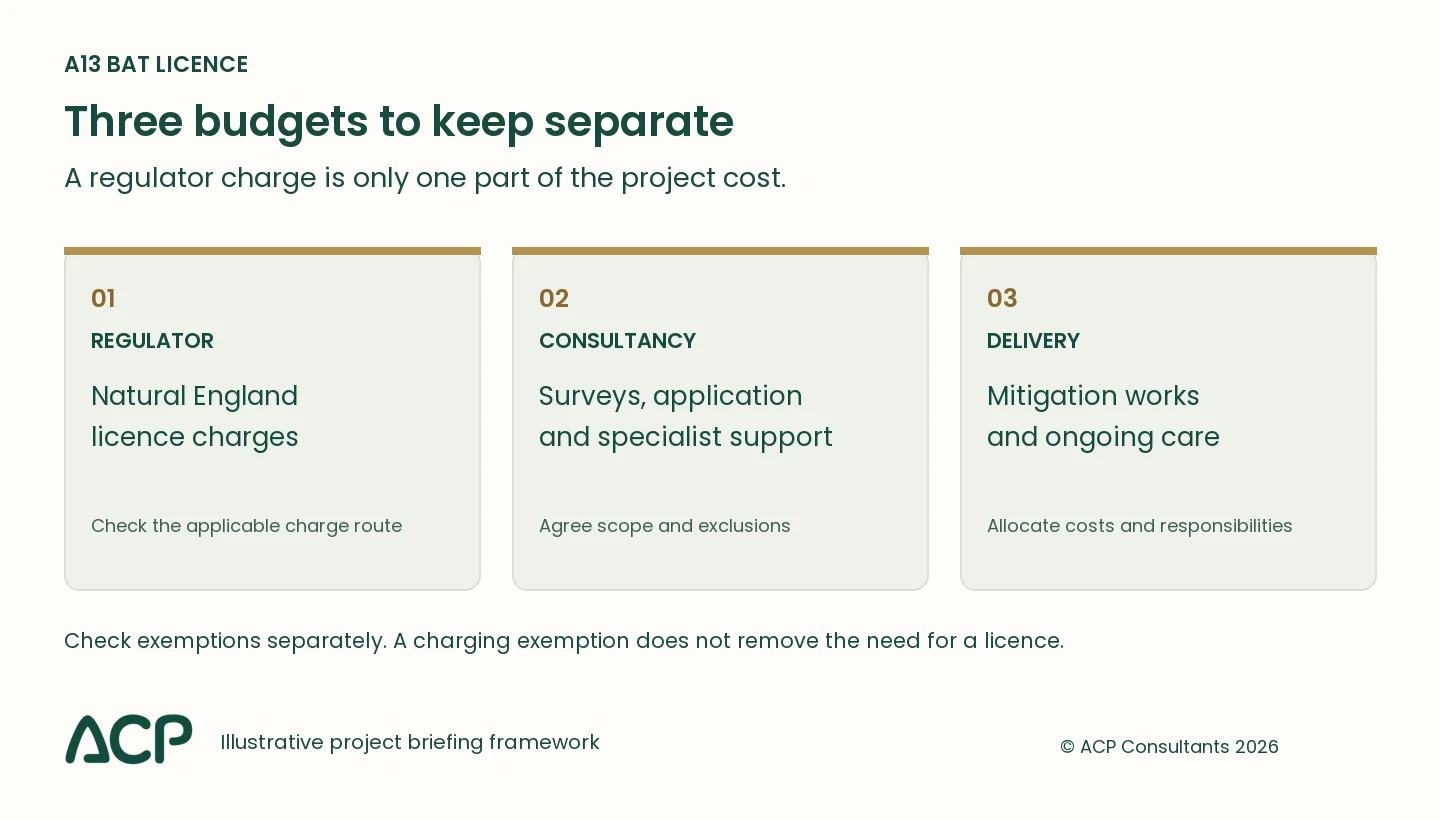
| Budget | What to clarify |
|---|---|
| Natural England charges | Confirm whether an exemption applies, the charging route and possible further assessment charges. |
| Ecological consultancy | Agree survey, application, design advice, supervision and monitoring scope with the appointed consultant. |
| Delivery and maintenance | Allow for the actual mitigation works, contractor coordination and ongoing responsibilities. |
Some purposes qualify for an exemption from licence charges. However, a charging exemption does not remove the need for a licence. Likewise, it does not make ecological work or mitigation construction free.
For example, a quotation that covers application preparation may exclude later site supervision. Ask for those boundaries in writing. Similarly, identify who will fund and organise any monitoring or maintenance after construction.
Budget separately for later changes or resubmission following a further-information request. Natural England’s guidance explains the additional assessment charges that can apply. Confirm the charge against the actual application and recheck the published rates before submission.
Prepare an application-readiness record
A short coordination sheet can prevent inconsistent information reaching the application. Use it as a project-management aid alongside the ecologist’s technical documents. It does not replace those documents or Natural England’s requirements.
- Proposal: record the current drawing revisions, scope and affected structures.
- Evidence: identify the surveys and any outstanding information the ecologist needs.
- Responsibilities: name the applicant, ecological lead and person coordinating design changes.
- Documents: check that plans, method statement and schedule refer to the same works.
- Budget: separate regulator charges, professional fees and delivery costs.
- Programme: record dependencies, decision points and who controls the instruction to start.
For instance, a roof drawing may change after the ecological method statement is prepared. Send that revision to the ecologist before the application proceeds. Otherwise, the team may be coordinating against different proposals.
Also agree a single route for changes during delivery. Contractors should know who to contact before departing from the agreed method. A convenient site adjustment can still require ecological review and a licence modification.
Allow for decisions, works and follow-up
Natural England advises applying when the work’s start date is within three months. Its usual decision target is 30 working days. However, this is not a guaranteed project start date, and an incomplete application can require further work.
Therefore, plan backwards from the relevant works and survey constraints. Include time for preparing documents, coordinating consents and responding to questions. Do not treat the licensing decision period as the whole ecological programme.
After approval, read the licence and associated requirements with the delivery team. Keep the relevant documents available and identify the responsible contacts. In addition, programme any required supervision, monitoring and reporting rather than leaving them until handover.
Natural England’s standing advice explains that site monitoring may continue over several years where proportionate. Management may also be necessary to keep roosting features suitable and accessible. Consequently, identify who inherits those responsibilities when ownership or management changes.
Also assign responsibility for the licence return. Natural England requires reporting no later than two weeks after expiry, even if no action took place, and may request interim reports. Record the deadlines stated in the issued licence and current instructions.
Keep the evidence aligned with the design
A licence programme can become unreliable when the proposal changes after the ecologist prepares the supporting documents. For example, a different roof detail or works sequence may alter the assumptions behind mitigation. Flag that change before relying on an earlier assessment.
- First, identify the drawing revision and works description used for the application.
- Next, separate survey completion, application submission, licence determination and permitted works in the programme.
- Finally, give one named role responsibility for informing the ecologist about design changes and recording the response.
Place the licensing work within the wider ecology survey programme. If the proposal also needs a biodiversity net gain assessment, coordinate the habitat drawings while keeping species licensing and BNG evidence distinct.
Common questions
How much does an A13 bat licence cost?
For chargeable applications, the current fixed-price route is £500 where its criteria apply. Otherwise, variable assessment charges apply. These regulator charges are separate from surveys, consultancy, mitigation works and monitoring. Check the official guidance for your application.
Does a householder always pay the licence charge?
No. Some applications qualify for a charging exemption, including qualifying improvements to a single home. However, confirm the purpose and eligibility against the official rules. An exemption from charges is not an exemption from wildlife protection.
Can I start work while the application is being assessed?
Do not begin activities that require a licence before the necessary authorisation is in place. Ask your ecologist to distinguish any unaffected work from the activities covered by the application. Also check planning conditions and other relevant permissions.
Is A13 the same as a bat survey licence?
No. Survey and mitigation licences serve different purposes. The ecologist’s permission to undertake particular survey activities does not automatically authorise your development works. Confirm the required route for the proposal.
Do all applications need a reasoned statement?
No. The official guidance lists circumstances where a reasoned statement is unnecessary. Your ecologist should check those criteria against the proposal. This document exemption and any exemption from licence charges are separate questions.
References and scope
This update is a coordination guide, not a determination of licence eligibility. Confirm the applicable requirements with the appointed ecologist and Natural England.
- Natural England. Bats: apply for a mitigation licence (A13).Publication record, application documents and update history. The October 2026 update is distinguished from the 2025 charging legislation.
- Natural England. How to apply for a bat mitigation licence.Current application and charging instructions for England; check the applicable route and charging position when applying.
- UK legislation. Wildlife Licence Charges (England) Order 2025, SI 2025/236.Legislative source for the charging framework. The linked text is the instrument as made; read with current Natural England instructions.
- Natural England and Defra. Bats: protection and licences.Explains protected-species responsibilities and licensing context in England.
- Natural England. Bats: advice for making planning decisions.Standing advice for planning decisions; planning permission and wildlife licensing remain distinct.