
ACP Insights & Guidance
A contaminated land investigation should answer a clear project question. BS 10175:2026 helps specialists plan the evidence they need. Start by connecting the decision, existing information and unresolved risks, then agree suitable fieldwork and reporting outputs.
The practical answer
Define what decision the investigation must support before comparing quotations. The site history, conceptual site model, access and proposed use determine the scope. A standard reference alone does not establish that a particular number of sampling locations or tests is sufficient.
What BS 10175:2026 covers
This guide helps developers and design teams commission decision-led work in England. It complements the specialist investigation scope; it is not a fixed sampling specification. Regulatory routes differ elsewhere in the UK.
BSI published BS 10175:2026 on 28 January 2026. Its scope includes investigation objectives, strategy, fieldwork, laboratory work and reporting. The standard helps specialists plan work on land affected by contamination or naturally elevated harmful substances.
BSI describes stronger consideration of climate change, sustainability and worker wellbeing in the revision. Its public summary also identifies guidance on leaching tests, bioavailability, bioaccessibility and on-site measurements. However, these additions do not create a universal sampling package for every development.
Instead, ask the consultant which requirements and related standards apply to your site. Geotechnical design, detailed ground-gas investigation and formal risk assessment procedures need their own appropriate methods. BS 10175 does not replace every specialist standard or regulatory framework.
This article uses BSI’s public scope and revision summary. It is not a clause-by-clause comparison of the licensed editions. The appointed specialist should consult the complete current standard when specifying the work.
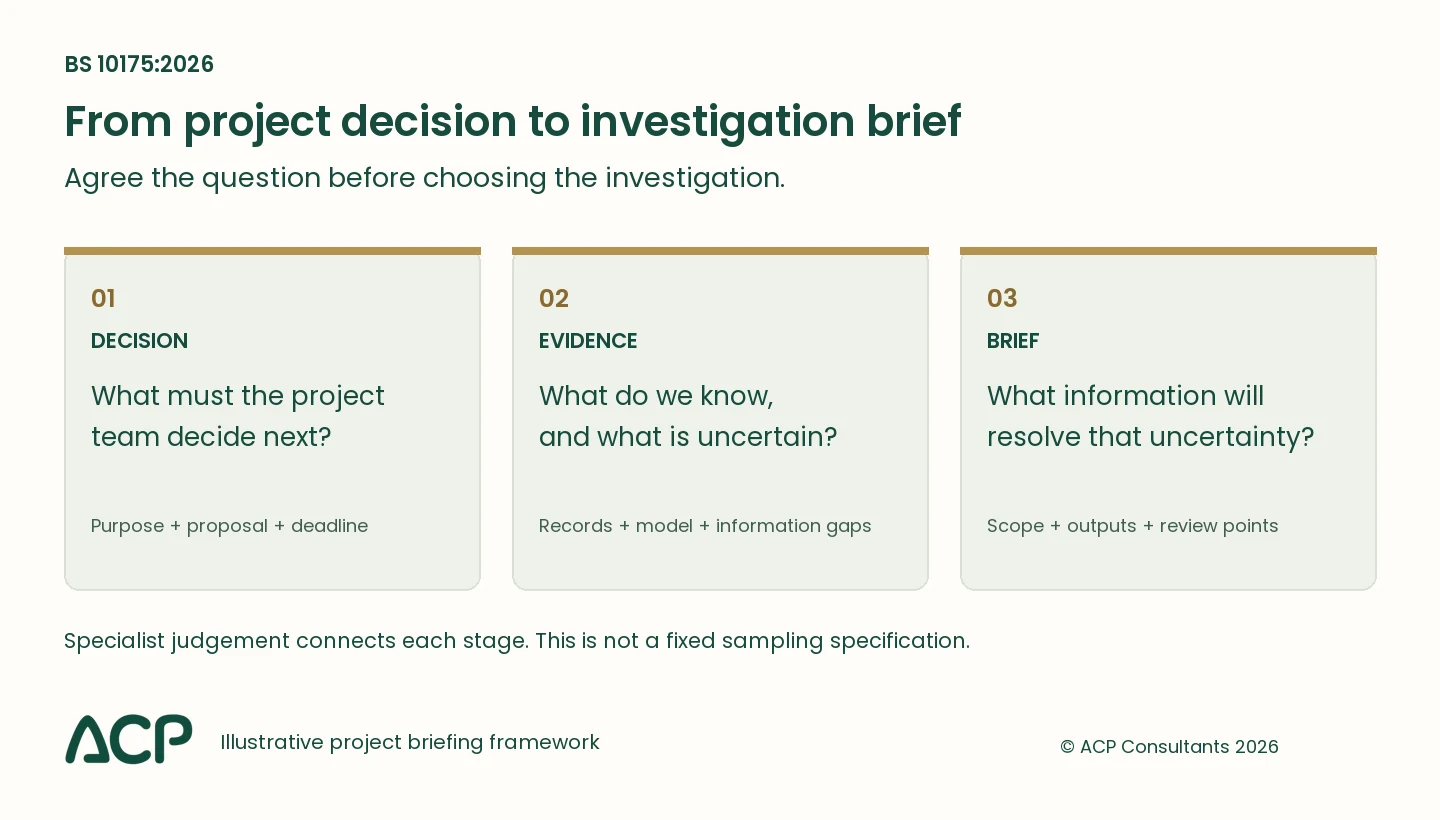
Define the contaminated land investigation brief
First, explain the proposed development and the decision date. For example, the team may need evidence for a planning submission, foundation coordination or a remediation strategy. Consequently, those purposes can require different information.
Next, assemble a single information pack. Include the latest site boundary, layout, levels and intended uses. Also provide previous reports in full, site history, access restrictions and regulator correspondence. Highlight missing appendices or areas that earlier work did not cover.
| Briefing question | Information to provide or request |
|---|---|
| What decision is due? | Name the planning, design or remediation decision and its deadline. |
| What is the intended use? | Show buildings, gardens, landscaped areas, drainage and likely earthworks. |
| What evidence exists? | Supply complete previous reports, drawings and relevant correspondence. |
| What remains uncertain? | Identify gaps in site history, access, coverage or the conceptual model. |
| How will work proceed? | Agree access, service clearance, permissions, welfare and coordination responsibilities. |
| What must the report deliver? | Request usable findings, limitations, recommendations and the next decision points. |
Finally, agree who can rely on the report and who will review it. A quotation should explain its assumptions, exclusions and arrangements for additional work. This makes comparisons more meaningful than comparing a headline price alone.
Use a conceptual site model
The Environment Agency’s LCRM framework begins with preliminary risk assessment. A desk study and walkover inform an initial conceptual site model. This model describes possible sources, pathways and receptors, then develops as evidence improves.
When applying BS 10175, ask the consultant to show which possible connections matter for your proposal. In particular, the model should distinguish observations from assumptions. It should also explain which gaps could change the assessment.
- 1 · Possible sourceA former fuel-storage area.Question: where was it, and what evidence remains?
- 2 · Possible pathwayMovement through soil or groundwater.Question: could a relevant connection exist?
- 3 · Potential receptorFuture residents or nearby water.Question: who or what could be affected?
For example, an old plan may show fuel storage away from the proposed buildings. However, that distance alone does not resolve every potential pathway. A specialist must consider the site conditions and intended use before choosing the investigation approach.
Similarly, changing a paved yard into private gardens changes the design context. Therefore, tell the consultant when the layout or use changes. Do not assume an earlier investigation answers a revised proposal automatically.
Agree sampling and programme dependencies
A contaminated land investigation brief should explain what the investigation needs to establish. It should not prescribe a convenient number of holes without a technical rationale. Ask how the proposed locations, depths and tests address the conceptual model and remaining uncertainties.
Also ask how the team will respond to unexpected conditions. Access restrictions, buried obstructions or new evidence may change the work. Therefore, the quotation should identify who can approve a revised scope and how that affects cost and timing.
- Confirm which areas the team can access and when.
- Identify underground services and agree the clearance process.
- Coordinate intrusive work with occupiers, contractors and other surveys.
- Ask which laboratory tests support the investigation objectives.
- Allow for monitoring, follow-up work and regulator discussion where relevant.
- Agree how field observations and design changes will reach the project team.
Where relevant, ask how climate conditions could affect the investigation or future site use. BSI’s revised emphasis supports that discussion. However, the answer should reflect the actual site rather than a generic climate paragraph.
Make the report useful for the next decision
For your contaminated land investigation brief, agree the report’s intended audience and required outputs. For instance, the design team may need clear drawings alongside the technical findings. Meanwhile, a regulator may need supporting information that demonstrates how the investigation addresses identified risks.
Ask the report to distinguish completed work, limitations and outstanding actions. It should explain whether the evidence resolves the investigation objectives or whether further work remains. Consequently, the team can plan the next stage without treating uncertainty as approval.
In England, planning guidance expects proportionate information about contamination and suitability for the intended use. An investigation report does not itself grant planning permission or discharge a condition. Therefore, check the relevant submission and approval requirements with the planning authority and appointed specialist.
A practical handover check
Before freezing the layout, ask: does the investigation still cover the current boundary, uses and levels? Record who will resolve each outstanding action. Then keep the report, drawings and correspondence together in the project information pack.
Check the brief before fieldwork
Ask the team to explain one proposed investigation location in plain language: which uncertainty will it resolve, and what decision could change? This helps distinguish targeted evidence from a list of tests without a stated purpose.
- First, record the source, pathway and receptor being investigated, including uncertainty in the existing information.
- Next, agree how access restrictions, buried services or unexpected ground conditions will trigger a revised plan.
- Finally, request factual results and their interpretation separately, with limitations and recommended next decisions clearly identified.
Our contaminated land assessment service explains the wider assessment stages. Where excavation could affect nearby people, coordinate the ground investigation with the air quality assessment brief so each specialist uses consistent site and material information.
Common questions
Is BS 10175:2026 the current edition?
BSI lists BS 10175:2026 as the current edition, published on 28 January 2026. Check the publisher’s status when commissioning work, particularly if an older report or specification cites an earlier edition.
Does BS 10175 replace a Phase 1 assessment?
No. BS 10175 guides investigation practice. A preliminary risk assessment establishes the site context and possible contaminant linkages. Its findings help determine whether further investigation is necessary and what that work should address.
How do you test potentially contaminated land?
A competent specialist first reviews the available evidence and conceptual site model. They then select suitable investigation and testing methods for the relevant uncertainties. There is no single test that proves every site suitable for every use.
How much does a contaminated land investigation cost?
Cost depends on the objectives, site size, access, investigation methods, testing and monitoring requirements. Ask for a site-specific scope with assumptions and exclusions. A desk study price is not directly comparable with an intrusive investigation quotation.
Does an investigation establish who is legally liable?
Not by itself. Technical investigation and legal responsibility are different questions. Planning responsibilities, statutory contamination liability and contractual arrangements can differ. Seek appropriate project-specific advice before relying on a report to allocate liability.
References and scope
This is general briefing guidance. Investigation design, assessment and regulatory submissions require competent site-specific judgement.
- BSI. BS 10175:2026 — Investigation of potentially contaminated sites: Code of practice.Published 28 January 2026. Public record supports edition and scope; the licensed full standard is not reproduced or compared clause by clause.
- BSI. How the UK’s key standard for contaminated land has evolved to meet modern needs.Publisher commentary on the 2026 revision, dated 2 February 2026. Read alongside the standard, not as a substitute for its requirements.
- Environment Agency. Land contamination risk management: Stage 1 — Risk assessment.Supports preliminary risk assessment and the conceptual site model. Apply the current LCRM framework to the site and regulatory context.
- GOV.UK. Planning practice guidance: Land affected by contamination.England planning context for assessing and managing land-contamination risks.