
ACP Insights & Guidance
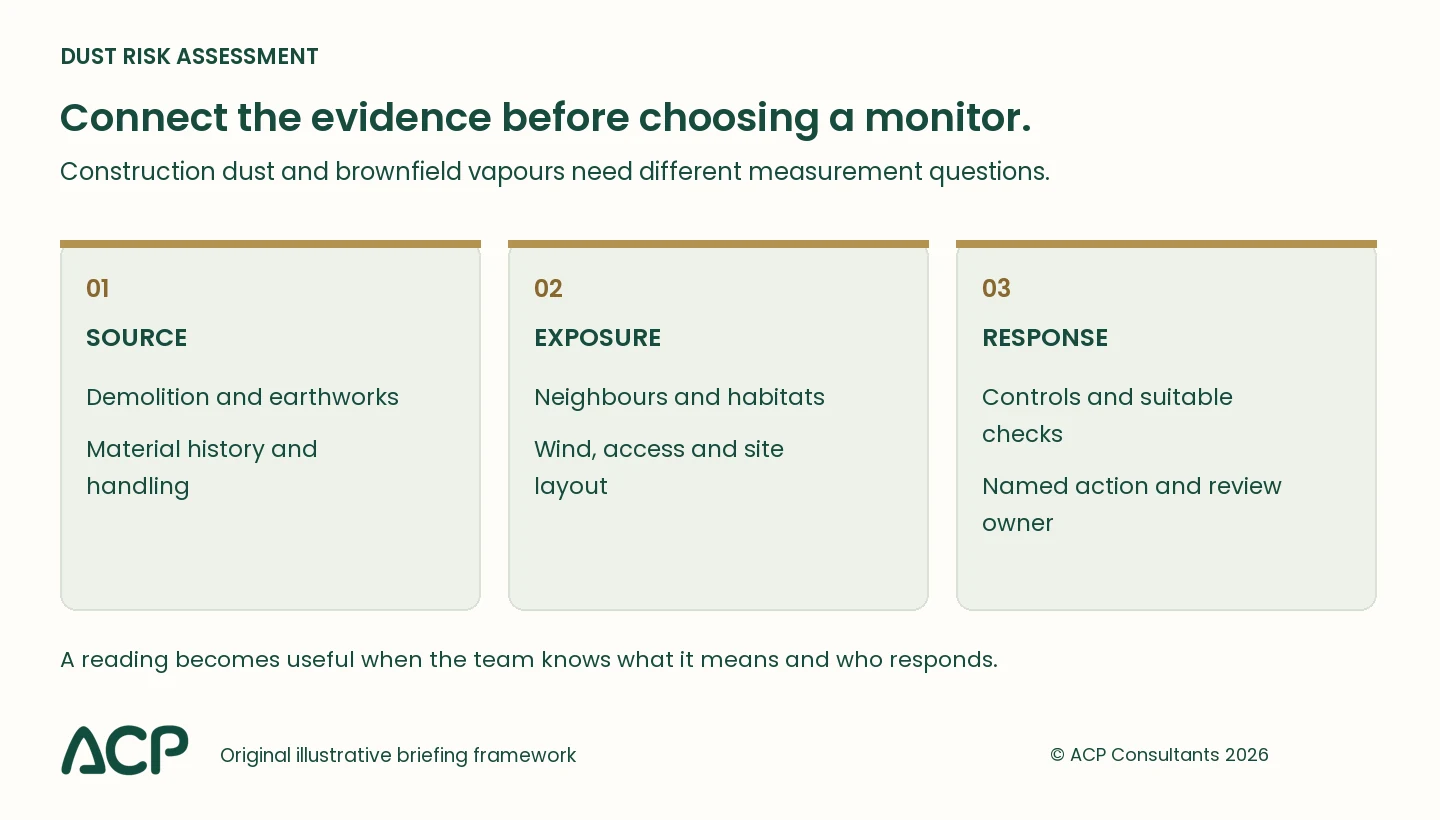
A dust risk assessment connects construction activities with nearby people, property and habitats. Use it to agree practical controls, monitoring questions and responsibilities before work starts. Brownfield remediation may also need a separate review of vapours and odour.
The practical answer
Start with the activity, the potential effect and the decision needed. Then select suitable evidence, controls and monitoring. An assessment, a management plan and a monitoring plan serve different purposes; a particle monitor cannot describe every airborne substance.
Choose the right guidance and edition
As checked on 29 October 2026, the Institute of Air Quality Management (IAQM) register lists its January 2024 dust assessment guidance, version 2.2. Its register describes an update in progress, with member consultation expected in Q4 2026. That timetable does not establish a replacement final edition.
Meanwhile, the separate construction monitoring guidance remains the 2018 version 1.1. IAQM lists its next member consultation for Q1 2027. The brownfield monitoring guidance is a different document: version 1.0, published in October 2025.
Therefore, record the document and edition in the project brief. Also check planning conditions and local requirements. A report should explain which guidance applies to each question, rather than treating all three documents as interchangeable.
Separate assessment, management and monitoring
The dust risk assessment considers activities, emission potential and the sensitivity of the surrounding area. Next, the management plan turns the findings into site instructions. Finally, monitoring provides selected evidence about conditions and the performance of controls.
| Deliverable | Useful question for the brief |
|---|---|
| Assessment | Which activities and receptors drive the risk, and what assumptions support that judgement? |
| Management plan | What must the contractor do, where, when and under whose supervision? |
| Monitoring plan | What will be checked, how will results be interpreted, and who will respond? |
In particular, keep ambient community exposure and workplace exposure assessments distinct. Their locations, methods and criteria may differ. Coordinate the relevant specialists where both affect the same works.
Prepare the site information pack
First, issue one current site plan and programme. Ask the design and construction teams to identify changes before the assessor fixes the scope.
- Show demolition areas, excavation, construction phases and vehicle routes.
- Describe material handling, stockpiles, crushing or screening where proposed.
- Identify nearby homes, schools, care settings and potentially sensitive habitats.
- Include boundaries, access points, haul routes and practical monitoring positions.
- Provide relevant land investigation findings and known uncertainties about materials.
- Attach the exact planning condition, validation request or regulator correspondence.
Next, separate confirmed inputs from provisional information. For example, record whether a haul route represents the contractor’s agreed plan or an early design assumption. That distinction helps the team identify when the assessment needs review.
Add brownfield monitoring questions where needed
The 2025 IAQM brownfield guidance addresses air pollutants associated with remediation, including volatile compounds and odour. It encourages coordination between air quality and contaminated land specialists. Its scope does not replace the construction dust guidance.
For the project brief, ask the land specialist to identify the material and process uncertainties. Then ask the air quality specialist which airborne substances and exposure questions need attention. Agree suitable methods, locations, quality checks and response arrangements before monitoring starts.
A total volatile organic compound reading does not, by itself, identify every compound or establish a health conclusion. Likewise, an odour observation and a particle concentration describe different things. Therefore, the report needs a reasoned interpretation of the selected evidence.
A revised excavation sequence: worked example
A revised excavation sequence
Imagine a former industrial plot beside occupied homes. The contractor moves a stockpile closer to the boundary and brings excavation forward. This is an illustrative example, not an ACP project or a calculated risk rating.
First, the project manager records the revised drawing and dates. Next, the assessor checks whether the original source and receptor assumptions still hold. The land specialist also reviews whether the material history raises a separate vapour or odour question.
Finally, the contractor receives the revised controls and reporting instructions. Any monitoring change records the reason, location and responsible person. The team therefore avoids treating the original report as approval for an altered working method.
Turn monitoring results into an agreed response
Before installation, agree who checks equipment, reviews results and receives alerts. Also define the procedure for unusual readings, complaints, instrument faults and changes in weather or activity. The responsible specialist should set and justify any project action levels.
In addition, keep a short decision log. Record the observation, relevant work, weather, response, person responsible and follow-up outcome. This makes later review more useful than an isolated graph with no site context.
Finally, confirm how the contractor will obtain advice outside normal reporting cycles. Clear ownership matters when the programme changes quickly. A monitoring dashboard should support active management, rather than become the project’s only control.
Keep the site response record practical
Use a consistent record when an alert or complaint needs investigation. The entries should explain the decision, including uncertainty, rather than imply that every alert proves a site impact.
| Record | Check and action |
|---|---|
| Observation | Record the time, location, reading or complaint, and any equipment fault flag. |
| Context | Record the work in progress, relevant weather and other possible sources. |
| Decision | Identify who checked the evidence, the agreed action and any unresolved question. |
| Follow-up | Record the outcome, responsible person, next check and whether the plan needs revision. |
The air quality assessment brief should connect risk assessment with construction controls. On brownfield projects, share the contaminated land findings so monitoring addresses relevant pollutants rather than particles alone.
Common questions
Does every construction site need continuous dust monitoring?
No. Instead, the scope depends on the assessed risks, site circumstances and applicable requirements. Agree whether inspections, measurements or a combination provide suitable evidence.
Is a dust risk assessment the same as a dust management plan?
No. The assessment explains the risks and mitigation needs. The plan translates those findings into actions, responsibilities and checks for the site team.
Can a PM monitor measure brownfield vapours?
A particle instrument does not measure all gaseous contaminants. Select equipment for the substances and questions identified through the site assessment.
Can I use a standard dust risk assessment template?
A template can organise information, but it cannot supply the site-specific evidence or professional judgement. Check every assumption against the actual proposal.
What affects the cost of a dust assessment and monitoring?
The scope, site complexity, available information and reporting needs affect the fee. Monitoring also depends on equipment, locations, duration and support. Therefore, request a quotation against a clear brief.
References and scope
This practical briefing concerns development projects in England. It does not provide numerical assessment criteria, a monitoring specification or a comparison with an unpublished edition. Apply the full relevant guidance and project requirements.
- Institute of Air Quality Management. Guidance register.Used to distinguish published guidance from consultation and planned updates.
- IAQM. Guidance on the assessment of dust from demolition and construction, version 2.2, January 2024.Assessment reference for the construction-dust brief. The article does not reproduce numerical criteria or prescribe a generic monitoring trigger.
- Institution of Environmental Sciences / IAQM. Good Practice on Air Quality Monitoring for Brownfield Projects, 2025.Publisher resource for brownfield monitoring scope. The full large PDF was not retrieved; detailed method or threshold claims are excluded.
- GOV.UK. Planning practice guidance: Air quality.England planning context for the assessment brief and relevant development effects.
- IAQM (2018). Guidance on Monitoring in the Vicinity of Demolition and Construction Sites, version 1.1.Monitoring purpose, responsibilities and the interpretation of site evidence; distinct from the construction assessment guidance.