
ACP Insights & Guidance
A commercial kitchen extraction brief connects the cooking operation with the system design, nearby buildings and maintenance plan. Agree the planning evidence before equipment selection. Give the operator, extraction designer and environmental assessors one current information pack.
The practical answer
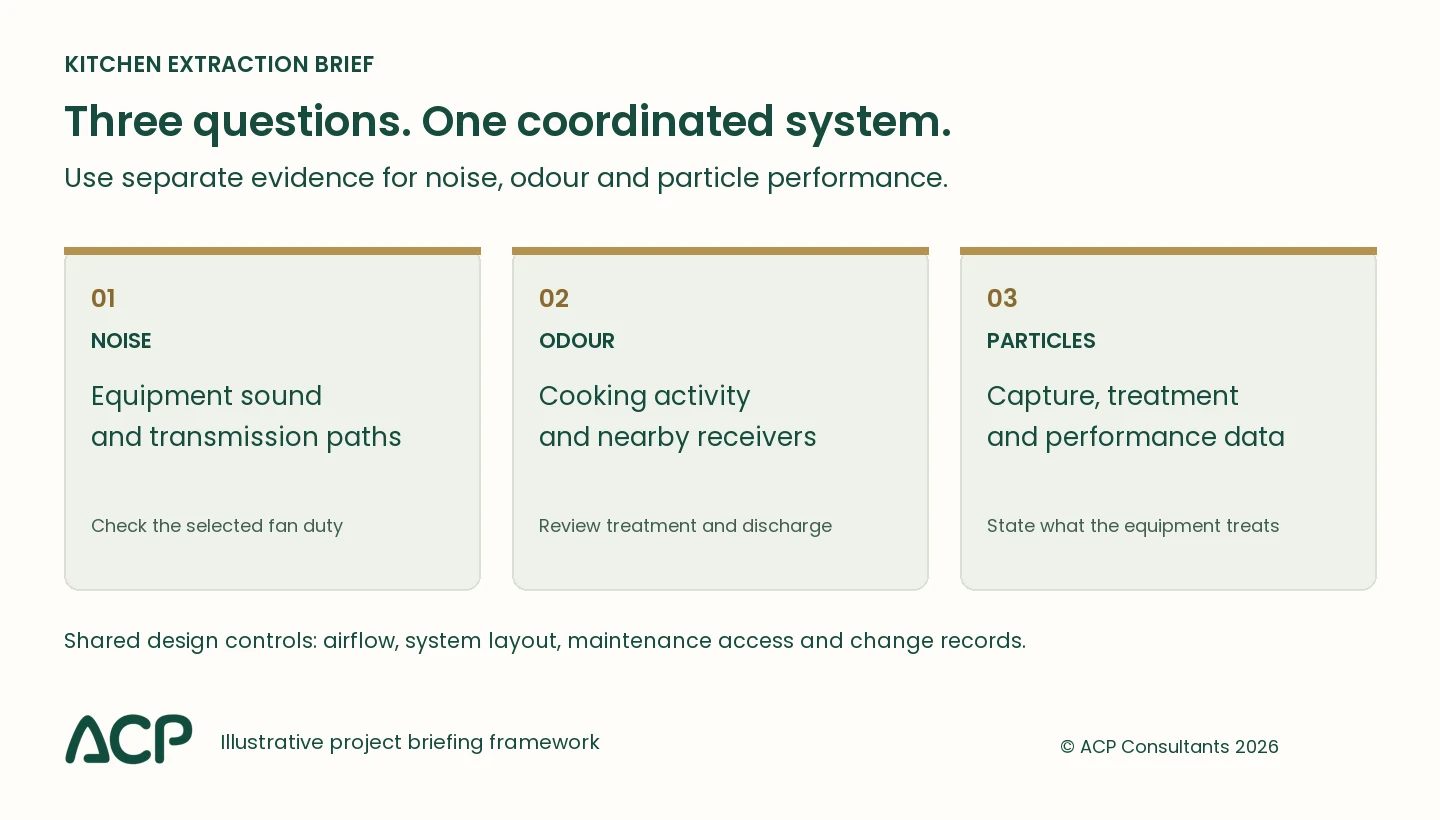
Noise, odour and particles require distinct evidence, even though they share one extraction system. Confirm the cooking assumptions, drawings, equipment duty and local submission requirements. Then record design changes and maintenance responsibilities so the final installation matches the assessed proposal.
Define the cooking operation
Describe the menu, cooking methods, appliances, anticipated throughput and operating hours. Include preparation, cleaning and plant run-on where relevant. Otherwise, the assessment may describe a quieter or less intensive operation than the business intends.
Also identify any uncertainty about the future operator. A shell unit with no agreed food use needs an explicit design assumption. Record who will confirm that assumption before equipment selection and installation.
For example, changing from reheating prepared food to regular grilling can alter the questions the team must assess. Therefore, treat a menu or appliance change as a review trigger, rather than a minor administrative update.
Separate noise, odour and particle evidence
These issues interact through the same extraction system, but they require different evidence. A noise result does not describe odour, and an odour judgement does not establish particulate performance. Ask the specialist team to explain what each assessment covers.
Noise and vibration
Provide the fan and other plant data, operating conditions and proposed locations. Also show the duct route and nearby sensitive uses. The acoustic assessor can identify the relevant sound paths and the information needed to evaluate them.
Odour and discharge
Describe the cooking source, treatment stages and outlet arrangement. Include neighbouring openings, balconies and air intakes on the drawings. Then obtain a reasoned assessment of the proposed operation and its surroundings.
Smoke, grease and particles
Ask what each treatment stage captures and under which operating conditions. Request supporting performance information rather than relying on a product name. Where particulate emissions need further assessment, agree the scope explicitly; do not substitute an odour score.
Keep worker safety and neighbouring amenity within their appropriate professional scopes. The Health and Safety Executive (HSE) kitchen ventilation guidance addresses workplace ventilation and related responsibilities. A planning assessment alone does not demonstrate compliance with every ventilation, gas or fire-safety requirement.
Coordinate the planning information pack
| Information | What to provide | Who should confirm it |
|---|---|---|
| Operation | Cooking methods, appliances, throughput and hours | Operator or applicant |
| System | Canopy, duct route, fan duty, treatment and discharge | Extraction designer |
| Context | Building geometry and relevant sensitive locations | Design team and assessor |
| Evidence | Equipment data; acoustic and odour reports where required; stated assumptions, limitations and any separate particle-emission evidence | Supplier and specialist assessor |
| Upkeep | Access, cleaning, replacement, service responsibilities and the proposed maintenance schedule | Designer, operator and maintenance provider |
| Submission record | A drawing and report register cross-referenced to each local validation requirement or planning condition | Applicant and planning team |
Use drawing numbers and revision dates throughout the submission pack. Then identify which details remain provisional. This prevents a supplier quotation from silently becoming the final assessed design.
Also retain the council’s request or planning condition in the bundle. It gives the team a common reference for the submission. Where wording is unclear, resolve the assessment scope before commissioning disconnected reports.
Review changes before ordering equipment
Update the brief when adding treatment or attenuation, because either can affect the system design. Therefore, ask the extraction designer to confirm the resulting airflow, pressure requirements and equipment selection. The environmental assessor should review any changes that affect their assumptions.
For example, a project may add an attenuator after the first acoustic review. The designer then proposes a different fan to meet the revised duty. The team should check that the original acoustic evidence still describes the selected equipment.
Similarly, moving an outlet to resolve an architectural concern can change its relationship with nearby windows. Record the new location and obtain the relevant review. A report based on the earlier arrangement cannot automatically support the change.
One change record. Describe what changed, why it changed, which assessment it affects and who confirmed the response.
Plan maintenance and access
A treatment proposal needs a practical upkeep plan. Ask for inspection, cleaning and replacement requirements, together with safe access arrangements. Also confirm who will organise the work and retain service records.
HSE identifies maintenance as an important part of reliable catering equipment operation. Follow suitable manufacturer information and competent advice for the actual equipment and use. A generic frequency cannot describe every system.
Before handover, check that the operator receives the final equipment schedule and operating instructions. Explain any assumptions about hours, cooking or maintenance that underpin the assessment. This makes later changes easier to identify and review.
Use the relevant guidance and local requirements
EMAQ+ publishes guidance on controlling odour and noise from commercial kitchen exhaust systems. Obtain the applicable edition through the publisher and confirm which references the authority expects. This briefing checklist does not reproduce its risk tables or provide a clause-by-clause edition comparison.
Local submission requirements also matter. For example, Epping Forest’s commercial-kitchen guidance asks for specialist system design and addresses odour, fumes, droplets and noise. That is a local example, so check the relevant authority’s requirements for your own site.
Identify the guidance used in the assessment brief and explain the assessment’s limitations. Avoid describing a guidance document as a universal approval certificate. The decision still concerns the proposed use, evidence and site circumstances.
Check the installed system against the assessed design
Before accepting a supplier substitution, compare it with the assessed design. Equivalent airflow alone does not establish equivalent noise, odour control, pressure loss or maintenance access. Keep the full system and operating duty in view.
- First, match equipment references, fan operating points, treatment stages and discharge arrangements to the approved drawings.
- Next, identify the evidence needed to demonstrate the installed system meets the agreed design requirements.
- Finally, provide accessible maintenance instructions, service responsibilities and a record of later changes.
Our commercial kitchen noise and odour assessment service covers the coordinated planning brief. Use the noise assessment team to resolve acoustic changes before equipment procurement fixes the available options.
Common questions
What is a commercial kitchen extraction system?
It captures and removes cooking fumes and heat through an arrangement of canopy, ductwork and extraction equipment. The detailed design should address the actual appliances and operation. Suitable replacement air and safe discharge also need consideration.
Does an odour filter remove all smoke and particles?
Do not assume that it does. Ask what the proposed equipment treats and obtain performance information for the relevant conditions. Different treatment stages may address different components of the exhaust.
Does an odour assessment prove acceptable noise?
No. Noise needs appropriate acoustic evidence. Although both assessments use the same system description, one conclusion cannot substitute for the other.
How often should extraction equipment be cleaned?
Agree a maintenance schedule for the equipment, cooking intensity and operating pattern. Use manufacturer requirements and competent advice. Also provide safe access and keep records so the operator can demonstrate the planned upkeep.
What changes should trigger another review?
Examples include a different cooking method, longer hours, replacement fan, revised treatment or moved discharge. Update the kitchen extraction brief and ask the relevant specialists whether the existing evidence remains suitable.
What information supports a commercial kitchen extraction planning submission?
Start with the council’s validation requirements or condition. Usually, the team needs an operation description, coordinated drawings and equipment data, plus the assessments and maintenance information required for that site. Ask the planner and specialists to confirm the deliverables before ordering equipment.
References and scope
Apply the relevant jurisdiction, local requirements and project-specific professional advice. These references support the scope described above.
- Health and Safety Executive. Ventilation in catering kitchens, Catering Information Sheet No 10.Workplace ventilation guidance. Detailed gas, fire-safety and extraction design need appropriately defined specialist input.
- Health and Safety Executive. Catering and hospitality: frequently asked questions.Operational and maintenance context; not a substitute for the site-specific planning assessment.
- Epping Forest District Council. Commercial Kitchens Systems Guidance Note & Risk Assessment, December 2025.Local submission guidance. Its requirements must not be presented as a universal national checklist.
- Ricardo / EMAQ+. Control of odour and noise from commercial kitchen exhaust systems — publisher access notice.The linked notice concerns access to the publication. It does not establish that the full current edition has been reviewed.