
Bats and lighting need consideration while paths, parking areas and external spaces are still being designed. A useful brief connects ecological evidence with the proposed layout, light fittings and operating hours. It gives the ecologist and lighting designer the same proposal to assess.
This guide is for developers, architects and project managers preparing that brief. It explains what to coordinate, what evidence to request and how to keep the agreed approach intact through installation.
The starting point
Establish where lighting is genuinely needed, identify the habitats and features that require protection, and test the layout before selecting products.
A fitting described as “bat friendly” cannot establish that the complete scheme is suitable. Its location, output, spectrum and controls need consideration alongside the site evidence.
Why bats and lighting are a layout question
Artificial light can affect how bats emerge, feed and move through the landscape. Responses differ between species and situations. Seeing bats around a lamp does not demonstrate that lighting is harmless to every species using the site. The Bat Conservation Trust explains these different effects.
Therefore, look beyond the building footprint. A new path may introduce evening activity beside a hedgerow. A car park may add lighting near a watercourse. Internal light through glazing may also need consideration where it reaches relevant habitats.
For planning in England, Natural England’s standing advice includes effects on roosts, commuting routes and foraging areas. It also identifies lighting near suitable habitat as a reason to consider survey evidence. The appointed ecologist should establish the scope; a drawing or photograph cannot resolve that question alone.
If the evidence is incomplete, begin with an appropriate bat survey and assessment brief. Record the information gap before the team fixes an affected layout decision.
Build a coordinated bats and lighting brief
First, prepare a common base plan with a revision and issue date. Show the site boundary, retained vegetation, buildings, proposed routes and relevant nearby features. Distinguish surveyed information from assumptions, and label any unconfirmed area clearly.
Next, explain how each external space will operate. Identify its users, expected hours and the practical reason for any proposed lighting. Include access, security and accessibility requirements so the team can resolve these alongside the ecological constraints.
Then allocate the decisions. The ecologist interprets the bat evidence; the lighting designer develops and tests the lighting proposal. Architects, landscape designers and the future operator supply the related layout and use information. Name the coordinator who will keep those inputs aligned.
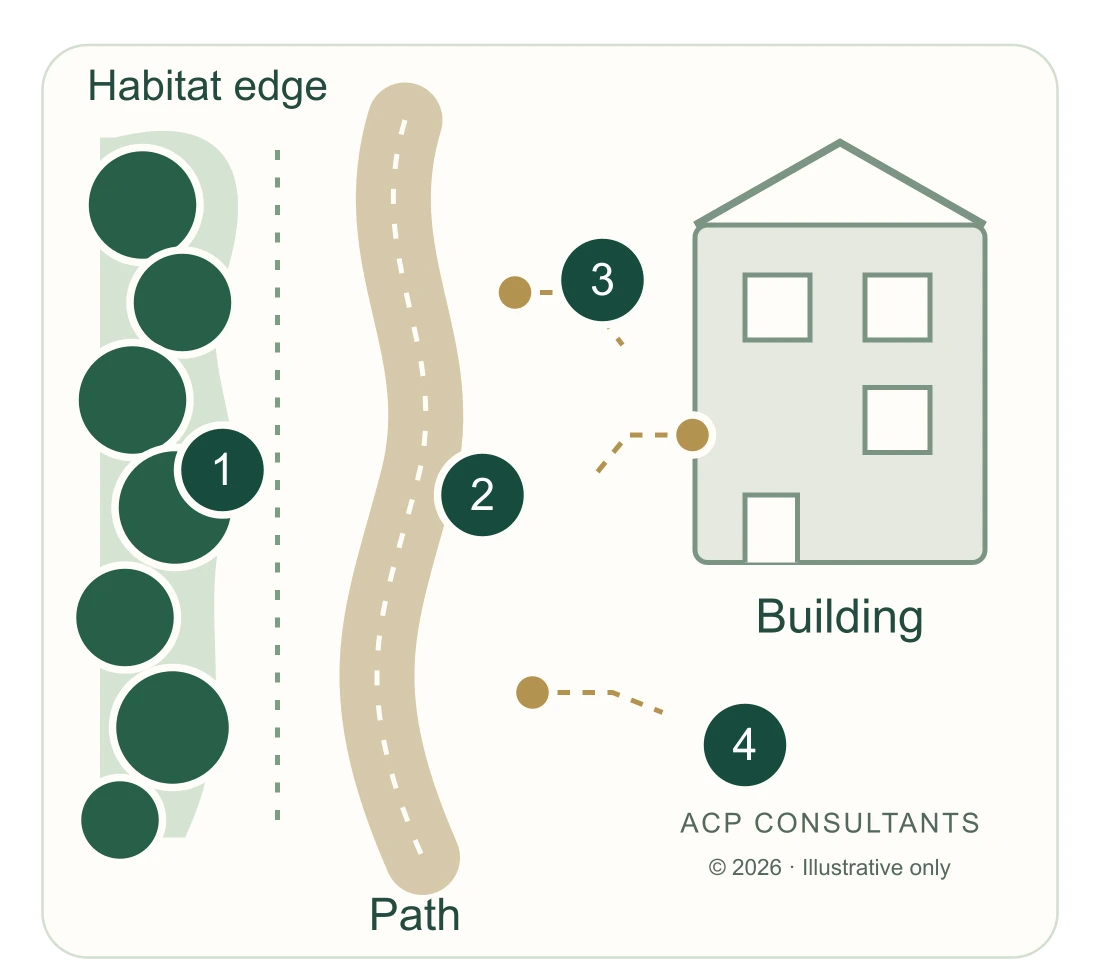
- Habitat evidenceIdentify the features and connections the ecologist needs to evaluate.
- Route and useExplain where people need to move and when the route will operate.
- Lighting proposalLocate each fitting and provide the matching specification and controls.
- Review and verificationAgree the evidence, reviewer and checks needed before installation and handover.
Keep the plan useful when the design changes. For example, moving an entrance may alter both the pedestrian route and the lighting arrangement. Send the coordinated revision for review rather than issuing separate drawings that describe different schemes.
What to include in the lighting brief
A product name and a row of symbols are not a complete brief. Use the following checklist to request the information needed for a meaningful review. Mark unavailable items as outstanding and give each one an owner.
| Brief item | Information to provide |
|---|---|
| Ecological context | Current report and plans; relevant features, evidence limitations and questions awaiting the ecologist’s decision. |
| Layout and levels | Matching site and landscape drawings, proposed mounting positions and heights, and relevant changes in ground level. |
| Fitting schedule | Unique references, exact product and optical option, output, shielding, orientation and manufacturer’s photometric information. |
| Light characteristics | The specified colour temperature and available spectral information, identified by product reference rather than a marketing label. |
| Operating states | Normal use, dimming, switching times, sensor behaviour, overrides and any relevant security or emergency arrangements. |
| Other sources and screening | Relevant existing lighting, nearby sources, glazing and proposed screening. State which assumptions depend on planting or future maintenance. |
| Evidence and ownership | Required calculations or surveys, current revision, responsible designer, ecological reviewer and outstanding decisions. |
For example, a supplier substitution may retain the same appearance while changing the light distribution. Therefore, use the exact product reference in the schedule. Record proposed substitutions as design changes that need the appropriate review.
Also separate a design intention from a confirmed arrangement. “Lights off after closing” needs an agreed closing time, control method and person responsible for operation. The future manager should understand that commitment before it becomes part of the handover pack.
Ask for evidence that answers the site question
The ILP and Bat Conservation Trust’s Guidance Note 08/23 prioritises avoiding lighting impacts on important bat habitats. It then addresses sensitive design, assessment and verification. Use its site-specific process rather than treating a generic lux value or lamp colour as a complete solution. [1]
Where calculations are required, agree the features and assessment planes to show. Ground-level contours alone may not describe exposure at a vertical habitat edge. The specialists should define the relevant operating states, baseline information and review criteria. [1]
Ask the lighting designer
Which drawings, fittings, settings and assumptions does this calculation represent? What would invalidate it?
Ask the ecologist
Does this evidence address the identified features and uncertainties? What remains to be resolved?
Keep the responses beside the relevant drawing revision. If a calculation assumes screening, record what provides it and when it will exist. Similarly, identify any lighting outside the project team’s control instead of quietly assuming it is absent.
Part-night controls are not an automatic solution: the hours proposed for lighting may coincide with important bat activity. Review the operating pattern with the ecologist rather than selecting a timer setting in isolation. [1]
A new evening-use path beside retained habitat
Illustrative coordination example
A revised landscape layout introduces a pedestrian connection beside a retained boundary feature. The architect expects occasional evening use, while the facilities brief assumes continuous access. The lighting supplier has priced a fitting but has not received the ecological constraints.
The coordinator first resolves the conflicting use assumptions. The team then compares route options and defines the information needed for ecological and lighting review. It records the selected layout, product references, controls and remaining evidence requirements together.
Before ordering equipment, the coordinator checks that the reviewed package and procurement schedule match. Any substitution goes back to the relevant specialists. This example illustrates a decision process; it does not demonstrate that a particular path or lighting design is acceptable.
The useful outcome is a traceable decision, not simply a note saying “bats considered”. Retain the question, the evidence used, the reviewer’s response and the drawing revision to which that response applies.
Carry the lighting design into installation and handover
Before installation, reconcile the contractor’s information with the reviewed design. Check fitting references, mounting details, shielding and control settings. Give the contractor a clear route for raising changes, including seemingly small alterations made on site.
Where post-completion lighting checks are required, agree their scope and responsibility in advance. GN08/23 links verification to the assessed lighting states and relevant measurement criteria; it also discusses monitoring where appropriate. [1]
Afterwards, give the operator the current drawings, settings, inspection requirements and contact details. Explain who can authorise a change. A later security light, altered sensor setting or replacement fitting should trigger the agreed review process.
- Confirm that the ecological report and lighting design refer to the same layout.
- Resolve outstanding information before the affected decision or purchase.
- Record any site substitution and its review outcome.
- Retain required verification findings and outstanding actions.
- Give the future operator practical, current instructions.
Where the scheme also affects landscaping or other habitats, coordinate the brief with the wider ecology assessment. Keep those commitments visible in the project information.
Questions about bats and lighting
Does an LED fitting automatically make lighting suitable for bats?
No. “LED” describes a light-source technology. The fitting’s characteristics, location and operation still need consideration alongside the ecological evidence. Ask for the actual specification and design review rather than relying on a product label.
Is there one safe lighting level or colour temperature for every site?
No single number establishes that a whole scheme is acceptable. The affected species, features and proposed lighting arrangement matter. The ecologist and lighting designer should explain the applicable guidance, criteria and limitations for the site.
Can a timer remove the need for ecological review?
No. Explain when the lighting would operate and which activities could trigger it. The team must consider that pattern alongside the ecological evidence; switching off later does not establish that the earlier lighting period is acceptable.
Do we need to consider light coming through windows?
Yes, where internal lighting could reach relevant bat habitats or features. Include the glazing and intended use in the brief. The specialist team should determine whether it affects the assessment and what design response is necessary.
What should we send ACP for an initial discussion?
Send the site location, current layout, planning stage and available ecology reports. Include the lighting proposal, intended operating hours and the decision you need to make. Identify any missing information or approaching procurement deadline.
References and scope
- Institution of Lighting Professionals and Bat Conservation Trust (2023). Guidance Note 08/23: Bats and Artificial Lighting at Night. Rugby: ILP. See section 4, including the mitigation hierarchy, design considerations, assessment and post-completion checking, pp. 21–40. The linked resource page provides the full 73-page PDF. Its website listing date is not a new guidance edition.
- Natural England (2022, updated 7 April 2025). Bats: advice for making planning decisions. GOV.UK. Standing advice for local planning authorities in England, including survey evidence and effects on roosting, commuting and foraging habitats.
- Bat Conservation Trust (undated). Lighting, Threats to bats. Background on how artificial light can affect bat behaviour. Accessed 29 October 2026.
- Bat Conservation Trust (2023 guidance announcement and current resource page). Artificial Lighting Guidance. Confirms the August 2023 GN08/23 release and links to the ILP publication. Accessed 29 October 2026.
The checklist, diagram and example are original ACP project-coordination material. This article supports briefing and review; the appointed specialists must determine the ecological evidence, lighting criteria and project-specific requirements. It does not supply a lighting specification or establish permission for works.
Bring the ecology and lighting questions together.
Discuss your site and design brief with ACP. Share the current proposal, available reports and the next decision your team needs to make.