
ACP Insights & Guidance
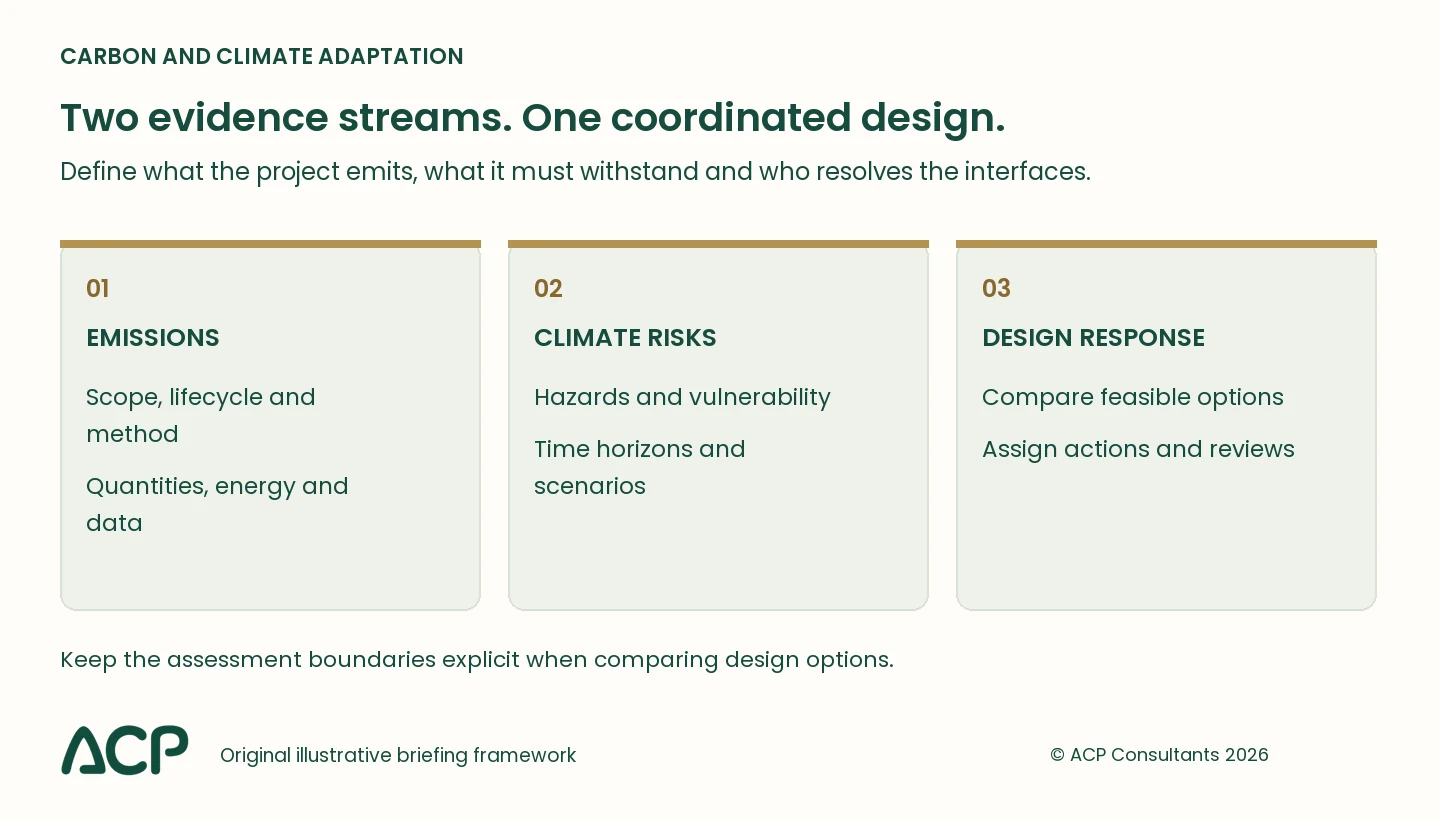
A whole life carbon assessment helps a project team understand emissions across an asset’s lifecycle. Climate adaptation asks a different question: how will the proposal cope with future hazards? Commission both with clear methods, evidence and responsibilities, then coordinate the design decisions.
The practical answer
Agree the assessment purpose, method, boundaries and submission requirements before modelling begins. Carbon and adaptation need distinct evidence, but their shared design inputs must remain consistent. A low-carbon result alone does not establish resilience to heat, flooding or other climate risks.
Define the assessment purpose
Start by naming the decision the assessment must support. For example, the team may need to compare retention and replacement options, inform material choices or meet a planning submission requirement. The purpose determines the information and reporting route to agree.
Whole-life assessment considers more than energy used during occupation. Depending on the applicable method and boundaries, it addresses emissions associated with materials, construction, use and end of life. Therefore, an operational energy calculation alone does not provide the same evidence.
Also distinguish an assessment from a promise of a particular saving. A credible comparison needs consistent assumptions and traceable inputs. Therefore, ask the appointed assessor to explain exclusions, data quality and uncertainty alongside the results.
Agree the method and submission route
RICS identifies its second edition professional standard as effective from 1 July 2024. Its current hub explains the requirements for RICS members undertaking WLCA and for assessments claiming compliance. Confirm the precise document version and reporting requirements in the appointment.
For London referable applications, the GLA’s published guidance contains an important qualification. At the 29 October 2026 check, it said its guidance and template remained based on first-edition methodology. It asked referable applications to follow that guidance, while allowing an additional second-edition assessment.
Consequently, do not assume that citing the latest professional standard automatically resolves the submission format. Agree how professional and authority requirements will both be addressed. Outside that route, check the relevant authority’s policy and validation requirements rather than applying London rules nationally.
Keep climate adaptation as a distinct assessment
Next, identify the climate hazards relevant to the site and its intended use. Heat, flooding, water availability and other hazards may affect different parts of a proposal. Their significance depends on exposure, vulnerability, design life and the available evidence.
Agree suitable future time horizons and scenarios with the responsible specialists. Then record how the assessment handles uncertainty. This supports a reasoned adaptation strategy without treating one projected future as a guaranteed outcome.
Government planning guidance for England encourages coordination between mitigation and adaptation and warns against maladaptation. For example, a design choice that reduces one problem can worsen another. Therefore, review the combined consequences before adopting a measure.
Coordinate the brief and deliverables
| Workstream | Information to agree | Decision to record |
|---|---|---|
| Carbon | Project boundary, method, reference period, quantities, product evidence and energy assumptions. | Which options will be compared, by whom and at what design stage? |
| Adaptation | Site hazards, vulnerable users or assets, time horizons, scenarios and existing studies. | Which risks need action, further analysis or a future review trigger? |
| Design coordination | Shared drawings, services, structure, landscape, drainage and maintenance requirements. | Who resolves conflicts and updates the relevant reports? |
| Submission and delivery | Required templates, authority requests, milestones and verification evidence. | What is due now, and what must be confirmed after detailed design or construction? |
In addition, maintain one assumptions register across the workstreams. If the energy strategy changes, check whether carbon inputs also need revision. Similarly, a different facade or roof arrangement may affect comfort, material quantities and maintenance.
| Record | Check and action |
|---|---|
| Whole life carbon assessment | A model and report that explain emissions, boundaries, inputs, data quality and the basis of option comparisons. Agree the required reporting format and update stages. |
| Climate adaptation assessment | A record of relevant hazards, exposure, vulnerability and design responses. Set responsibility for unresolved risks, monitoring and future review triggers. |
| Shared design decision | An options record linking the preferred design to both assessments. Explain any trade-offs and keep drawings, assumptions and responsibilities consistent. |
An illustrative shading and cooling decision
Comparing options before adding equipment
Imagine a design team considering external shading and a revised cooling strategy for a new building. This fictional example shows the questions to coordinate. It does not calculate savings or establish compliance.
First, the comfort specialist assesses the options using the agreed weather and occupancy assumptions. Meanwhile, the carbon assessor considers the relevant material, replacement and energy implications. The designers also check daylight, structure, ventilation, noise and maintenance access.
Next, the team compares the evidence on a consistent basis and records the reasons for its preferred option. If assumptions differ between reports, it resolves them before presenting a combined conclusion. Finally, it identifies which details need confirmation at the next stage.
Resolve the commissioning questions
Ask for a clear scope, information schedule and responsibility list. In particular, confirm which calculations the appointment includes and which specialist inputs others must provide. However, a general sustainability statement does not automatically include a detailed lifecycle model or climate-risk assessment.
- Which policy, client requirement or design question triggers each assessment?
- Which method, version, boundaries and reporting templates will be used?
- What drawings, quantities, product data and energy information are available?
- Which climate scenarios and asset time horizons need consideration?
- Who will review design conflicts and update the assumptions?
- What evidence, review rounds and later-stage checks are included?
Finally, align the programme with real design decisions. Early work can compare options while choices remain open. Later reviews should test material changes and replace provisional information with better evidence.
Compare options on a consistent basis
For an illustrative retention-versus-replacement comparison, define what each option delivers before comparing emissions. Different floor areas, service lives or performance assumptions can make a simple total misleading. Ask the assessor to explain the basis of comparison.
- First, record the functional brief, assessment boundary, reference period and data sources for each option.
- Next, distinguish measured quantities and product evidence from provisional assumptions, with sensitivity checks where appropriate.
- Finally, revisit the preferred option when design changes materially affect quantities, energy use or replacement assumptions.
Our climate and sustainability assessment service helps frame the wider brief. Reconcile shared inputs with the energy and sustainability statement, while retaining the distinct methods and reporting requirements of each assessment.
Common questions
What is a whole life carbon assessment?
It evaluates emissions across an agreed lifecycle and scope using a defined method. The brief should identify the project boundary, input data, assumptions and reporting requirements.
Is whole-life carbon the same as operational energy?
No. Operational energy is one part of the wider picture. Materials, construction, maintenance, replacement and end-of-life assumptions may also be relevant under the agreed assessment method.
Does a low-carbon proposal automatically address climate adaptation?
No. Emissions performance does not establish resilience to heat, flooding or other climate hazards. Assess those risks and coordinate the resulting design measures.
Does every English planning application need the London WLC template?
No. The GLA route has its own policy scope. Check the requirements for the actual authority, application and project rather than assuming a national rule.
Can the carbon and adaptation work use different assumptions?
Some methods need different inputs, but shared assumptions should be reconciled or their differences explained. Otherwise, a combined design conclusion can become misleading.
References and scope
England-focused commissioning guide, checked 29 October 2026. London requirements are labelled separately. This article explains scope and coordination; it does not provide a lifecycle calculation, certify compliance or claim a newly operative national requirement. Check current authority instructions at submission.
- RICS. Whole life carbon assessment for the built environment, second edition.Effective 1 July 2024; current hub identifies version 3, August 2024. Confirm the applicable version and compliance requirements in the appointment.
- Greater London Authority. Whole Life-Cycle Carbon Assessments guidance.London referable-application route. The checked guidance retains its first-edition template basis and permits an additional second-edition assessment.
- GOV.UK. Planning practice guidance: Climate change.Used for coordination between mitigation and adaptation. Historic target wording on this page is not repeated as current policy.