
Reptile survey guidelines: season, methods and planning
ACP Insights & Guidance
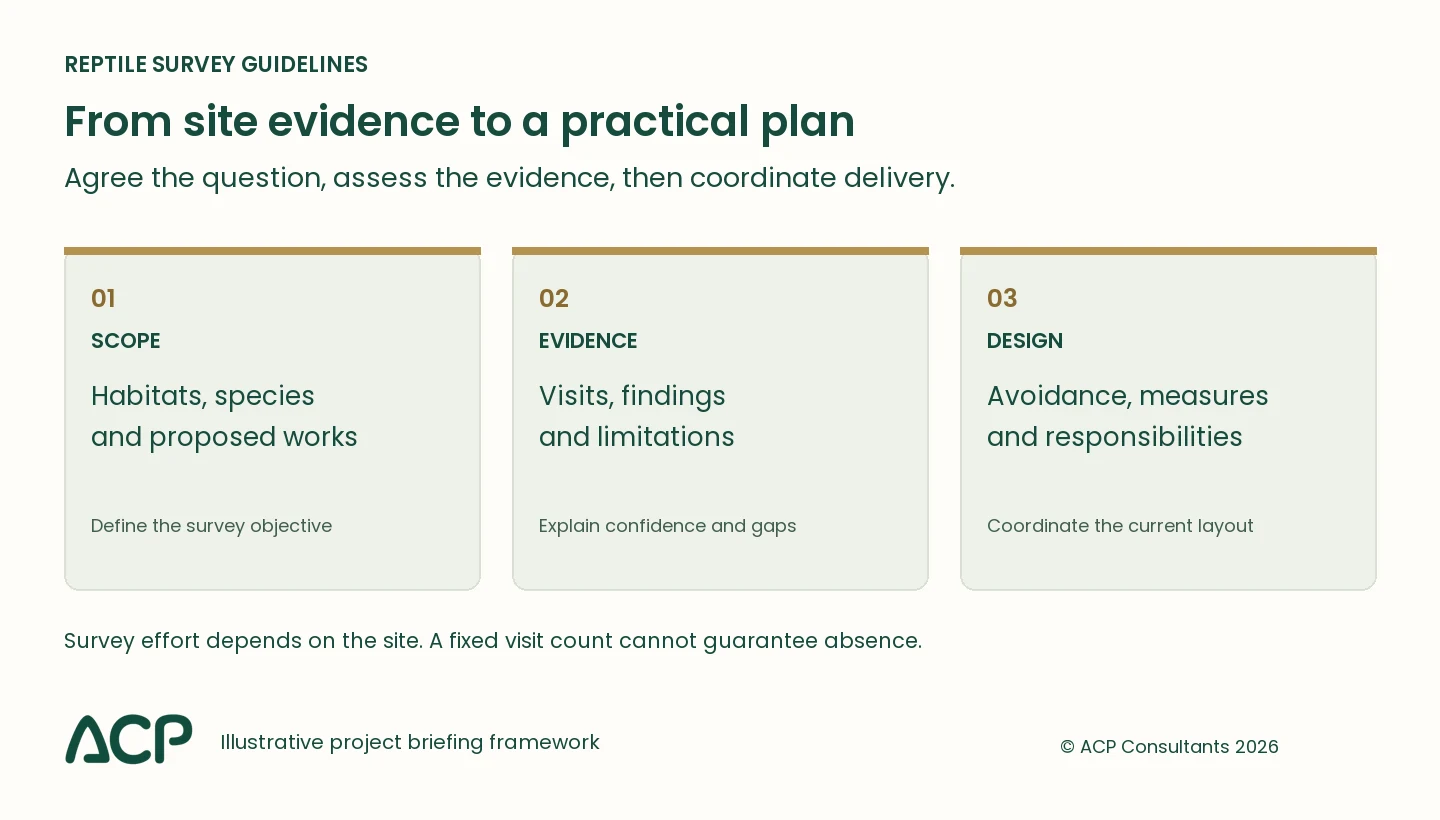
Reptile survey guidelines help project teams plan fieldwork, interpret findings and address development impacts. Start with the habitats and proposed works. Then agree suitable methods, timing and evidence needs with an experienced ecologist before fixing the planning programme.
The practical answer
Natural England’s indicative reptile survey season is April to mid-October, subject to weather and species requirements. Spring and early autumn can provide useful conditions. The ecologist should justify coverage and effort; a fixed visit count cannot guarantee absence.
When do you need a reptile survey?
Suitable habitat, existing records and potential harm can all trigger the need for investigation. Rough grassland, scrub edges, wetlands and brownfield mosaics can support reptiles. However, a lack of records does not establish absence.
Therefore, commission an early habitat appraisal and show the ecologist the full works boundary. Include access roads, storage areas, drainage works and temporary compounds. These areas can matter as much as the proposed buildings.
For example, a retained habitat strip may still lose its connection to neighbouring land. A plan that only considers the building footprint could overlook that effect. Ask the ecologist to explain which parts of the scheme need further evidence.
Confirm the species and protection
England’s native reptiles include adder, grass snake, common lizard and slow-worm, alongside sand lizard and smooth snake. All have legal protection, although the scope differs. Natural England’s standing advice explains the distinctions. Sand lizards and smooth snakes have additional protection, including their breeding sites and resting places.
Consequently, confirm the species likely to occur before agreeing methods. Work involving the rarer species may require an appropriately licensed ecologist. Also check the relevant wildlife permissions separately from planning permission.
Plan the survey season and programme
Natural England’s indicative survey timetable gives April to mid-October for reptiles, dependent on weather. Treat this as a programme guide, not confirmation that every date or visit is suitable.
Plan fieldwork around reptile activity and suitable weather. Spring and early autumn often offer useful conditions, but the calendar alone cannot determine suitability. Local climate, habitat, species and the survey objective all influence the programme.
For a planning submission, allow time for preparation, repeat visits, analysis and reporting. In addition, leave contingency for unsuitable weather or inaccessible survey areas. Booking the final visit immediately before submission creates an avoidable programme risk.
Keep the habitat intact. Do not clear vegetation, move potential refuges or alter the site to simplify the survey. First obtain project-specific ecological advice.
Where the active season has passed, desk research and survey planning can still progress. However, winter preparation does not replace suitable field evidence. Agree what the next available survey window means for the application.
Choose methods that answer the survey question
First, define the question. Establishing likely presence differs from assessing relative abundance or monitoring a population over time. The Amphibian and Reptile Conservation (ARC) survey protocols distinguish these objectives, so a visit count alone cannot describe a survey’s adequacy.
Design the survey around the habitat
The ecologist should justify the search areas, methods and effort. Visual searches and artificial refuges can provide complementary evidence. However, refuge placement, settling time and repeated checks need to reflect the site and target species.
Also record access restrictions, missing refuges and unsuitable weather. These details explain whether each visit contributes useful evidence. Without them, a report can appear complete while leaving important uncertainty unresolved.
Interpret results without false certainty
Seven visits are often discussed in practice, but they are not a universal legal rule or a guarantee of absence. Equally, a small number of sightings does not provide a census of every reptile present. Ask for a clear explanation of confidence and limitations.
For example, ARG UK’s peatland advice (version 2, April 2024) discusses additional effort where populations may occur at low densities. That habitat-specific advice should not become a rigid template for every development site. The method must answer the actual planning question.
A practical survey-to-design checklist
| Stage | Information to agree | Decision it supports |
|---|---|---|
| Before fieldwork | Works boundary, habitats, access and survey objective | Where and how to survey |
| During fieldwork | Visit conditions, observations and limitations | Whether evidence is sufficient |
| Before layout approval | Retained habitat, connections and impact areas | How to avoid and reduce harm |
| Before site works | Agreed measures, responsibilities and permissions | Whether the team can implement the plan |
Use one consistent drawing revision across the ecology report and design package. Then record any later changes and ask whether they affect the conclusions. This simple control helps prevent the report and construction plan from drifting apart.
What happens if reptiles are found?
Consider avoiding impacts through layout, timing and working methods first. Where effects remain, develop appropriate mitigation and, as a last resort, compensation. Translocation needs a suitable receptor site and a credible long-term plan; it is not an automatic solution.
For the project team, the next task is coordination. Identify who owns each action, which drawing shows it and when it must happen. Also separate habitat establishment from construction activities that depend on it.
A useful responsibility schedule names the designer, contractor, ecologist and future land manager. It should explain handover evidence and the response to unexpected findings. Therefore, avoid leaving delivery obligations in a report that the site team never receives.
Agree the fee, scope and report requirements
Agree a written scope instead of relying on a generic starting price. Site size, habitat distribution, travel, access and field effort all affect the quotation. In addition, clarify whether the fee covers records, reporting, meetings and responses to planning comments.
Keep mitigation, licensing and habitat management separate from the survey allowance. Otherwise, a low initial survey figure can create a misleading project budget. Ask how extra visits or a revised layout would affect the fee.
The final report should explain its objective, methods, results, limitations and implications for the current proposal. It should also identify any further work. Before submission, check that the site boundary, drawing references and proposed measures agree.
Check what the findings mean for the layout
A useful report connects recorded reptile activity and suitable habitat with the actual works. A map of observations alone does not show whether temporary access, storage or later maintenance could affect the proposed mitigation.
- First, ask which areas were surveyed, which could not be accessed and how those limits affect the conclusions.
- Next, show temporary works alongside the permanent layout before selecting avoidance and mitigation measures.
- Finally, record who will deliver, maintain and check each agreed measure, with review points tied to the construction programme.
Coordinate reptile work with the broader ecology survey brief. Where BNG habitat proposals overlap, check that habitat objectives and management arrangements are compatible; a metric calculation does not replace species-specific advice.
Common questions
How many reptile survey visits are required?
The ecologist should justify effort for the species, habitat and purpose. A standard visit count cannot guarantee absence. Therefore, judge the evidence alongside conditions, coverage and limitations.
How long is a reptile survey valid?
There is no single expiry date for every site. The Chartered Institute of Ecology and Environmental Management (CIEEM) advises considering circumstances and the currency of the evidence. Changes in habitat, management or the proposal can justify an update, even where the original report is relatively recent.
Can surveys take place in winter?
Winter can support desk research, access arrangements and programme planning. However, those tasks do not substitute for fieldwork under suitable conditions. Ask the ecologist which evidence can progress now and which must wait.
Can we assume reptiles are present and skip surveying?
Do not assume that a precautionary working method will answer every planning question. The ecologist should explain whether the available evidence supports the proposal and discuss any justified alternative approach with the planning authority.
Does finding reptiles prevent development?
Not necessarily. The implications depend on species, habitat and the effects of the proposal. Early evidence can help the team explore layout changes and practical measures before important design decisions become difficult to revise.
References and scope
Apply the relevant jurisdiction, local requirements and project-specific professional advice. These references support the scope described above.
- Natural England. Reptiles: advice for making planning decisions.Updated 7 April 2025. Supports England planning, survey and mitigation context; protection differs between species.
- Amphibian and Reptile Conservation. Survey protocols: resource page and Survey protocols for the British herpetofauna, version 1.0, March 2013.Methodological resource to inform a proportionate, site-specific survey approach; not a universal statutory visit count.
- CIEEM. Advice note on the lifespan of ecological reports and surveys.Supports review of evidence currency, taking account of site changes and the purpose of the assessment.
- ARG UK (2024). Advice Note 10: Reptile Survey and Mitigation Guidance for Peatland Habitats, version 2, April 2024.Habitat-specific advice. Do not transfer its recommendations indiscriminately to every habitat or project.
- Natural England and Defra. Protected species and development: advice for local planning authorities.Updated 7 April 2025. Table 2 provides indicative survey timings, dependent on weather and the species-specific requirements.