BAT ECOLOGY · DESIGN & TECHNICAL GUIDANCE
Bats and artificial lighting
Bats and lighting need to be considered together, while the design can still change. Protecting a dark roost entrance or flight route starts with the layout, not the label on a lamp.
This guide explains light spill, lux measurements, colour and controls. It also shows how ecological evidence can inform a proportionate lighting strategy, from an individual building to a wider development.
Discuss your lighting proposalUnderstand lux and light spill
Design foundations
Design for darkness before choosing fittings
A lighting proposal can affect bats without removing a roof tile or cutting down a tree. Light may reach a roost entrance, interrupt a sheltered route or change the places where bats can feed. Therefore, the assessment needs to follow the likely exposure, not just the boundary of the building works.
Start with a practical question: does this place need lighting at all? An entrance may need a safe approach, while the neighbouring hedge does not. Moving that approach can sometimes resolve a conflict more effectively than repeatedly changing the lamp.
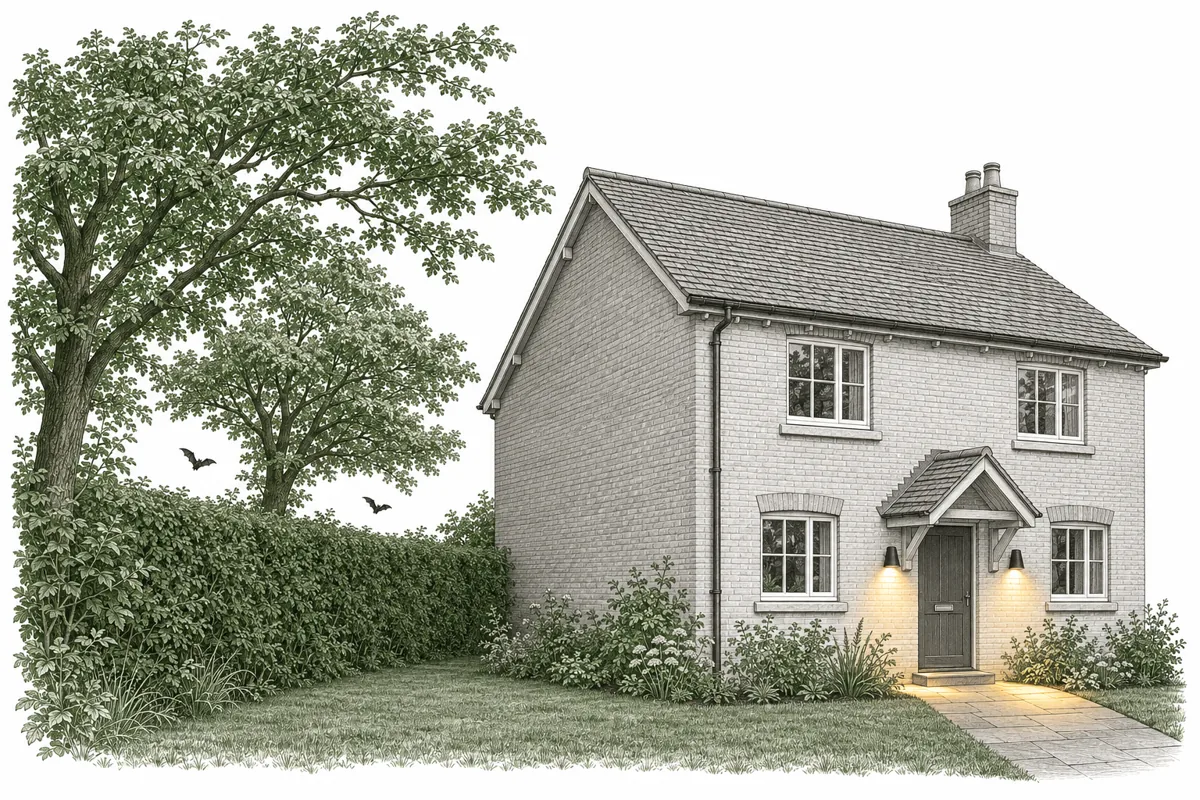
For example, a design team could consider moving a path to the building side of a courtyard. The retained hedge could then remain part of a dark route. However, the ecologist must check whether that route serves the bats actually using the site. A tidy line on a drawing is not enough.
Our guide to bat surveys and design options explains this approach more broadly. A design review may reduce an impact or refine the survey question. It does not automatically remove the need for surveys or a licence.
 © 2026 ACP Consultants Ltd.
Original illustration
The ecological brief
What the ecological evidence needs to establish
The starting point is an ecological question, not a standard package of additional surveys. Existing reports may identify roosts, access points or important habitat. However, they may not answer how a new light source would affect those features.
An ecologist should establish which bats could be exposed, where that exposure would occur and when it matters. The review should also identify uncertainty. A detector recording beside a hedge shows activity near that detector; it does not, on its own, prove the precise route, roost location or number of bats.
- Roost context: known or potential entrances, roost function and links to surrounding habitat.
- Movement: sheltered routes, crossing points, bottlenecks and alternative connections.
- Foraging: woodland edges, water, gardens or other areas used by the relevant species.
- Exposure: existing lighting, proposed lighting, windows and likely operating hours.
- Change: vegetation removal, new surfaces, altered levels and development phases.
The scope should match the likely impact. Where further work is needed, explain the question it will answer and the decision it will support. Our bat survey service provides the wider route into assessment.
Species & behaviour
Why different bats respond differently
Responses depend on species, activity, habitat and the light itself. “Light tolerant” describes observations in a particular setting; it is not a guarantee of harmless exposure.
Roosts and sheltered routes
Some bats avoid illuminated habitat. That can change access between a roost and feeding areas, even when the vegetation remains in place. At a narrow crossing, a relatively small lit area may matter more than its size suggests.
Roost access also needs its own assessment. A lamp that appears well controlled on a ground-level plan can still be visible from an elevated entrance. Include the entrance, approach space and onward route in the review.
Feeding around lights
Some agile bats forage near lamps, where insects gather. More recorded passes at a lamp do not demonstrate a benefit to the whole bat community. Other species may avoid the same area.
Repeated passes can also come from the same individual. Therefore, activity counts should not be presented as population size or proof that a lighting scheme is ecologically successful.
Season and time of night
A curfew starting late at night may leave the period after emergence fully illuminated. Consider when the relevant bats use the feature, including seasonal changes in roost use and movement.
Winter should not automatically be treated as a period with no bat activity. Site conditions, species and the function of the feature determine the assessment.
Landscape and prior exposure
A 2026 paired-night experiment at 72 sites in Italy and Montenegro found different responses in urban parks and naturally dark woods. Species richness fell under illumination in both settings.
The study could not separate individual behavioural change from ecological filtering. Consequently, weaker avoidance in an already lit place should not be described as proven adaptation. See Meola, Šestović and Russo (2026).
Professional guidance
Which guidance should inform the design?
The principal UK lighting reference used here is the Institution of Lighting Professionals and Bat Conservation Trust Guidance Note GN08/23: Bats and Artificial Lighting at Night. It supersedes GN08/18. The current downloadable file was checked against our existing full research copy.
GN08/23 connects ecological assessment with lighting design, implementation and monitoring. Its sections 4.47–4.54 are especially useful when reviewing a lighting strategy, calculations and contour plans. The requirements should be read alongside the ecological findings and the actual planning condition.
For planning in England, Natural England’s standing advice includes proposals that illuminate buildings or green spaces near bat habitat. It identifies redesigning lighting and retaining dark connections among the measures that may avoid or reduce harm.
Planning approval and protected-species licensing address different matters. An accepted lighting drawing does not, by itself, authorise an otherwise unlawful effect on bats or their roosts. Conversely, not every external light requires a bat licence. The effect and the circumstances need assessment.
Technical drawing · measurement
Lux: the direction of the measurement matters
Illuminance describes light arriving at a surface. Lux is the unit. A horizontal reading describes light falling onto a horizontal plane; a vertical reading describes light arriving at a vertical plane facing a stated direction.
These are different questions. Low illumination on the ground does not prove low illumination on a wall, hedge face or roost entrance. The figure explains the distinction without pretending to model a real site.
Horizontal illuminance
Use an upward-facing plane at a stated height and location. A low result here does not establish the exposure at a wall, hedge face or elevated roost entrance.
© 2026 ACP Consultants Ltd.Original technical diagram
Vertical illuminance
State the plane’s location, height range and facing direction. Assess the relevant habitat face, entrance or approach space; one orientation does not capture every source.
© 2026 ACP Consultants Ltd.Original technical diagram
Amber arrows show incoming light; teal and blue arrows show sensor orientation. Schematic geometry, not calculated spill. The sensor sketches explain measurement direction, not a site survey protocol.
The lighting vocabulary
Light levels, brightness and colour are different
Lux and lumens
Lumens describe a source’s light output weighted for human vision. Lux describes illuminance at a surface. A lower-lumen lamp can still create a problem if it sits close to a sensitive entrance.
Neither measure alone describes the biological response. Distribution, viewing direction, spectrum, duration and the ecological setting also matter.
Colour temperature and spectrum
Correlated colour temperature, expressed in kelvin, describes the appearance of a near-white light. It does not provide the complete spectral distribution. Two products with the same nominal colour temperature can differ.
Ask for the exact product data. A red or amber source should not simply be assigned the ecological meaning of a warm-white lamp.
Spill, glare and reflected light
Spill is light reaching somewhere beyond its intended task area. Glare relates to the effect of a bright source in a field of view. A calculation on one plane does not fully describe both.
Walls, paving and other surfaces can reflect light. Consequently, a downward fitting still needs assessment within its actual surroundings.
Time and operating state
A scheme may have full-output, dimmed, triggered and off states. Each can produce a different exposure pattern. A weekly average can conceal the periods that matter most.
Therefore, review the state that will occur in normal operation at the relevant ecological time, including overrides and repeated sensor triggers.
Interpreting results
Are 0.2 lux and 0.4 lux safe limits for bats?
No universal safety threshold should be inferred from those figures. GN08/23 section 4.54 discusses a practical interpretation of complete darkness where lighting is proposed: illuminance at or below 0.2 lux horizontally and 0.4 lux vertically may be appropriate in that context.
The same guidance states in section 3.13 that species-specific lux thresholds do not remove the need for advice about the site. Read these passages together. The figures are not a licence to illuminate every roost or route up to a fixed amount.
For a project, identify the feature to protect and the agreed assessment method. Specify where calculations or readings will apply, which plane they represent and which operating state is being assessed. Then explain how the result meets the ecological objective.
A reported value of 0.00 lux also needs care. It may reflect rounding, model settings or an instrument’s reporting limit. It does not necessarily mean an absolute absence of light.
Spectrum & colour
Warm white, amber and red: what the evidence means
GN08/23 section 4.29 recommends warm-white sources of 2700 K or lower to reduce the blue component, alongside other specification measures. That recommendation should form part of a wider design response. It should not replace avoiding unnecessary exposure.
In a Dutch experiment, Spoelstra and colleagues (2017) compared white, green, red and dark treatments at eight field sites. Myotis and Plecotus activity was lower under white and green treatments. Activity under the tested red treatment was comparable to the dark control.
The study assessed grouped acoustic activity around particular lighting installations. It did not establish that any red product is safe at a British roost entrance. Its red spectrum also contained other visible wavelengths, so a colour name alone cannot reproduce the experiment.
A separate migration study found attraction to red light for some pipistrelles. Voigt and colleagues (2018) used alternating ten-minute light and dark intervals at a migration corridor. This different context helps explain why blanket claims about red light are unreliable.
Layout & habitat connections
Protect the route as well as the roost
Make space in the layout
Review access, parking, paths and service areas before their positions become fixed. A path immediately beside a sensitive hedge can create competing demands for human use and darkness.
Consider an alternative alignment, a different entrance or a change in how the space is used. The purpose is to reduce conflict at source, while retaining safe and accessible movement for people.
Keep the connection continuous
A dark patch beside a bat box is of limited value if the onward route is brightly illuminated. Assess links between roosts, tree cover, feeding areas and the wider landscape.
Pay attention to narrow gaps, road crossings and changes at site boundaries. Several small sources can combine to interrupt an otherwise retained route.
Review windows and internal lighting
Large areas of glazing, rooflights and internal circulation spaces can contribute to exposure. Moving a window or changing room layout may be more reliable than expecting future occupants to close curtains every evening.
State the assumptions for internal lighting and glazing. Where it matters to the assessment, model the contribution and agree a durable design response.
Make the solution durable
New planting takes time to establish and can fail or be removed. It should not quietly become the only reason a model predicts a protected dark area.
Review the opening-day situation and future management. Any permanent screen must also work with landscape, access, safety and the bats’ movement requirements.
Application · sports lighting
Example: a 3G pitch or outdoor sports court
Sports floodlighting combines a large lit area with elevated sources and evening use. A hedge beside a pitch may remain physically intact while its role as a bat route changes. The review therefore needs the surrounding habitat, not just the playing surface.
Questions to resolve: are there roosts, woodland edges, water or important routes near the proposed columns? How will the pitch operate through the year? Include warm-up, clear-down, maintenance and any associated car-park or pavilion lighting.
Design options: review the pitch location and orientation, column positions, optics and aiming before fixing the scheme. Moving a column is not automatically an improvement; the whole distribution must be recalculated. A lower column may need a different arrangement to light the same playing area.
Ask the sports-lighting designer to demonstrate the required playing conditions and the off-site distribution. Then assess the relevant habitat-facing vertical planes as well as the horizontal ground results. The pitch’s target light level is not an acceptable light level for the neighbouring bat habitat.
Finally, agree hours, booking controls and responsibilities for preventing unnecessary operation. A curfew is useful only where its timing addresses the identified ecological risk. The illustration shows the components to review, not a compliant specification.
 © 2026 ACP Consultants Ltd.
Original illustration
Application · streets & crossings
Example: street lights, cycleways and crossings
A line of street lights can influence a much longer route than an isolated entrance fitting. Of particular concern are places where a road, junction or path crosses an existing hedge, treeline or watercourse. Review the crossing as part of the wider connection.
Questions to resolve: which features do bats use and in which direction? Are existing columns being replaced, moved or operated for longer? Will a new junction introduce light into an otherwise dark section? Consider adjoining schemes and private frontage lighting too.
Design options: explore road and path alignment, column siting, optics, output and operating controls with the highway or lighting authority. Any change must still address the relevant road-user safety and accessibility requirements. A private ecological proposal cannot assume an authority will accept an unapproved dimming regime.
A replacement LED may have a different spectrum and distribution from the old fitting, even if its energy use is lower. Compare the actual before-and-after exposure, including the vertical face of relevant habitat. Keep the product and control assumptions traceable.
Where a critical crossing cannot retain suitable conditions, return to the design team before treating a lamp change as the answer. The appropriate solution depends on the bats, route and road context.
 © 2026 ACP Consultants Ltd.
Original illustration
Application · commercial premises
Example: commercial yards and security lighting
A commercial site may combine loading-bay floodlights, parking, illuminated signs, office windows and security lighting. The ecological effect comes from their combined operation. Reviewing one fitting while overlooking the rest can miss the relevant exposure.
Questions to resolve: where are the sensitive boundaries and any roost features? Which areas operate overnight? Do delivery times, cleaning, shift changes or security patrols trigger the lights? Include open loading doors and internal light where they could affect habitat.
Design options: separate work areas from sensitive edges where feasible. Consider alternative door positions, inward-facing tasks, local control zones and a revised operating brief. A specialist should test the fitting optics and mounting arrangement for the actual yard.
Security needs should be defined with the responsible team rather than equated with lighting the whole boundary. Likewise, camera requirements need coordination; do not assume that a CCTV product or its illumination is ecologically neutral.
At handover, identify who can change timers, sensors and output settings. A carefully reviewed scheme can drift if a replacement fitting defaults to full output or a temporary override becomes permanent. Review tenant changes and later additions through the same process.
 © 2026 ACP Consultants Ltd.
Original illustration
Application · industrial sites
Industrial sites beside potential roost features
A warehouse boundary can contain mature trees, older outbuildings or other features with bat roost potential. The industrial appearance of a site does not rule out ecological interest. Equally, a visible cavity or roof gap is not proof of an occupied roost.
In this fictional example, the numbered features identify questions for an ecologist. A tree cavity may warrant closer assessment. An older outbuilding may need a preliminary roost assessment. The connected woodland edge could provide movement or feeding habitat.
Review the position of yard lights relative to these features, including their height and direct visibility. A ground-level contour beside the warehouse may not describe the light reaching an elevated tree cavity or eaves opening.
Then consider practical design choices: can the lit task move away from the boundary, can a door or fitting face a different direction, or can the operating arrangement reduce exposure? The appropriate response follows the ecological evidence and the actual task.
Where a roost is confirmed, assess both its access and the surrounding habitat needed for it to function. Do not treat a dark patch around the entrance as sufficient if the onward connection is illuminated.
 © 2026 ACP Consultants Ltd.
Original illustration
Application · roads & habitat
A lit road near roosts, foraging habitat and a transect
This second fictional scene brings the survey question into the lighting review. It contains potential roost features in a barn and tree, a hedge connection, and a pond that may offer feeding habitat. Their use by bats would need to be assessed.
The dashed line is an illustrative walking-survey transect. It shows where an observer might sample activity, subject to access, method and safety planning. It is not a confirmed bat flight route and does not show that bats cross the road.
A transect can help describe activity across a route, but it cannot answer every question alone. An ecologist may need complementary static recordings, targeted observations or roost assessment, depending on the likely impact and uncertainty. The methods should follow the question, rather than the diagram.
For the lighting review, relate each source to the relevant feature and its height. Assess the potential effect at the barn and tree, along the hedge and around the water where appropriate. Consider the complete connection, including any actual crossing identified by survey evidence.
Keep observations, inferred habitat value and confirmed findings separate on the plan. This makes it easier for the designer and decision-maker to understand both the evidence and its limits.
 © 2026 ACP Consultants Ltd.
Original illustration
Wider project settings
Other settings that need the same joined-up review
Barns, churches and heritage buildings
Architectural floodlighting can illuminate entrances and approach routes even when the building itself is retained. Consider whether decorative lighting is necessary, where it faces and when it operates. Any effect on a roost needs ecological advice before changes proceed.
Bridges, rivers and waterfronts
Light can reach water, bridge cavities and sheltered bank-side routes. Reflections and source visibility may need attention alongside the calculation plane. Review both sides of a crossing and the connection along the watercourse.
Construction compounds and temporary works
Temporary towers, welfare units and overnight security can create exposure before the permanent scheme exists. Include construction phases, moving work areas and responsibility for aiming or switching lights. “Temporary” does not mean ecologically insignificant.
Hospitality, gardens and visitor sites
Festoon lights, terrace lighting, glazed dining areas and late-night departures can extend exposure beyond a building entrance. Review the combined scene and realistic operating hours. Small decorative sources can matter when placed directly beside a sensitive feature.
Technical drawing · site plan
How to read a bat-sensitive lighting plan
A useful plan connects the ecological constraints to the lighting calculations. It should make the assessed boundary, fittings, operating states and receptors easy to trace. The simplified example below shows the information relationship, not a ready-made design.
From habitat to assessment
© 2026 ACP Consultants Ltd.Original technical diagram
Ecological feature
Identify the habitat and its function from the ecological evidence. Include relevant roost entrances and links beyond the drawing.
Assessment geometry
Define the location, height and facing direction of vertical planes. Read them with the horizontal results.
Fitting and operation
Match the point to its product, optic, output and control schedule. Check every relevant operating state.
Read with the calculations
The accompanying contour plots, numerical results and assumptions must explain the actual light distribution. This teaching sketch contains no calculated results.
The calculation package
What to check in the calculation pack
One coordinated drawing set
Use the current architecture, landscape and lighting revisions. Clearly identify roost features and habitat constraints. If different consultants are working to different layouts, a technically detailed calculation can still answer the wrong question.
Include a fitting schedule so that every plotted light can be matched to a product, optic, height, orientation and output setting.
Relevant planes and operating states
Review ground-level horizontal calculations and the vertical planes needed for the sensitive features. A vertical plane should have a stated position, height range and facing direction.
GN08/23 calls for separate results where dimming or sensor-controlled states apply. A low standby result cannot stand in for a higher triggered output.
Clear assumptions and limits
Ask the lighting professional to identify initial output, maintenance assumptions, reflectance, topography and relevant window spill. GN08/23 addresses Day 1 calculations with a maintenance factor of 1.
Check the treatment of planting and permanent screening. Record model limitations rather than hiding them behind a highly precise colour plot.
Readable results and explanation
GN08/23 identifies contours including 0.2, 0.5, 1, 5 and 10 lux, together with appropriate higher values. The drawing should also provide useful minimum and maximum results.
Those contours communicate the model; they do not define universal ecological limits. Include a written interpretation of the relevant receptors, glare considerations and any remaining design actions.
Operation & controls
Sensors, dimming and curfews need testing
Controls can reduce the duration or level of exposure. However, they work only if their real operation matches the assessed scenario. A sensor that triggers repeatedly can leave a route illuminated for much longer than expected.
Review the detection zone, hold time, standby output and full-output state. Consider consecutive users, nearby traffic, vegetation movement and manual overrides. Also establish what happens after a fault, a power interruption or a change in building management.
A curfew may help, but its timing needs to match both the task and bat activity. Switching off after midnight does not address illumination during early-evening emergence. Equally, a short timer is not a complete solution if each activation exposes a sensitive entrance.
A 2025 study by Reusch, Kelm and Voigt examined combined part-night and motion-controlled lighting. Its abstract supports considering that combination as mitigation. It does not justify treating every motion-controlled installation as equivalent; the full experimental specification was not available in our retrieved source.
Worked design example
Worked example: a path beside a retained hedge
Illustrative design scenario, not an ACP case study or a guaranteed approval route. A small development proposes a lit path beside a retained hedge. Ecological evidence identifies the hedge as a route requiring protection.
1. Identify the conflict
The initial plan puts pedestrian lighting next to the habitat edge. Changing the lamp colour would leave the source in the same place. The team first asks whether the path must follow that alignment.
They also check the building’s windows and entrance lighting, because these could affect the same route.
2. Explore a different layout
The architect considers moving the path towards the building and retaining an unlit strip beside the hedge. The ecologist reviews whether the resulting connection serves the identified bat movement.
The lighting designer then tests whether the revised path can meet its human-use requirements without lighting the protected feature.
3. Test the actual proposal
The calculation includes the selected products, their positions and the relevant full-output and controlled states. Horizontal and vertical results are reviewed at the habitat edge and any sensitive roost feature.
If the objectives cannot be achieved, the team revisits the layout. A reassuring product description does not close the design issue.
4. Verify and retain the outcome
Installation checks compare the fittings, aiming and controls with the reviewed design. Suitable measurements investigate whether the agreed lighting criteria have been met.
Where ecological monitoring is required, it asks whether bats continue to use the protected feature. Physical compliance and ecological function are related, but different, checks.
From drawing to installation
From a design promise to an installed scheme
Procurement and installation can change a scheme after ecological review. A visually similar fitting may have a different optic or output. A bracket can alter the angle. A default control setting can leave lights on throughout the night.
Keep an approved issue register and a substitution process. The installer should know which details are essential to the ecological design. If a product or setting changes, refer it back before describing the proposal as equivalent.
At completion, record the installed specification, positions, heights, orientation and controls. Where field measurements are needed, use a competent person and equipment suitable for the low levels being assessed. Record the conditions, measurement geometry and instrument limitations.
Testing should distinguish sources where practicable. For example, a comparison with relevant lights on and off can help identify their contribution, provided ambient conditions and other sources are considered. A bright photograph is not a substitute for a calibrated measurement.
Checking the outcome
Monitoring: measure the right outcome
Has the lighting objective been met?
Compare the installed arrangement with the reviewed design and agreed criteria. Investigate unexpected spill, source visibility or control behaviour. Record the corrective action and recheck the affected aspect.
A single reading does not describe every season or operating state. The monitoring brief should explain which conditions it represents and which limitations remain.
Is the habitat still functioning?
Where required, ecological monitoring should address the relevant roost, route or foraging function. Choose methods and timing that can answer that question, rather than collecting recordings without a decision framework.
Before-and-after comparisons need consistent methods and consideration of weather, season and other habitat change. A change in recorded activity is not automatically caused by the lighting alone.
How ACP can help
How ACP can help with bats and lighting
We can review the bat evidence alongside your proposal, identify the ecological questions and help the design team consider practical options. That may include moving a light source, changing a path alignment or protecting an existing dark connection.
Where additional survey evidence is necessary, we explain why it matters and what decision it will support. We also work with the project’s lighting professional so that the ecological requirements can be tested against the actual design.
The scope may include an ecological review of a lighting strategy, comments on drawings and calculations, or a monitoring brief. Specialist lighting calculations and electrical design require the appropriate lighting professional; agree those responsibilities at the outset.
For a building project, consider lighting alongside bat mitigation and roost design. A carefully designed roost still needs suitable access and a functioning connection to surrounding habitat.
Your questions answered
Bats and lighting: common questions
Do bats avoid all artificial light?
No. Responses differ between species and situations. Some bats feed near lights, while others avoid illuminated routes or feeding areas. Even a species recorded near a lamp may need a dark roost entrance. Assess the feature and behaviour at risk.
Is 0.2 lux always acceptable for bats?
No. GN08/23 discusses 0.2 lux horizontally and 0.4 lux vertically in a particular interpretation of darkness. These are not universal biological safety limits. Agree the ecological objective, location, plane and operating state for the project.
Are 2700 K LEDs automatically bat friendly?
No. Lower colour temperature can reduce the blue component of a warm-white source, but suitability also depends on output, spectrum, direction, location and duration. The fitting must work within the assessed site design.
Is red or amber lighting safe for every species?
No. Research has found different responses in different settings, including attraction to red light during migration. A colour label does not establish that a product is suitable beside a particular roost or route.
Will a motion sensor solve the problem?
It may reduce exposure, but repeated triggers can extend illumination. Review the full-output state, detection area, hold time, standby level and overrides. The sensor must also work with the human-use requirements and the ecological objective.
Can we avoid further surveys by changing the design?
Sometimes a design change can remove an impact pathway or refine the evidence needed. However, that conclusion needs an ecological review. Do not assume that moving a light or retaining a roof removes every survey or licensing requirement.
How wide should a dark corridor be?
There is no single width suitable for all sites. Species, habitat structure, existing movement, adjacent lighting and the wider connection matter. Set the objective and test a workable layout rather than adopting an unexplained standard distance.
Do internal lights and windows count?
They can. Light through glazing may reach a roost, hedge or waterbody even when external fittings are well controlled. Review the building layout, room use, glazing and lighting assumptions where they could affect the ecological conclusion.
Are bollards better than taller columns?
Not automatically. Low mounting height does not guarantee low ecological impact. Glare, upward reflection, fitting numbers and distribution all matter. GN08/23 cautions against assuming bollards or low-level fittings are generally suitable.
Does a lux survey replace a bat survey?
No. A lighting survey describes the lighting environment. A bat survey addresses ecological use or roost evidence. The project may need one, both or a targeted review of existing information, depending on the question and likely effects.
Can the installer substitute a similar fitting?
Only after the relevant design review. Appearance and nominal wattage do not establish equivalent light distribution or spectrum. Record the replacement’s exact specification and assess any changed output, optic, mounting arrangement or controls.
What should we send ACP first?
Send the current ecological report, layout and lighting proposal, together with the site address and planning condition if relevant. Explain the decision you need to make. We can then help scope a proportionate ecological review.
Evidence & further reading
Guidance, research and further reading
Checked 14 November 2026. The technical guidance is supported by research, but individual experiments are not universal design rules. Access and limitations are stated below.
Professional guidance
- ILP and BCT (2023), GN08/23. Bats and Artificial Lighting at Night. Full guidance reviewed. Relevant sections include 3.13, 4.29, 4.47–4.54 and the monitoring provisions. The current download matches the full copy already held in our research pack.
- Natural England, standing advice. Bats: advice for making planning decisions. Current England planning context, survey triggers and avoidance measures. It is not a substitute for project-specific assessment or licence advice.
- Bat Conservation Trust (2023). GN08/23 update announcement. Confirms the replacement of the 2018 guidance and the emphasis on early coordination.
- Sport England. Artificial lighting guidance hub. Sports requirements need coordination with the ecological assessment. Older floodlighting publications are contextual reading, not a source of current universal specifications.
- ILP, PLG23 (2020). Lighting for Cycling Infrastructure. Publisher description checked; full paid publication not accessed. Listed for the appointed lighting professional, not relied upon for numeric design requirements.
Research and practical reading
- Spoelstra et al. (2017). Response of bats to light with different spectra. Proceedings of the Royal Society B, 284:20170075. Full paper reviewed. Eight Dutch sites; grouped acoustic activity and specific experimental spectra. This is not a roost-entry safety test.
- Voigt et al. (2018). Migratory bats are attracted by red light but not by warm-white light. Ecology and Evolution. Full paper reviewed. Alternating light treatments at a migration corridor; interpret in that migration context.
- Meola, Šestović and Russo (2026). Context-dependent responses of bats to artificial light at night in urban and natural woodlands. Science of the Total Environment, 1034:181847. Publisher text reviewed. A short-term, paired-night experiment at 72 sites; it does not establish long-term population effects or individual habituation.
- Reusch, Kelm and Voigt (2025). Mitigating light pollution through motion-controlled LED lighting to protect bats. Environmental Pollution, 386:127204. Bibliographic record and abstract reviewed; the full experimental specification was not retrieved. Used as emerging evidence, not a prescribed control setting.
- ACP practical reading. Our design coordination checklist addresses team responsibilities. The paths and external spaces design brief provides a shorter project briefing. For species context, explore our British bats guide.
Bring the ecology into the design conversation
Share your reports, layout and lighting proposal. We can help identify the ecological constraints, practical design options and evidence needed for the next decision.
Prefer to start with the survey question? Explore our bat survey service.