A flexible, living wing
Start with the bones, joints and membrane. Then follow how shape changes affect the forces that keep a bat airborne.
ACP learning · anatomy to ecology
How a living wing produces flight, how a small mammal powers it, and why energy needs change through the year.
Explore the structures and processes behind bat behaviour. This illustrated guide connects anatomy with flight, torpor, reproduction and survival, while showing where the evidence has limits.
How to use this guide
Start with the bones, joints and membrane. Then follow how shape changes affect the forces that keep a bat airborne.
Compare the costs of activity and rest. Use the worked example to see why a low metabolic rate and an arousal cost both matter.
A laboratory mechanism is not a universal field prediction. Each research example identifies its species, setting and main limitation.
Prepared by ACP Consultants · research checked 17 November 2026. This is an educational guide. For identification, use our British bats comparison guide; for project decisions, use site-specific ecological advice.
01 · Structure
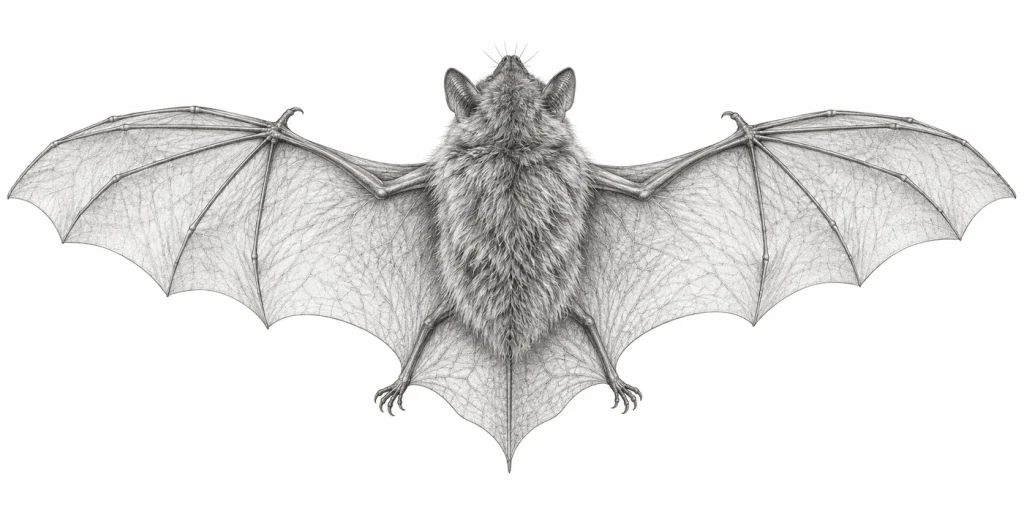
The familiar mammalian forelimb has been transformed into a controllable aerodynamic surface.
Proportions are simplified. Do not use the drawing to measure a bat or distinguish a species.
Propatagium: the leading-edge region between shoulder and wrist. Dactylopatagium: the membrane between elongated digits. Plagiopatagium: the region linking the arm/hand to the body and hindlimb. Uropatagium: the tail membrane.
The membrane contains vessels, nerves, elastic fibres and small muscles. Its response to loading changes the wing’s three-dimensional shape. Therefore, a useful explanation needs both the supporting skeleton and the properties of the membrane.
[1], [3]02 · Aerodynamics
A flapping wing accelerates air and produces aerodynamic forces. The balance changes throughout the stroke. In steady, level flight, the average upward force supports weight, while forward propulsion balances drag.
During many flight conditions, the downstroke contributes both lift and thrust. The upstroke changes with speed: it can contribute to weight support during slow flight. It is therefore misleading to describe every upstroke as an inactive reset.
Bats alter wing spread, curvature and rotation as they fly. The pattern used for slow manoeuvring differs from fast travel. A fixed-wing aircraft equation can help introduce a term, but it cannot fully describe an unsteady wingbeat.
[2]Ground speed is movement over the landscape. Airspeed is movement relative to the surrounding air. A tailwind can increase ground speed without the same increase in airspeed. Always check which quantity a study reports.
03 · Shape and performance
Long, narrow wings commonly accompany open-air travel. Shorter, broader wings with low wing loading can support slow flight in confined vegetation. However, wing shape alone cannot establish a species’ identity or predict its exact behaviour. [17]
This dimensionless measure describes how long and narrow the wing is. It helps compare proportions, but it does not specify a flight speed or turning ability by itself.
Weight is a force, so SI wing loading uses N/m². Mass per area uses different units. State whether the reference area includes the body or tail membrane when comparing published values.
For an invented wing with a 0.30 m span and 0.015 m² area, aspect ratio is 0.30² ÷ 0.015 = 6. If its mass is 0.010 kg, weight is about 0.0981 N, giving 6.54 N/m².
These are teaching inputs, not measurements of a named species. They do not predict survey coverage or flight performance.
A 2023 computer model explored how fibre reinforcement and flapping affect membrane stability. Such models help test mechanisms under controlled assumptions. However, a simulated efficiency gain is not a measured improvement shared by all wild bats.
[4]04 · Physiology
The pectoralis is a major downstroke muscle. Other muscles move the shoulder, elbow, wrist and fingers. Together, they control the wing’s position and shape. This is more complex than a single motor pulling a rigid paddle.
Muscle fibres use ATP during contraction. Sustained activity needs continued energy supply. Mechanical power is the rate of useful movement-related work; metabolic power describes the chemical energy being used. They are not interchangeable, because energy also leaves as heat.
[5]Researchers temporarily impaired armwing membrane muscles in Jamaican fruit bats. The wings became more curved, and the animals’ flight behaviour changed. The experiment supports active control of membrane stiffness and camber.
It involved a small captive sample of a tropical fruit bat. It does not provide a speed limit for British bats or show that every wing muscle performs the same task.
[3]Original ACP teaching sequence. It omits biochemical intermediates and does not assign a universal efficiency to bats.
A 2026 study examined the cave nectar bat Eonycteris spelaea. Tissue and molecular analyses found features consistent with substantial aerobic capacity. Cardiac stimulation experiments also showed a strong reserve response compared with mice. These findings help explain physiological capacity, but they do not measure the energy used by a free-flying British bat.
The study’s core laboratory comparisons used captive young adult male nectar bats. Diet, species, experimental conditions and the difference between heart function and whole-animal flight all limit transfer.
[6]05 · Feedback and control
Tiny sensory hairs can provide information about airflow over the membrane. Experimental work linked their removal to altered obstacle-course flight, supporting a role in aerodynamic feedback.
This finding concerns touch-related sensory control. It should not be confused with echolocation, which uses returning sound to obtain information about surroundings and targets.
[15]Bats are not blind. Their use of vision and sound varies with species, task and conditions. An observer should therefore avoid explaining every turn solely as a response to an echo.
Our echolocation and acoustics guide explains calls, frequency, echoes and recording methods. The British bats guide compares identification evidence without relying on one feature.
[16]06 · Saving energy
Normothermy means maintaining the usual active body-temperature range. Torpor is a controlled reduction in metabolic activity, often accompanied by lower body temperature. Hibernation involves a seasonal pattern of prolonged torpor bouts interrupted by arousals.
Consequently, hibernation is not uninterrupted sleep. Rewarming needs energy, and winter activity can include drinking, feeding or moving between roost positions. Our bat hibernation guide explains the survey and roost context.
[7], [10]Noctules in a 2022 experiment maintained low metabolic rates under some warm conditions. Skin temperature and heart rate did not always track oxygen consumption in a simple way. Temperature alone therefore cannot establish how much energy a bat is using.
[7]In a Norwegian summer study, heavier brown long-eared bats generally aroused at lower ambient temperatures. Individuals also differed in their use of active thermoregulation. The results support flexibility rather than one fixed switching temperature.
Body mass can reflect more than fat reserves, including feeding and hydration. Summer chamber results should not be treated as winter roost thresholds.
[8]Research on Bechstein’s bat colonies combined gas measurements with group and temperature records. Group size, torpor use and energy expenditure changed across reproductive periods. This shows why an isolated-animal model may miss social and seasonal effects.
Measurements included mixed groups. They could not cleanly separate every individual’s reproductive status or energy use.
[9]07 · Seasonal demands
After winter, feeding restores reserves. Pregnancy adds developing tissue and changes the demands on the mother. Lactation transfers energy into milk, while young bats must grow before they can forage independently.
The balance is sensitive to food, weather and roost conditions. A warm refuge can reduce some thermoregulatory costs, but a warmer roost is not automatically suitable in every circumstance.
[9], [10]Juveniles develop independent foraging skills. Later, many bats build reserves while mating and moving among seasonal sites. During winter, long torpor bouts help reduce demand when insect food is less available.
These phases overlap. Species, latitude and annual conditions shift the timing. A biological calendar therefore provides context, not permission to disturb a roost on a chosen date.
[10]Pregnant noctules in the 2022 experiments used several strategies: some rested without torpor, some remained torpid, and others switched between states. Reproductive condition changes the trade-off; it does not create a universal prohibition on torpor.
The pregnant and non-reproductive groups came from different locations and seasonal contexts. Treat the comparison as evidence of flexibility, not a perfectly isolated test of pregnancy.
[7]08 · Work through the numbers
All inputs below are invented teaching assumptions. This is arithmetic for exploring trade-offs, not a prediction for a species, a feeding recommendation or a roost-design calculator.
Enter hours and an additional arousal cost, then calculate. The remaining hours become normothermic rest. Inputs stay in your browser.
No-torpor comparison: 20.52 kJ.
4.12 kJ lower than the no-torpor comparison.
Assume constant metabolic powers of 1.20 W in flight, 0.15 W at normothermic rest and 0.02 W in torpor. One watt is one joule per second, so one watt-hour is 3.6 kJ.
Allocate all 24 hours to the three states. Add the selected arousal energy once if torpor occurs. It represents energy above the allocated state costs, not extra uncounted hours.
Flight: 1.20 × 2 × 3.6 = 8.64 kJ.
Rest: 0.15 × 10 × 3.6 = 5.40 kJ.
Torpor: 0.02 × 12 × 3.6 = 0.864 kJ.
Additional arousal: 1.50 kJ.
Total: 16.404 kJ, displayed as 16.40 kJ. With the same two flight hours and 22 resting hours, the no-torpor comparison is 20.52 kJ.
Rounding each component separately can make displayed subtotals differ by 0.01 kJ. Calculations use unrounded values.
Actual expenditure varies with body size, temperature, flight conditions, reproductive state and behaviour. The example omits growth, milk production, digestive costs, water balance and multiple arousals. Its powers are deliberately fixed, so changing the hours does not simulate those responses.
Try one hour of torpor with an 8 kJ arousal cost. The total becomes higher than the comparison: a low-rate state does not guarantee a net saving. For reproducible analysis of measured data, see our R and Python learning resource.
09 · Compare carefully
| Species | Evidence and useful finding | Boundary of the conclusion |
|---|---|---|
| NoctuleNyctalus noctula | Temperature-controlled respirometry showed flexible low-energy states in females, including during pregnancy. [7] | Experimental conditions and different source populations limit a simple reproductive-status comparison. |
| Brown long-eared batPlecotus auritus | Summer measurements in Norway linked individual condition with arousal behaviour. [8] | Body mass is an imperfect proxy for stored energy; the result is not a winter temperature threshold. |
| Bechstein’s batMyotis bechsteinii | Group measurements linked social roosting and torpor with seasonal energy management. [9] | Group expenditure cannot reveal every individual’s contribution or reproductive costs. |
| Jamaican fruit batArtibeus jamaicensis | A membrane-muscle manipulation changed camber and flight behaviour. [3] | A small tropical captive sample tests a mechanism, not all British species. |
| Cave nectar batEonycteris spelaea | 2026 cardiac experiments examined metabolic organisation and functional reserve. [6] | Heart measurements are not whole-animal flight-energy measurements; this is not a UK insect-feeding bat. |
On a small screen, swipe the table sideways. For appearance, distribution and identification evidence, use the 18-species British bats comparison.
10 · Lifespan and mortality
Some bats live exceptionally long lives for their size. However, the oldest recorded individual does not describe the average life of a pup born today. A record depends on identification, marking, recovery and the length of the study.
One important update concerns the famous bat recovered 42 years after ringing. BCT now attributes that record to Myotis sibiricus following a species split. It should not be presented uncritically as the normal lifespan of British Brandt’s bats.
[13]A study of 712 known-age bats across 26 species examined age-related DNA methylation. It developed age predictions and investigated associations with longevity. Such associations help guide research; they do not demonstrate one cause of long life or mean bats cannot age.
[11]Population studies address survival over time. In Leisler’s bats, long-term capture histories revealed differences by age, sex and origin. Those findings describe the studied population, not a universal annual survival rate.
For locally born females, estimated annual apparent survival was 0.45 (SE 0.04) in the first year and 0.76 (SE 0.04) later. These are probabilities, not lifespans or confirmed death rates. SE describes estimation uncertainty.
[12]The oldest documented individual in a dataset. It is sensitive to observation effort and does not equal life expectancy.
If first marked as an adult of unknown age, the time until a later encounter provides a lower bound, not an exact birthday.
The probability of surviving and remaining in the study population. Permanent emigration can look like death; failure to recapture is not proof of either.
[12]11 · Behaviour and risk
A bat leaving a roost faces changing light, weather, prey and potential predators. Consequently, a later emergence time should not automatically be attributed to fear of an owl. A useful explanation considers competing causes.
Species and surroundings also matter. What happens during short northern summer nights may differ from a sheltered British roost. Cover and darkness should be assessed alongside the actual ecological evidence.
A Finnish experiment compared owl calls, music and silence. Its apparent emergence-delay pattern was not statistically clear, and the model including weather found no treatment response. Foraging activity fell under both owl calls and music within owl territories.
The result supports context-dependent responses. It does not prove that owl sounds always delay emergence or provide a reliable bat-deterrent method.
[14]12 · Apply the understanding
Energy management helps explain why a roost is more than a hole. Thermal conditions, access and seasonal use require project-specific assessment.
Explore mitigation and roost designFlight ability does not make a bat indifferent to its surroundings. Assess habitat connections, roost access and the effects of lighting together.
Explore bats and lightingA detection records activity within a system’s limits. It does not directly measure calories, population size or every animal present.
Understand bat activity surveysUse this page to understand the mechanisms. If you need to assess a building, tree or development proposal, ACP can help define the ecological question and the evidence required.
Discuss a bat survey or project assessmentQuick answers
Yes. A bat wing includes the arm, wrist and elongated fingers supporting a membrane. The free thumb is usually short and clawed. However, the wing also includes regions connected to the body and hindlimb.
No. The membrane is living tissue with vessels, nerves, elastic fibres and muscles. Its mechanical properties and sensory feedback contribute to flight control.
No. The role of the upstroke changes with flight speed and wing movement. During slow flight, it can contribute to weight support. A single fixed description does not fit every wingbeat.
Wing loading divides weight by wing area. Aspect ratio divides squared span by wing area. They describe different properties and should be reported with clear units and area definitions.
No. Torpor involves a controlled reduction in metabolic activity. Hibernation combines prolonged torpor bouts with arousals. It is therefore not continuous ordinary sleep.
Yes, some can. Noctule experiments show several strategies during pregnancy. The balance depends on species, individual state and conditions, so pregnancy should not be treated as a universal exception.
Not reliably by itself. Skin temperature, heart rate and oxygen consumption can become partly uncoupled. A suitable physiological method and context are needed to estimate expenditure.
No. Its powers and arousal costs are invented teaching assumptions. It omits several biological demands and does not represent a feeding, husbandry or roost-management model.
No such general conclusion follows from an exceptional record. BCT now assigns the well-known 42-year ringing record to the Siberian bat following a taxonomic split. Typical survival requires population evidence.
No. The wing, force and energy diagrams are simplified teaching illustrations. Use the linked British bats guide for species comparisons and retain uncertainty when identification evidence is incomplete.
Evidence and attribution
We used primary research where it answers the question, alongside specialist reviews and BCT guidance. Laboratory, field and modelling results are identified separately. The illustrations are original ACP explanations; they do not reproduce a journal figure.
Relevant full text, methods and limitations were reviewed for the detailed experimental examples. The longevity paper’s 2021 correction and 2022 correction were checked. The energy example uses stated synthetic inputs and independently tested arithmetic.
Original diagrams and explanatory text: © 2026 ACP Consultants. Research authors retain rights in their work. Links and scientific references do not imply endorsement of ACP.